Buy Now, Pay Later vs Credit Cards: Which Can Really Cost You More?
Table of Contents
01 Event
Buy Now, Pay Later services and credit cards can both separate the moment you buy from the moment you finish paying. But the products work differently, and “interest-free” does not automatically mean financially harmless.
The Consumer Financial Protection Bureau has studied BNPL lending and has highlighted issues including rapid growth, multiple simultaneous loans and the importance of consumer protections around disputes and refunds.
02 What Changed?
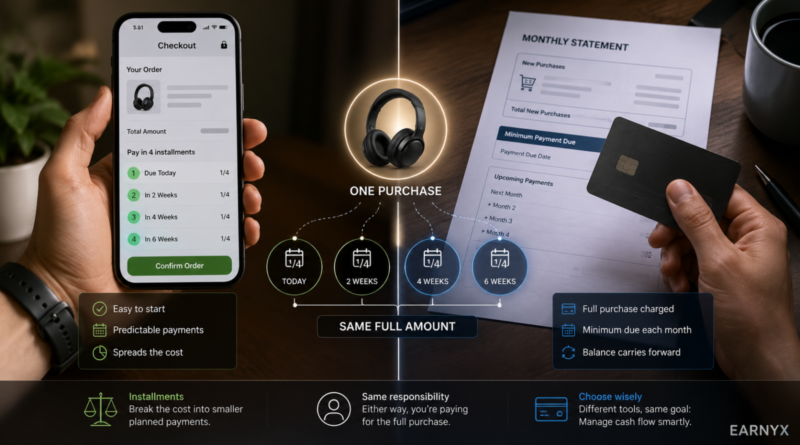
BNPL made installment financing a routine checkout option for relatively small purchases. Instead of applying for traditional financing, a shopper can often divide a transaction into several payments directly at checkout.
Credit cards, meanwhile, generally offer a revolving line of credit. Depending on the card and how the balance is managed, purchases may receive a grace period, earn rewards or incur interest when balances are carried.
03 Why It Matters
The financial danger in both products is affordability illusion. A $400 purchase can feel like four $100 payments, while a credit-card minimum payment can make a large balance feel temporarily manageable. Neither framing changes the underlying amount spent.
Multiple obligations can also overlap. That resembles the accumulation Earnyx described in subscription creep: individually manageable charges can become significant when stacked together.
04 What It Means for You
Compare the total repayment amount, due dates, late-fee rules, interest or other financing charges, refund process and consequences of missed payments. For a credit card, know the annual percentage rate and whether you will pay the statement balance in full. For BNPL, look at all outstanding installments—not just the payment attached to today’s purchase.
If you need either product to make an otherwise unaffordable discretionary purchase feel affordable, the financing mechanism may be solving the wrong problem.
05 Numbers + Context
A $600 purchase split into four interest-free payments remains a $600 purchase: four payments of $150. A $600 credit-card balance carried at a hypothetical 24% APR can generate substantial interest depending on payment timing and size. Conversely, a card balance paid in full within an applicable grace period may avoid purchase interest altogether.
Actual terms vary widely, so consumers should use the lender’s disclosures rather than assuming every BNPL plan or credit card behaves the same way.
06 Earnyx Takeaway
Choose financing by total cost and repayment certainty, not by which monthly or biweekly number looks smaller. Interest-free BNPL can be inexpensive when payments comfortably fit your budget; a credit card can also be inexpensive when paid in full. Both become risky when financing makes you stop thinking about the full purchase price.
Sources: Consumer Financial Protection Bureau research and consumer guidance on Buy Now, Pay Later; CFPB credit-card guidance.