
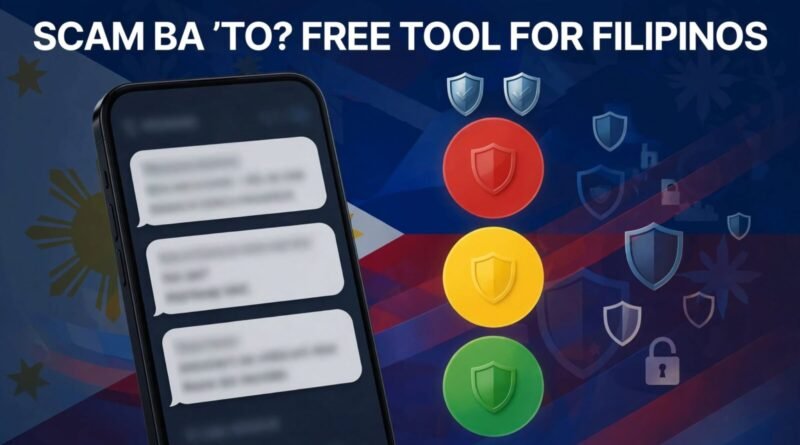
Free ‘Scam Ba ’To?’ Tool Helps Filipinos Check Suspicious Messages
A Philippine-focused web tool is giving people another way to evaluate suspicious messages before clicking a link, sending money or handing over personal information. Called “Scam Ba ’To?”, the independently developed service lets users paste questionable messages into a checker and receive a risk assessment designed around scams encountered by Filipinos.
Table of Contents
01 Event
Newsbytes.PH reported in August 2026 that a National University professor developed the free “Scam Ba ’To?” platform. Users can paste a suspicious message into the tool and receive Red, Yellow or Green risk guidance. The service also explains the behavior it detected and, when available, points users toward verified official channels.
The concept addresses a familiar problem. Scam messages often imitate banks, government agencies, delivery companies, online services or people the recipient knows. The message may create urgency, promise money or claim that an account has a problem in order to push the recipient into acting before checking.
02 What Changed?
Traditional advice tells people to recognize common warning signs themselves. Tools like this add a second layer: instead of relying entirely on the recipient’s judgment, the user can submit the message for structured analysis.
The Philippine focus is important because scams are localized. Messages can use Tagalog, English or Taglish, refer to local banks and e-wallets, imitate Philippine agencies, and exploit local events or payment habits. A checker designed around that context can potentially identify signals that a generic international spam filter may not explain clearly.
03 Why It Matters
Scam prevention is partly a timing problem. Victims are often pressured to act immediately. A quick checking step can introduce enough friction to make someone reconsider a suspicious link, payment request or demand for credentials.
However, no automated checker should be treated as an absolute guarantee. Scam tactics evolve, legitimate messages can look unusual, and automated systems can make mistakes. The safest approach is still to verify important requests using a known official website, app, phone number or physical branch rather than contact details supplied in the suspicious message.
04 What It Means for You
If a message asks for a password, one-time PIN, card information, account credentials or an urgent payment, do not rely on the message itself to verify the request. A tool such as Scam Ba ’To? can be useful as an additional screening step, especially for messages that are difficult to judge.
Users should also avoid pasting unnecessary sensitive information into any third-party service. Remove personal data where possible and independently confirm the privacy practices of the tool being used.
05 Numbers + Context
The checker uses three simple risk levels—Red, Yellow and Green—to communicate its assessment. That simplicity is useful because security advice is most effective when people can understand what to do next. Philippine authorities and companies regularly warn consumers about phishing, impersonation and social-engineering campaigns, making accessible verification tools increasingly relevant.
06 Earnyx Takeaway
The real value of Scam Ba ’To? is not that software can magically eliminate fraud. It is that it encourages a habit that prevents many scams: check first, act second. For suspicious financial or account-related messages, the best outcome is not simply receiving a green or red result—it is slowing down long enough to verify the request through an official channel.
Related Earnyx reading: Scam protection also depends on understanding the tradeoffs behind digital services. See The True Cost of a “Free” App and WhatsApp Strengthens Account Security With Passwords, Passkeys and Caller Context.
Sources: Newsbytes.PH, August 2026; Clurky coverage of the Philippine-focused scam message checker.



Pingback: Philippine Businesses Lag in Digital Payments Adoption