
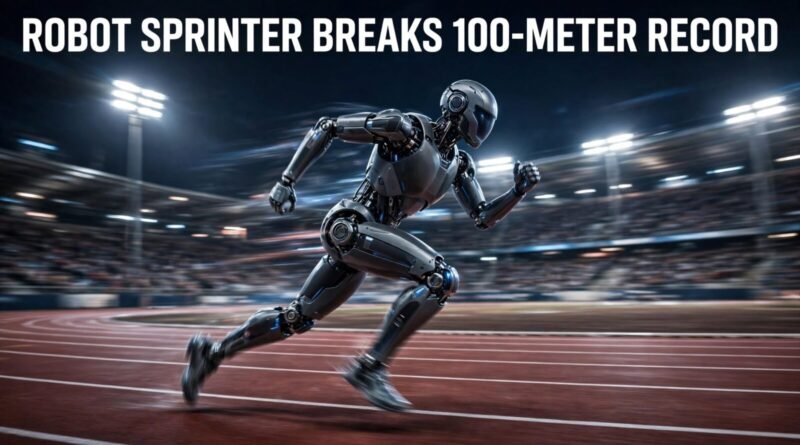
China’s Tiangong Ultra Robot Runs 100 Meters in 8.64 Seconds
A humanoid robot in China has completed a 100-meter sprint in 8.64 seconds, setting a new benchmark at the World Humanoid Robot Games in Beijing. The result is eye-catching because the recorded time is faster than the human 100-meter world record, but the comparison needs context: robot competition rules, machines and performance conditions are fundamentally different from human athletics.
Table of Contents
01 Event
Tiangong Ultra recorded the 8.64-second run during the 2026 World Humanoid Robot Games, according to Reuters and the Associated Press. The machine was developed by the Beijing Humanoid Robot Innovation Centre. The result improved on times recorded earlier in the competition, including 8.86 seconds and 9.39 seconds.
The five-day event brought together more than 2,000 robots from hundreds of teams. Competitions included running and other sports-style events alongside tasks intended to test capabilities relevant to industry and services.
02 What Changed?
The sprint times improved rapidly during the event, illustrating how developers are refining balance, gait, control and speed. Humanoid robots have historically struggled with movement that humans perform naturally, particularly when acceleration, stability and recovery must happen together.
The competition also exposed limitations. Fast robots can have difficulty stopping cleanly after the finish, and machines in humanoid competitions still fall, collide or require assistance. Speed is therefore only one dimension of useful mobility.
03 Why It Matters
Humanoid robotics is attracting investment because a human-shaped machine could theoretically operate in environments already designed for people. Factories, warehouses, hotels and homes contain stairs, doors, shelves and tools built around human bodies. A capable humanoid could potentially work in those environments without every facility being redesigned.
But commercial usefulness depends on much more than running speed. A robot must perceive objects, make decisions, manipulate items, work safely around people and operate reliably for long periods. The games provide a public demonstration of progress while also revealing how much engineering remains.
04 What It Means for You
The record does not mean humanoid robots are about to replace human workers simply because one can sprint quickly. Athletic demonstrations test specific engineering problems. Real workplaces demand consistency, judgment and safe interaction rather than maximum speed.
Consumers should expect robotics advances to arrive first in controlled or repetitive applications where the economic case is strongest. Broader household use will depend on falling hardware costs and major improvements in reliability.
05 Numbers + Context
Tiangong Ultra’s reported time was 8.64 seconds for 100 meters. Usain Bolt’s official human world record is 9.58 seconds, set in 2009, but the two performances should not be treated as equivalent sporting records. Reuters reported more than 2,000 robots from 666 mostly Chinese teams competing across 51 categories at the event.
06 Earnyx Takeaway
The 8.64-second headline is impressive, but the deeper story is the pace of improvement in robot mobility. The most valuable milestone will not be a robot that can outrun a person. It will be a machine that can move safely, manipulate real objects, recover from mistakes and perform useful work reliably enough that its economics make sense outside a demonstration arena.
The event is therefore best understood as a robotics benchmark rather than a human-versus-machine sporting contest. Developers are using competition to stress-test locomotion systems and expose weaknesses that can then be addressed before similar technology moves into less controlled environments.
Related Earnyx reading: For more on automation economics, see AI Automation vs Hiring Someone: Where Is the Break-Even Point? and our look at Tesla’s approval for up to 5,000 Las Vegas robotaxis.
Sources: Reuters, August 26, 2026; Associated Press coverage of the 2026 World Humanoid Robot Games.