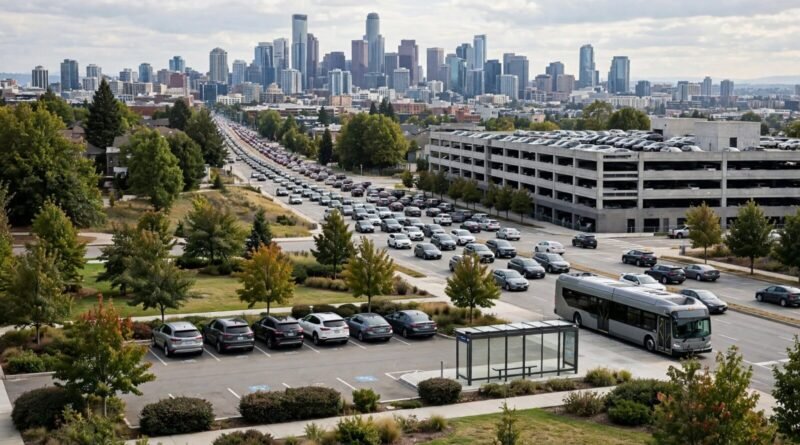
Park-and-Ride vs Driving Downtown: Which Costs Less Once Parking Is Included?
Driving all the way into a city center can feel faster and more convenient than switching to transit. But once downtown parking, tolls, fuel, and congestion are included, the cost difference can change quickly. Park-and-ride systems try to capture the best of both modes: use a car for the part of the trip where it is most useful, then switch to rail or bus before the most expensive and congested section.
Table of Contents
01 Event
As employers bring more workers back to offices and urban traffic returns to normal peak patterns, commuting costs are again a major household expense. Parking is one of the biggest variables because it can turn an otherwise modest car commute into a high-cost daily habit. A driver who spends $15 to $30 per workday on downtown parking can easily pay more for parking than for fuel.
Park-and-ride changes the calculation because the car portion of the trip is shorter and the expensive downtown parking charge may disappear entirely. But the commuter adds transit fares, possible transfer time, and the inconvenience of changing modes.
02 What Changed?
The traditional comparison between driving and transit often treats them as mutually exclusive. In reality, many commuters can combine them. A suburban driver may have poor transit near home but good rail or express-bus service from a regional station. That creates a middle option that can outperform both driving downtown and taking transit door to door.
The economics also changed as parking prices, tolls, and vehicle ownership costs increased. AAA’s 2025 driving-cost study estimated the average new vehicle cost at $11,577 per year for 15,000 miles, showing how much transportation cost exists beyond fuel. Every avoided mile reduces fuel and maintenance exposure, while every avoided downtown parking day can remove a large fixed daily charge.
03 Why It Matters
Commuters tend to focus on the visible transaction: the train ticket or parking receipt. But the correct comparison is total door-to-door cost. For driving downtown, include fuel, tolls, parking, wear, and any congestion charges. For park-and-ride, include the shorter driving segment, station parking if charged, and transit fares.
Time matters too. Park-and-ride may take longer if trains are infrequent or transfers are unreliable. But driving can become highly unpredictable in heavy traffic. A 45-minute drive that occasionally becomes 90 minutes may have a different practical value from a 60-minute train commute with predictable arrival times.
There is also productive time. Time spent driving cannot safely be used for reading, messages, or work. Transit time may have some utility if seating and connectivity are reasonable. That does not make transit time free, but it can reduce the opportunity cost.
04 What It Means for You
Start by calculating your true downtown driving day. Estimate round-trip distance, fuel cost, tolls, and parking. Add a modest per-mile maintenance allowance rather than pretending fuel is the only variable cost. If your employer subsidizes parking, use your actual out-of-pocket amount but remember that the benefit may disappear if you change jobs.
Then calculate the park-and-ride day. Include the miles driven to the station, station parking, transit fare, and any last-mile cost at the destination. If the station parking is free, note that clearly because it can be the factor that makes the hybrid trip attractive.
Compare monthly totals using your actual office frequency. A five-day commuter has around 20 to 23 commuting days in a typical month. A hybrid worker going in twice a week may only make eight or nine trips. The fewer days you commute, the less important annual passes and monthly parking contracts may become.
Do not overlook parking pricing structure. If downtown parking costs $25 per day but your employer offers a monthly garage pass for $250, the break-even is only ten parking days. A hybrid worker who commutes eight days per month should not value that pass the same way as a daily commuter.
05 Numbers + Context
Consider a commuter who drives 20 miles each way. Suppose fuel and maintenance together average $0.25 per mile for the marginal driving cost, tolls are $6 per day, and downtown parking is $20. A 40-mile round trip costs about $10 in variable driving, plus $6 in tolls and $20 parking, for $36 per day.
Now assume a park-and-ride station is 8 miles from home. The commuter drives 16 miles round trip, costing about $4 at the same marginal rate, parks free, and pays $8 for a round-trip train fare. Total cost is about $12 per day. The difference is $24. Over 20 commuting days, that is about $480 per month.
If park-and-ride adds 25 minutes per day, the commuter is effectively saving $24 for 25 additional minutes. That is roughly $58 per hour of extra travel time avoided in cost terms. Some people will gladly make that trade; others will value the time more highly.
AAA’s 2025 figures also show why using only fuel understates driving cost. Its average new-car calculation included depreciation, finance, insurance, registration, fuel, and maintenance. Park-and-ride will not eliminate fixed ownership costs if you keep the car, but reducing mileage can still reduce variable costs and slow depreciation.
06 Earnyx Takeaway
Park-and-ride is often strongest when downtown parking is expensive, the transit leg is reliable, and the station is close enough that the car portion stays short. Driving downtown can still win when parking is free or heavily subsidized, traffic is light, or transit service adds too much uncertainty.
The right comparison is not car versus train. It is total door-to-door cost versus total door-to-door time. Once parking is included, the cheapest-looking option can change very quickly.
For commuters with flexible schedules, it is also worth testing both modes for a few weeks and comparing actual receipts and travel times rather than relying only on estimates.