Sewer Line Repair Costs: How to Compare Cleaning, Spot Repair, Lining, and Replacement
A slow drain or sewage backup can lead to anything from a simple blockage removal to a major sewer-lateral replacement. The financial mistake is assuming that every backup means the pipe must be replaced—or, at the other extreme, repeatedly paying for cleaning when the pipe has a structural defect that keeps causing failures.
The right sequence is diagnosis first, then a repair method matched to the actual condition of the line.
Table of Contents
First determine who owns the failed section
Responsibility for sewer laterals varies by municipality. EPA collection-system guidance notes that property owners are often responsible for private service laterals, while the public utility is responsible for the main sewer, but local boundaries and rules differ.
Before paying for excavation, confirm where the blockage or defect is located and which party is responsible.
A backup does not prove a broken pipe
Grease, wipes, foreign objects, root intrusion, scale, or temporary blockage can stop flow without requiring replacement.
Cleaning can be appropriate when the pipe itself remains structurally serviceable. Repeated blockage at the same location, however, deserves deeper investigation.
Camera inspection can clarify the condition
A sewer camera can help identify roots, cracks, offsets, bellies, corrosion, collapsed sections, or other visible defects. The camera does not always reveal every condition, but it can provide better evidence than guessing from the location of the backup.
Ask for video or still images and an explanation of the defect location.
Locating the line matters
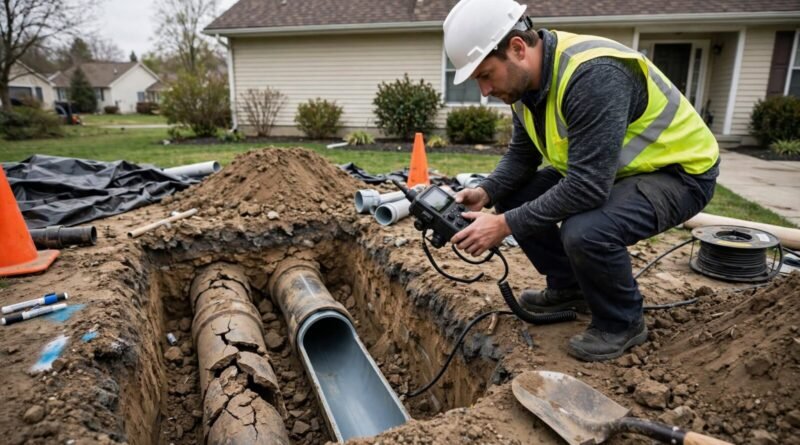
Electronic locating can identify depth and position of a defect. This is important because excavation cost is affected by depth, access, landscaping, driveways, sidewalks, roads, retaining walls, and utilities.
A repair 3 feet below an open yard is a different project from one 10 feet deep under a driveway.
Cleaning, repair, lining, and replacement solve different problems
Common options can include:
- mechanical cleaning or root cutting;
- hydro-jetting where appropriate;
- localized excavation and spot repair;
- cured-in-place lining;
- pipe bursting;
- or full open-cut replacement.
EPA technical materials describe different rehabilitation methods and their limitations. No single method fits every pipe condition.
Trenchless does not automatically mean cheaper
Lining or bursting can reduce surface disruption, but feasibility depends on pipe condition, bends, diameter, access, cleanouts, offsets, collapses, and connection details.
A trenchless quote can be excellent value under a finished driveway and unnecessary in a shallow open yard. Compare site restoration as part of the decision.
Open-cut replacement has advantages too
Excavation provides direct access, allows severely damaged or misaligned sections to be corrected, and can permit upsizing where allowed. It also creates more surface disruption.
The right choice depends on the pipe and site, not marketing language.
A hypothetical quote comparison
Suppose cleaning costs $700 and temporarily restores flow. Camera inspection shows heavy roots entering a cracked joint. A spot repair is quoted at $4,500, while full replacement is $15,000.
If the rest of the pipe is sound, spot repair may be economical. If several sections show serious defects, repeated spot repairs can become poor value.
These figures are illustrative.
Root intrusion is evidence of an opening
Roots usually enter through joints, cracks, or other defects where moisture is available. Cutting roots can restore flow but does not necessarily seal the opening that allowed them in.
Ask whether ongoing cleaning is being proposed as maintenance or whether the underlying defect should be repaired.
Pipe material changes the failure pattern
Clay, cast iron, Orangeburg-type materials, concrete, PVC, and other pipes have different vulnerabilities and repair methods. Age alone does not determine condition.
A camera report should identify the observed material and defect rather than relying only on the home’s construction date.
Surface restoration can be a major cost
Excavation may disturb asphalt, concrete, pavers, landscaping, fences, decks, or interior floors. Ask whether restoration is included and to what standard.
A cheap sewer quote can become expensive when the separate driveway contractor arrives later.
Permits and inspections matter
Municipal sewer-lateral work can require permits, inspections, approved materials, licensed contractors, or coordination with the utility. Work near public right-of-way can add requirements.
Verify local rules before accepting a proposal.
Backwater protection is a separate question
Some backups result from public sewer surcharge rather than a private lateral blockage. Depending on local code and building conditions, backwater valves or other measures may be considered.
Do not install one without understanding local requirements and maintenance needs.
Insurance coverage can differ
Standard homeowners policies may treat sewer backup, service-line damage, and resulting interior damage differently. Optional endorsements can exist.
Earnyx’s insurance exclusions guide explains why the policy should be checked before assuming an underground line is covered.
Emergency cleanup can be separate from pipe repair
A sewage backup inside the home can require sanitation, removal of contaminated materials, drying, and restoration. The plumber who clears the pipe may not provide remediation.
Include both scopes when calculating the total event cost.
Homebuyers should consider lateral inspection when risk is meaningful
Older neighborhoods, mature trees, known sewer problems, or prior backup history can make a sewer scope valuable during due diligence. Local practice varies.
Earnyx’s homeownership cost framework is relevant because underground infrastructure is part of ownership risk even though it is invisible during a normal walk-through.
Normalize sewer proposals
Compare:
- diagnosis and video evidence;
- pipe material and diameter;
- defect location and depth;
- repair method;
- length of work;
- cleanouts;
- permits;
- utility coordination;
- surface restoration;
- warranty;
- and exclusions.
Bottom line
Sewer line repair cost depends on the defect, location, depth, access, and repair method—not simply the number of feet of pipe.
Confirm responsibility, inspect and locate the problem, distinguish temporary cleaning from structural repair, and include restoration and permits. The best sewer solution is the least disruptive method that actually fixes the documented failure for the long term.