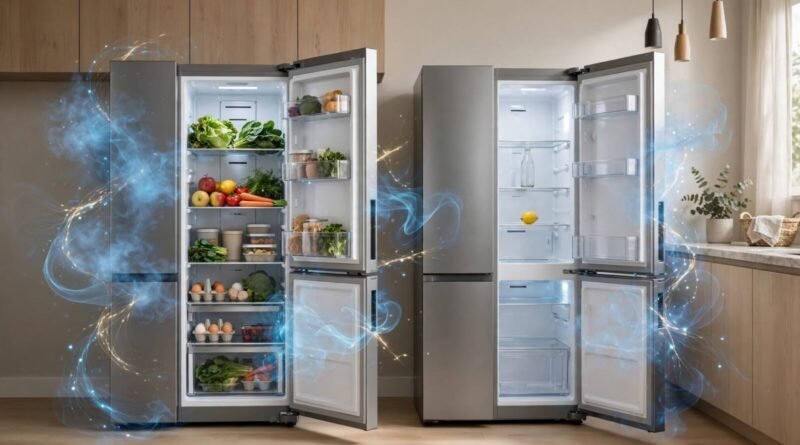
Does a Full Refrigerator Use More Electricity Than an Empty One?
A refrigerator packed with food looks as though it must work harder than an empty one. The opposite claim is also common: a full fridge supposedly saves large amounts of electricity because the cold food stores energy. Both versions oversimplify how refrigerators operate. The appliance’s energy use depends on heat entering the cabinet, its efficiency, temperature settings, airflow, door openings and the temperature of items placed inside.
Table of Contents
What the refrigerator is actually fighting
A refrigerator removes heat that enters through its insulated walls, door seals, warm food and air exchanged when the door opens. Once food is cooled to the set temperature, it does not continuously demand extra cooling simply because there is more mass inside.
Adding a large quantity of warm groceries does create a temporary load because that food must be cooled. After it reaches the target temperature, the ongoing situation changes.
Cold contents can stabilize temperature
Food and beverages have thermal mass. When the door opens, cold stored items can help the cabinet temperature recover after some cold air is replaced with warmer room air. An almost empty refrigerator has less stored cold mass.
That does not mean filling every space guarantees large savings. The compressor still responds to heat entering the appliance, and the design depends on proper internal airflow.
Overpacking can cause problems
Refrigerators need air to circulate so temperatures remain reasonably even. Blocking vents with tightly packed food can create warm spots, cause freezing in other areas or make the system work inefficiently. Follow the manufacturer’s loading and clearance guidance.
Food safety is more important than chasing a small energy difference. The U.S. Food and Drug Administration recommends keeping refrigerators at 40°F (4°C) or below for food safety.
Door habits matter
Every door opening lets warm, humid room air enter. Standing with the door open while deciding what to eat increases the heat and moisture the appliance must remove. Organizing contents so commonly used items are easy to find can reduce unnecessary open-door time.
Check door seals too. A damaged gasket can allow continuous infiltration and should be repaired according to the manufacturer.
Temperature settings matter
Setting a refrigerator colder than necessary can increase energy use and may freeze food. Use the recommended safe range and verify with an appliance thermometer if you are uncertain about the actual temperature.
Room conditions also affect consumption. A refrigerator in a very hot space or near a heat source may have a greater cooling load than the same model in a moderate kitchen.
Efficiency varies by model
Newer efficient refrigerators can use substantially different amounts of energy than older or larger models. ENERGY STAR provides standardized information for comparing qualifying products. If an old refrigerator is a major household load, replacing it with an efficient appropriately sized model can matter more than trying to optimize whether it is 50% or 70% full.
Extra refrigerators kept in garages or basements can also add significant annual consumption, especially if they are old and lightly used.
Earnyx takeaway
A full refrigerator does not automatically use more electricity than an empty one. Once contents are cold, the important ongoing factors are heat leakage, door openings, temperature settings, room conditions, airflow and appliance efficiency.
Keep enough space for air circulation, avoid leaving the door open, maintain seals and use safe temperature settings. Do not overpack the cabinet or keep it empty purely because of an electricity myth. Browse more household fact checks in Earnyx Everyday Myths.
Sources
U.S. Department of Energy — refrigerator and freezer tips; U.S. FDA — storing food safely.