
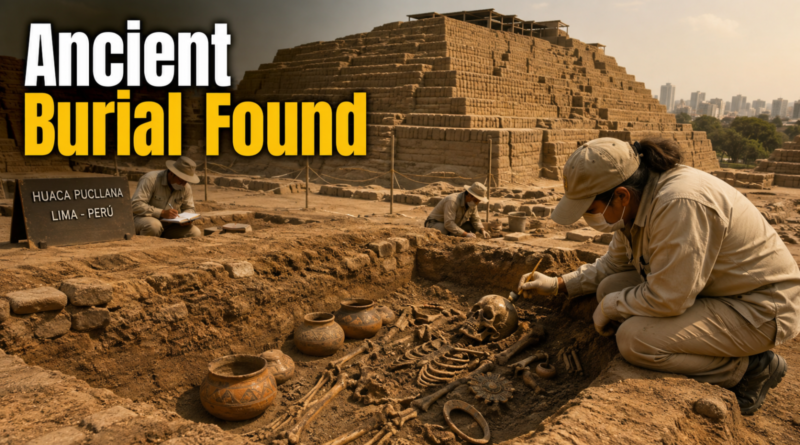
A 1,400-Year-Old Burial Beside a Lima Pyramid May Reveal an Ancient Ritual
Table of Contents
01 Event
Archaeologists at Huaca Pucllana in Lima have uncovered skeletal remains in an underground channel near the base of the adobe pyramid. Researchers believe the burial may have been connected to a ritual performed by the Lima culture around A.D. 650. Source: Associated Press.
02 What Changed?
The remains were found in a carefully positioned burial rather than an ordinary grave. The adult male skeleton was laid on its left side, with the skull oriented toward both the pyramid and the Pacific Ocean. Archaeologists say the location and body position may indicate a ceremonial offering associated with sealing or closing the channel.
03 Why It Matters
Huaca Pucllana was a major ceremonial and administrative center long before the Inca Empire. Finds like this help researchers reconstruct how the Lima culture used architecture, water systems and ritual to organize community life.
04 What It Means for You
This is a reminder that major cities can still contain intact pieces of ancient history beneath modern neighborhoods. Lima has hundreds of documented archaeological sites, and discoveries continue to emerge even in heavily developed areas.
05 Numbers + Context
The burial is roughly 1,400 years old. Huaca Pucllana itself began developing around A.D. 400 and remained important for centuries. Researchers are still examining the remains for age, sex, trauma and other evidence that could clarify whether this was a sacrifice or another form of ritual burial.
06 Earnyx Takeaway
The most valuable part of this discovery is not the dramatic possibility of sacrifice. It is the chance to understand how people in ancient Lima connected ceremony, water, architecture and belief. The evidence is still being studied, so the strongest story is what researchers may learn next.