Solar Panel Purchase vs Lease: Which Ownership Model Is Really Worth It?
Buying a solar system and leasing one can both reduce reliance on utility electricity, but they create very different financial commitments. Ownership requires more capital or financing and can provide more long-term upside. Leasing can reduce upfront cost while trading away some control and future savings.
Table of Contents
01 Event
Homeowners comparing solar proposals may encounter cash purchases, loans, leases and power-purchase arrangements. The monthly payment can make these options look easy to compare, but a monthly bill does not capture the full lifetime economics.
The decision should include total payments, incentives, maintenance responsibility, contract terms, home-sale implications and the value of electricity produced.
02 What Changed?
Solar financing has made installations accessible without paying the full system price upfront. At the same time, long contracts can introduce escalation clauses, transfer requirements and financing costs that deserve the same scrutiny as the equipment itself.
The U.S. Department of Energy’s Homeowner’s Guide to Going Solar recommends understanding financing options, installer proposals and applicable incentives before signing.
03 Why It Matters
Ownership and leasing allocate risk differently. Owners generally bear the purchase or financing cost and may receive available incentives subject to eligibility. Lease providers typically retain ownership of the equipment and may handle certain maintenance obligations under the contract.
A lower first-year lease payment can still become expensive if payments escalate over a long term. Conversely, an owned system financed at a high cost can lose much of the advantage implied by its cash price.
Earnyx’s solar installer quote guide explains how to normalize equipment, production and financing assumptions before comparing offers.
04 What It Means for You
Request the cash purchase price even if you intend to finance. That reveals the underlying system cost before loan interest or financing fees.
For a lease, request the full payment schedule, escalation formula, term length, purchase options, early termination rules and home-transfer requirements.
Verify who receives tax credits, rebates or other incentives under each structure. Eligibility and rules change, so use current authoritative guidance and qualified tax advice where appropriate.
Model what happens if you sell the home before the contract ends. A long-term solar agreement can affect the transaction even when monthly savings look attractive.
05 Numbers + Context
Use a lifetime cash-flow table rather than comparing only monthly payments.
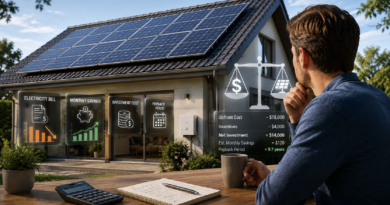
Suppose an owned system has a hypothetical $24,000 cash price. A lease begins at $110 per month and hypothetically escalates 2.5% each year for 20 years. The first-year lease payment is $1,320, but later-year payments are higher. Add the entire payment stream before comparing it with ownership.
Then compare both structures with the utility costs expected to be avoided, using conservative assumptions. These figures are illustrations and not a claim about current solar prices or lease terms.
06 Earnyx Takeaway
Solar ownership often offers more control over long-term economics, while leasing can reduce upfront responsibility. Neither is automatically superior for every household.
Financing terms can overwhelm equipment savings. Compare total loan payments and cash price, not just interest rate or monthly payment.
Lease escalators deserve explicit modeling. Even a small annual increase compounds over a long contract.
Maintenance responsibility should be written clearly. Determine who handles equipment failures, monitoring, roof access and removal or reinstallation if roof work is needed.
Production guarantees, if offered, should be read carefully. Understand what is guaranteed, for how long and what remedy applies if production falls short.
Utility export compensation can change during a long ownership period. Avoid projections that assume today’s tariff remains unchanged for decades unless the rules actually provide that certainty.
System degradation should be included in long-term production estimates. First-year output should not simply be multiplied by the contract term.
Home-sale timing is a major sensitivity. A homeowner planning to move in five years should not evaluate a 20-year contract as though they will definitely remain for the entire term.
Roof condition matters under either structure. Clarify responsibilities and costs if roofing work becomes necessary while panels are installed.
Insurance and property-tax treatment can vary by location. Verify local rules instead of assuming solar has the same effect everywhere.
Cash buyers should still consider opportunity cost: money used for solar cannot simultaneously fund other goals. That does not make the purchase bad, but it belongs in the household decision.
The Earnyx method is to model ownership and leasing under the same production, utility-rate and time-horizon assumptions. Compare lifetime out-of-pocket cost, flexibility and responsibility. The structure that works under conservative assumptions is more meaningful than the one with the lowest first payment.