
Solar Panel System Sizing: How Big Should Your Home Solar System Really Be?
Choosing a residential solar system size is not simply a matter of covering last year’s electricity use or installing as many panels as the roof can hold. The strongest design matches expected future demand with site-specific production and the value of electricity consumed or exported.
Table of Contents
01 Event
Homeowners considering solar typically receive proposals showing system capacity in kilowatts and estimated annual production in kilowatt-hours. Those two figures are related but not interchangeable.
A system’s annual output depends on location, orientation, tilt, shading, equipment and other site factors. NREL’s PVWatts calculator is one tool for estimating photovoltaic energy production.
02 What Changed?
Household electricity demand is becoming less static for some homeowners. Electric vehicles, heat pumps, induction cooking and home offices can increase future consumption, while efficiency upgrades can reduce it.
Utility compensation for exported solar also varies by location. That makes “100% annual offset” an incomplete target because the financial value of each generated kilowatt-hour can depend on when and where it is used.
03 Why It Matters
Undersizing can leave the household buying more utility electricity than expected and may make future expansion desirable. Oversizing can commit capital to production that has lower value if it is routinely exported under weak compensation.
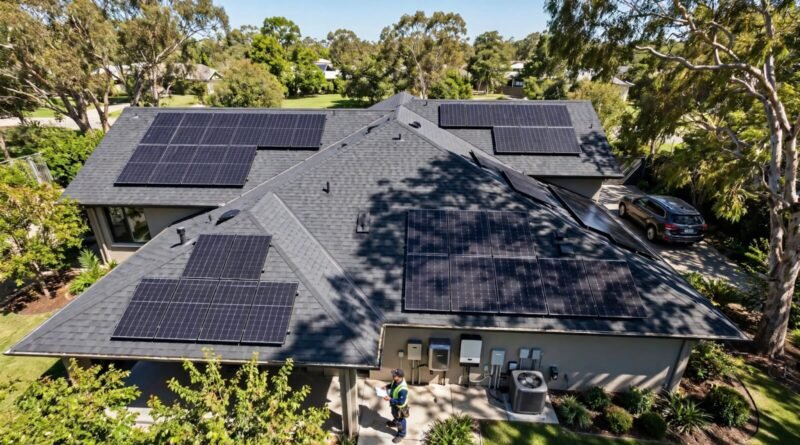
Roof area also has opportunity cost. Using the best roof sections first can be more valuable than filling marginal shaded or poorly oriented areas simply to reach a larger capacity number.
04 What It Means for You
Start with at least a year of electricity usage where available. Review monthly patterns rather than only the annual total.
Then adjust for known future changes. Estimate EV charging from expected mileage and vehicle efficiency, and use credible contractor or equipment estimates for major electrification projects.
Ask installers to model multiple system sizes using consistent assumptions. Compare installed cost, first-year production, degradation assumptions, self-consumption and exports.
Check current utility interconnection and compensation rules. Do not assume exported electricity will always be valued at the same rate as electricity purchased from the grid.
Earnyx’s undersizing solar guide and oversizing solar guide examine the two main sizing errors in more detail.
05 Numbers + Context
A basic starting point is:
Target annual solar production = expected future annual electricity use × desired economically useful offset
Suppose a household currently uses 8,000 kWh per year and expects a future EV to add 2,000 kWh of annual home charging. Modeled future use becomes 10,000 kWh. If a proposed system is expected to produce 1,300 kWh annually per installed kW at that site, roughly 7.7 kW would produce 10,000 kWh in the first year. These are illustrative assumptions, not a recommendation for a specific home.
The financial optimum may still be smaller or larger depending on export value, roof constraints, degradation, future load and system pricing.
06 Earnyx Takeaway
Size solar around expected future electricity demand and the economics of the local utility arrangement. Do not use a universal panel count or offset percentage.
Model several sizes and examine the incremental cost and value of additional capacity. The right system is the one whose production is useful enough to justify the capital required.
Monthly consumption patterns reveal information that annual totals hide. A household with heavy summer cooling demand may align well with solar production, while another with high winter electric heating demand can have a different seasonal match.
Hourly timing matters too. Solar produced while the household is using electricity can have different economics from electricity exported midday and repurchased later, depending on the tariff.
Future EV assumptions should be realistic. Estimate how many miles will be driven, what share of charging will occur at home and the vehicle’s expected efficiency. Do not automatically add a full battery charge every day.
Heat pumps require similar care. They can raise electricity consumption while lowering another fuel expense. Solar sizing should use expected electric demand, while the broader household economics should consider both fuels.
Energy-efficiency improvements can reduce the system needed. Insulation, cooling upgrades or efficient appliances may lower future consumption. Compare the cost of saving a kilowatt-hour with the cost of generating it.
Roof condition should be assessed before installation. Panels can remain in service for many years, so a roof nearing replacement can create future removal and reinstallation work.
Shading should be modeled across the year. Trees, chimneys and nearby buildings can affect sections differently as the sun angle changes.
Inverter architecture influences design and possible expansion. Ask whether the proposed equipment can support future capacity and what changes would be required.
Panel degradation means first-year output should not simply be multiplied by decades of operation. Use the manufacturer’s applicable performance assumptions in long-term models.
Financing can change the optimum because interest increases the cost of additional capacity. Compare cash-equivalent prices and total financing obligations rather than focusing only on monthly payments.
The Earnyx method is iterative: estimate future load, model site production, apply current utility economics, compare several system sizes and test how the answer changes under conservative assumptions. Solar sizing is a planning problem, not a roof-filling contest.


Pingback: Solar Installer Quotes: How to Compare the Real Cost