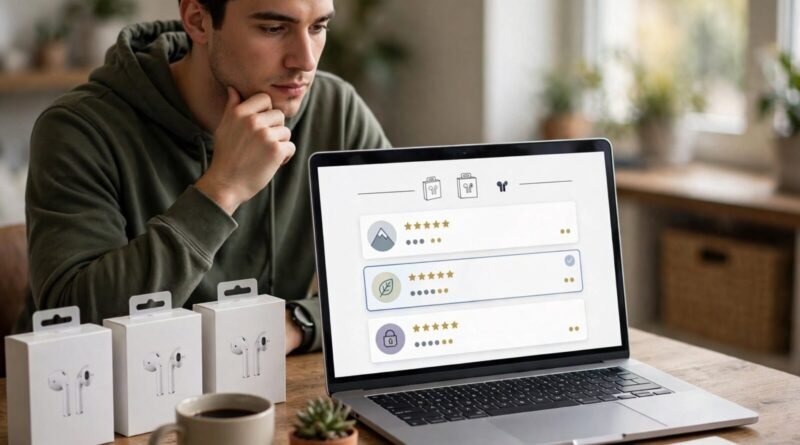
Cyber Monday Marketplace Sellers: When Is the Lowest Price Not Worth the Seller Risk?
Cyber Monday marketplaces can make price comparison look simple because several sellers appear on the same product page. The lowest number can be tempting, especially when the difference is only visible for a few minutes. But marketplace buying adds another variable to the transaction: the seller itself.
A lower price can become more expensive if the seller has weak return support, unclear warranty coverage, slow delivery, counterfeit risk, or poor communication. The useful question is not “Who has the lowest listing?” It is “Which offer has the lowest risk-adjusted total cost?”
Table of Contents
Separate the marketplace from the seller
A familiar marketplace logo does not necessarily mean the platform itself is the seller. The product may be listed, fulfilled, or both by a third party.
Before buying, check the seller name, fulfillment method, return address, warranty terms, and whether customer service is handled by the platform or the merchant.
Small savings can be poor compensation for large risk
Imagine an authorized retailer sells a device for $320 while an unfamiliar marketplace seller lists it at $305. The visible saving is $15.
If the cheaper seller has unclear returns, slower shipping, or uncertain manufacturer warranty coverage, that $15 may be too little compensation for the additional friction.
These numbers are illustrative.
Seller history matters
Look at the number of completed transactions, the pattern of recent reviews, recurring complaints, and how long the seller has been active.
A perfect rating based on a handful of transactions is not the same signal as a long history of consistent fulfillment. Read recent negative reviews rather than relying only on the average score.
Check whether the item is actually new
Marketplace listings can include new, refurbished, renewed, open-box, used, imported, or gray-market inventory. The title can look similar even when condition differs.
Confirm product condition, packaging, included accessories, warranty, and exact model number before comparing the price with a new retail unit.
Manufacturer warranty can depend on seller status
Some manufacturers restrict warranty coverage to authorized sellers or regions. Policies vary by brand and product.
If warranty matters, check the manufacturer’s current rules rather than assuming every new-looking marketplace item carries the same coverage.
Returns can be the biggest hidden cost
A trusted retailer may offer local drop-off or prepaid returns. A marketplace seller may require the buyer to pay return shipping or send the product to another region.
For bulky or expensive goods, that difference can exceed the initial price saving.
Delivery timing matters during holiday shopping
The cheapest seller can be less useful if estimated delivery falls after the date you need the product.
Compare realistic arrival dates, not only “ships in” estimates. A late gift can create the cost of buying a replacement locally.
Counterfeit risk changes expected value
Counterfeit or misrepresented goods are especially problematic for branded accessories, memory cards, chargers, cosmetics, batteries, and other products where visual similarity does not guarantee equivalent quality.
A lower price should not override basic authenticity checks. For safety-sensitive products, seller reliability can matter even more than the discount.
Payment protection helps, but it is not free convenience
Marketplace dispute systems and credit-card protections can reduce financial risk, but filing a claim takes time and requires documentation.
Protection is a backstop, not a reason to ignore seller quality.
Save the listing
For a high-value purchase, keep a screenshot of the seller, product condition, included items, price, delivery promise, and return terms.
If the listing later changes, you still have a record of what you agreed to buy.
Check the exact model and region
Electronics sold for another market can use different plugs, cellular bands, keyboards, software, or warranty rules. A model number that differs by one suffix can represent a meaningful change.
Compare the complete model identifier before concluding that a marketplace listing is cheaper than domestic retail.
Cyber Monday urgency increases seller risk
Countdowns and low-stock messages can push buyers to skip due diligence. The FTC has documented how urgency signals can influence consumer decisions through dark-pattern design. See the FTC’s dark-pattern report.
The seller risk does not disappear because the offer expires soon.
Compare the risk-adjusted price
A useful framework is:
Risk-adjusted cost = purchase price + expected return/warranty friction + delivery risk + authenticity risk
You do not need precise probabilities. The purpose is to make hidden seller differences visible.
When the lowest marketplace price can be worth it
A lower-price marketplace offer is stronger when the seller has a long reliable history, clear returns, strong fulfillment, verified condition, appropriate warranty, and a meaningful price advantage.
If the discount is only a few dollars, seller quality usually deserves more weight.
Internal Earnyx rule: compare the whole transaction
Earnyx’s holiday sale pricing guide uses the same principle: the lowest visible number is not automatically the lowest real cost.
Shipping, returns, seller reliability, warranty, and product condition are all part of the purchase.
Bottom line
The lowest Cyber Monday marketplace price is not worth the seller risk when the discount is small and the cheaper offer introduces meaningful uncertainty around condition, warranty, authenticity, returns, or delivery.
Check who is selling, how the item is fulfilled, what condition you are buying, and what happens if something goes wrong. A slightly higher price from a trusted seller can be the cheaper decision once the cost of resolving a bad transaction is included.