Electricity Bills Explained: Where Your Meralco Payment Actually Goes
Table of Contents
01 Event
When a household electricity bill rises, it is easy to assume the distribution utility simply increased its own price. Meralco’s official 2026 bill guidance shows why that conclusion can be wrong.
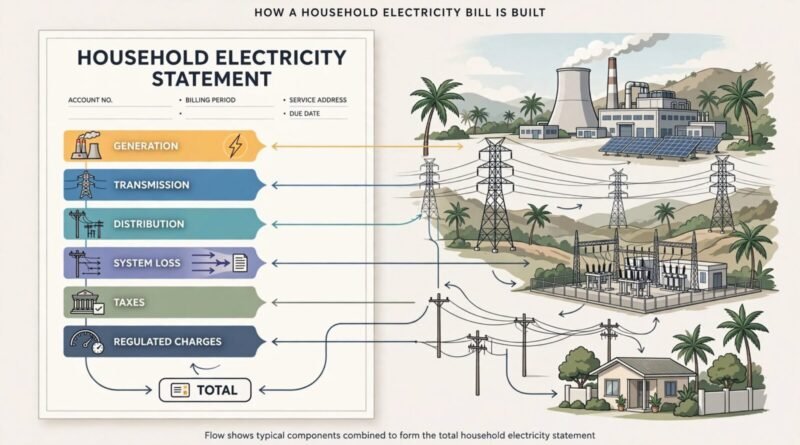
A residential bill is made up of several regulated components covering generation, transmission, distribution, system loss, taxes, subsidies and government-mandated programs. Some of those charges go to Meralco, while many are collected by Meralco and passed through to generators, the grid operator, government agencies or other entities.
Understanding the bill matters because the action that lowers one component may not lower another. Using fewer kilowatt-hours can reduce energy-linked charges, but fixed or regulatory components can still remain.
02 What Changed?
Meralco updated its public “Breakdown of Charges” guidance on May 1, 2026. Based on its stated 2025 average, the company says only about 12% of the bill goes to Meralco for distribution-network operations, customer service, metering and billing. Meralco says the remaining 88% consists of pass-through charges it collects but does not earn from.
The largest component in that average is generation at 64%. Transmission accounts for about 8%, system loss about 5%, and taxes, subsidies and other charges about 11%.
Meralco’s 2026 FAQ also explains a new Green Energy Auction Allowance, or GEA-All, which it began collecting in January 2026. The FAQ currently lists GEA-All at ₱0.0371 per kWh. The charge supports renewable-energy projects selected through the government’s Green Energy Auction Program and is remitted to the National Transmission Corporation.
03 Why It Matters
The generation charge is the largest average component, so changes in the cost of purchased electricity can materially move the total bill even when the distribution charge is unchanged.
Meralco says generation costs can move with global fuel prices, supply and demand in the power market, power-plant availability and foreign exchange. Transmission charges can also change and affect the final rate.
This distinction matters for consumers. A higher bill can come from:
- using more electricity;
- a higher per-kWh generation component;
- changes in transmission or regulatory charges;
- tax or government-mandated components;
- some combination of consumption and rate changes.
That means comparing only the peso total from one month to the next can be misleading. Compare both kWh consumed and the effective rate per kWh.
04 What It Means for You
When reviewing a Meralco bill, start with these checks:
- Consumption: Did kWh usage rise versus the previous month or the same season last year?
- Generation charge: This is the largest average component and can change monthly.
- Transmission charge: Review whether grid-related costs moved.
- System loss: This is regulated and capped; Meralco says losses above the ERC cap cannot be passed to customers.
- Taxes and mandated charges: These include government-defined items rather than discretionary utility markups.
- New or changed regulatory items: GEA-All is one 2026 example.
If usage is the main reason the bill increased, then appliance behavior, cooling, water heating and standby loads become relevant. Earnyx’s standby-power reality check explains why unplugging everything is not always the biggest saving opportunity, while our lights-on/off electricity myth article addresses another common misconception.
05 Numbers + Context
Meralco’s current public breakdown, based on its stated 2025 average, is:
| Bill component | Share cited by Meralco | Where it goes / what it covers |
|---|---|---|
| Generation | 64% | Power purchased from suppliers and related generation-side mandated items |
| Transmission | 8% | Use of transmission lines and ancillary services; remitted to NGCP |
| System loss | 5% | Regulated cost of technical and non-technical electricity losses within allowed caps |
| Taxes, subsidies and other charges | 11% | Government and other mandated charges |
| Meralco distribution/customer service portion | 12% | Distribution network, metering, billing and customer service |
These percentages are an average breakdown, not a promise that every household bill has exactly the same proportions each month. Actual components vary with consumption and current rates.
Meralco also states that system-loss recovery is capped by the Energy Regulatory Commission. Losses above the allowed level cannot be passed on to customers. Its FAQ explains that system loss includes technical losses from wires and transformers as well as non-technical losses such as theft or illegal connections.
For GEA-All, Meralco’s current FAQ lists ₱0.0371/kWh. At 300 kWh of monthly consumption, the arithmetic for that specific component is ₱11.13 before considering any applicable tax treatment: 300 × ₱0.0371. That calculation illustrates the scale of the line item without pretending it represents the whole bill.
06 Earnyx Takeaway
An electricity bill is a stack of costs, not one utility price.
For Meralco customers, the largest average portion is generation, while Meralco’s own distribution/customer-service portion is much smaller than the total bill. That is why total rates can move even when the utility says its distribution charge has not increased.
When the bill jumps, separate two questions: Did you use more electricity? and Did the effective cost per kWh change? The answer tells you whether the most useful response is household energy reduction, rate monitoring, or both.
Sources: Meralco — Breakdown of Charges, updated May 1, 2026; Meralco — Bill Breakdown FAQs.