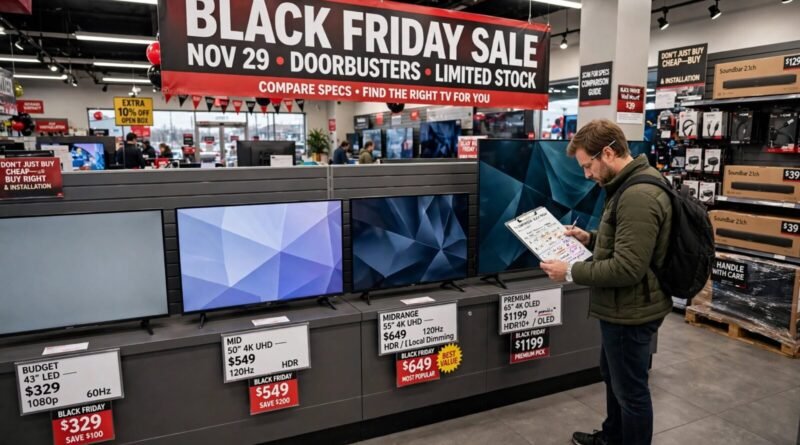
Black Friday TVs: Why the Cheapest Model May Not Be the Best Deal
Black Friday television deals can make screen size look like the only number that matters. A 65-inch set at a very low price can seem automatically better than a smaller or more expensive model. But televisions with the same diagonal size can differ significantly in panel quality, brightness, local dimming, refresh behavior, gaming features, ports, software support, warranty, and long-term usefulness.
The cheapest television can still be the right purchase. The mistake is assuming that the lowest sticker price is the lowest cost for the viewing experience you actually want.
Table of Contents
Compare the exact model number
Retailers may carry models that look nearly identical in advertisements but differ in specifications. Write down the complete model number and compare it with the manufacturer’s official specification page.
If a Black Friday model has a unique suffix or limited price history, compare features rather than relying on the product-family name alone.
Panel technology affects picture quality
LCD-based televisions can use different backlights, local-dimming systems, and panel types. OLED and other display technologies behave differently again.
You do not need the most expensive technology for every room, but a deeply discounted television is not a bargain if poor contrast, viewing angles, motion, or brightness makes it frustrating for your normal use.
Brightness matters for the room
A television used in a bright living room faces different conditions from one used mainly at night in a dark bedroom. A model with limited brightness can look acceptable in a showroom clip yet struggle with glare at home.
Evaluate the product against your room rather than against a generic “best TV” list.
Refresh rate and gaming features can change value
Gamers may care about input latency, variable refresh rate, high-refresh inputs, HDMI bandwidth, and console compatibility. A low-cost television that lacks the features your console or PC can use may require another upgrade sooner.
For a household that only streams films and shows, paying extra for advanced gaming capability may create little value.
Ports are easy to overlook
Count how many HDMI devices you expect to connect: console, soundbar, streaming box, cable box, media player, or PC.
A cheaper set with too few suitable ports can create the need for switches or constant cable swapping. Confirm which ports support advanced features rather than assuming every HDMI connection is equivalent.
Smart-TV software is part of the ownership experience
Built-in apps, operating-system speed, update support, and advertising can differ by brand and model. A television with mediocre built-in software may still be good value if you already use an external streaming device.
If you rely entirely on the television’s apps, software support deserves more weight.
Example: cheaper today, replaced sooner
Imagine a $350 Black Friday television that meets your basic needs but lacks the gaming feature you expect to use next year. A $450 alternative includes that feature and otherwise suits the room equally well.
If buying the cheaper set causes you to replace it two years earlier, the $100 upfront saving may be poor long-term value. If you never use that feature, the cheaper set may be the correct choice.
These figures are illustrative.
Compare price history, not only MSRP
A television can be advertised at a dramatic percentage off a manufacturer reference price even if it frequently sells below that figure. The FTC’s Guides Against Deceptive Pricing provide context for why former-price comparisons should be genuine.
Earnyx’s holiday sale pricing guide explains how to compare a sale with the product’s real recent market price.
Delivery can change the final deal
Large TVs can carry delivery charges or create inconvenience if damaged in transit. A slightly higher price with reliable delivery and easy local returns can be worth more than a cheaper marketplace offer.
Check who handles damaged-item pickup and whether returning a large television requires you to ship it yourself.
Warranty and seller authorization matter
Verify the manufacturer warranty, product condition, and seller. Open-box, refurbished, and imported units can have different coverage.
A $20 or $30 price advantage may not justify weak warranty handling on an expensive device.
Sound quality may create an extra purchase
Thin televisions often rely on compact speakers. If you know you will need a soundbar, include that cost when comparing a television with a model whose built-in audio is sufficient for your room.
The same logic applies to wall mounts, cables, stands, and installation.
Energy use belongs in long-term cost
Television electricity use varies with size, brightness, settings, and technology. For most buyers, purchase price and picture quality will dominate the decision, but a set used many hours per day can accumulate meaningful energy use over years.
Where available, compare official energy labels under similar test assumptions.
Do not pay for features you will never use
A premium television can also be poor value. If you watch casual streaming in a small room, expensive gaming or high-end picture features may not improve your experience enough to justify the price.
The best value is the lowest-cost model that meets your actual requirements with enough room for the ownership period you expect.
Black Friday model substitutions need caution
If your planned model sells out, do not automatically take the next television a salesperson or website recommends. Compare the substitute’s exact specifications and normal price first.
Scarcity can turn a carefully researched purchase into an impulse downgrade or overspend.
Use cost per year, not only checkout price
If you expect to keep a $600 television for six years, the simple purchase cost is $100 per year. A $400 set replaced after three years costs about $133 per year before resale or repairs.
This is not a prediction of lifespan; it is a way to think about durability and feature fit. Earnyx’s cost-per-use framework applies well to durable electronics.
Bottom line
The cheapest Black Friday television is the best deal only when it provides the picture quality, ports, software, gaming support, return terms, and expected useful life you actually need.
Compare exact models, recent selling prices, delivery, warranty, and necessary add-ons. A slightly higher price can create better long-term value when it prevents an early replacement or avoids buying extra hardware. The goal is not the cheapest screen; it is the lowest total cost for a television you will be satisfied to keep.