Well Water System Costs: How to Budget for Testing, Pumps, Treatment, and Repairs
A private well can eliminate a monthly municipal water bill, but it does not make water free. The homeowner takes responsibility for the well, pump, pressure system, electrical equipment, water testing, treatment where needed, and repairs. The financial profile is therefore different from a public-water home: fewer utility charges can be offset by larger irregular maintenance costs.
The right budget starts with the actual well and water quality rather than a generic annual estimate.
Table of Contents
Private wells are the homeowner’s responsibility
The U.S. Environmental Protection Agency explains that private wells are not regulated under the federal Safe Drinking Water Act in the same way public water systems are. EPA’s private-well guidance emphasizes that owners are responsible for protecting and monitoring their water.
State and local rules can impose additional requirements, so use the local health department as a primary source.
Know the well construction
Keep records showing well depth, casing, pump type, installation date, yield information, drilling log, and prior repairs when available.
The cost of pulling and replacing a pump can differ dramatically between a shallow accessible installation and a deep well with difficult equipment access.
Water testing is a recurring ownership cost
Water can look, taste, and smell normal while still containing contaminants. EPA recommends testing private wells based on local risk and health guidance.
The appropriate test panel depends on location, nearby land use, known contaminants, well construction, household health concerns, and local recommendations. Do not pay for an arbitrary “everything” test without knowing why each parameter matters.
Changes in taste, smell, or appearance deserve investigation
Sudden changes can indicate a problem with the well, plumbing, treatment equipment, or source water. Flooding, repairs, nearby construction, or a damaged well cap can also justify additional testing.
Testing should guide treatment rather than the other way around.
Treatment should be based on measured water quality
Softening, filtration, activated carbon, reverse osmosis, disinfection, iron treatment, nitrate treatment, and other systems solve different problems.
A salesperson may recommend several devices at once. Ask for certified laboratory results, the target contaminant, expected performance, replacement media schedule, wastewater production where relevant, and operating cost.
The pump is only one component
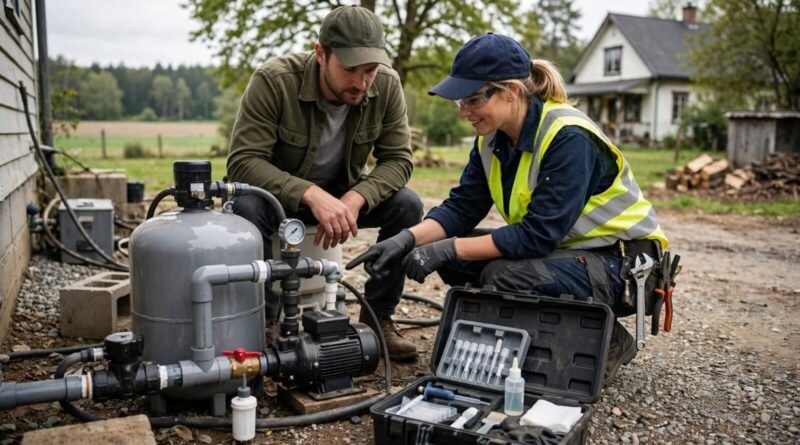
A well-water system can include:
- submersible or jet pump;
- pressure tank;
- pressure switch;
- controls;
- electrical wiring;
- pitless adapter or piping;
- well cap;
- treatment equipment;
- and sometimes storage or booster systems.
A “no water” call can come from several of these components, so diagnosis matters.
Electrical problems can mimic pump failure
A tripped breaker, control problem, failed pressure switch, damaged wire, or other electrical issue can stop water delivery even when the pump itself is serviceable.
Do not approve a pump replacement until the contractor explains the diagnosis.
A hypothetical repair comparison
Suppose a household loses water pressure. Contractor A quotes $4,000 for a pump replacement. Contractor B finds a failed control component and repairs it for $650.
The point is not that control failures are always cheap or pump quotes are excessive. It is that the same symptom can have very different causes.
These figures are illustrative.
Pressure tanks affect pump cycling
The pressure tank helps reduce frequent pump starts and stabilizes household pressure. A failed or improperly charged tank can contribute to rapid cycling and equipment wear.
Include tank condition when evaluating a well system with pressure problems.
Well yield can limit household use
A low-producing well may require changes in usage, storage, controls, or—in some cases—additional drilling or rehabilitation. A high-capacity pump cannot create groundwater that the well does not produce.
For a home purchase, review any available yield or recovery information and ask about seasonal problems.
Drought and groundwater conditions can change performance
Water levels can vary. Some wells experience reduced yield during dry periods. A system that works during a wet-season inspection may perform differently later.
Local well professionals and public agencies can provide more useful context than a national rule.
Septic systems can interact with well risk
EPA notes that poorly functioning septic systems can contaminate nearby drinking-water wells under certain conditions. Well depth, groundwater direction, soil, setbacks, and maintenance all matter.
Properties with both systems should maintain and document both.
Flooding can contaminate wells
Surface water entering a well can introduce contaminants. EPA recommends protecting the wellhead, maintaining a sanitary cap, and directing runoff away from the well.
After flooding or suspected contamination, follow local public-health guidance for testing and disinfection before relying on the water.
Treatment equipment has recurring costs
Filters, salt, membranes, UV lamps, cartridges, chemicals, electricity, service visits, and wastewater can all add to ownership cost.
When comparing treatment systems, calculate:
Annual treatment cost = consumables + electricity + scheduled service + expected replacement parts
Do not ignore abandonment costs
If a well is replaced or permanently taken out of service, local rules can require proper sealing or abandonment by a qualified professional to protect groundwater.
Include this in major renovation or public-water conversion plans.
Homebuyers should request records
Ask for testing history, pump invoices, drilling records, treatment maintenance, and known seasonal issues. A general home inspection may note basic operation but is not a substitute for well-specific evaluation.
Earnyx’s homeownership cost framework is relevant because private utilities shift costs from monthly bills to owner-maintained infrastructure.
Build a well reserve by component
List each major component, current age and condition, recent service history, local replacement quote where practical, and expected maintenance. Then fund routine testing separately from emergency repair reserves.
A property-specific plan is more useful than a national “well costs X per year” claim.
Bottom line
Well water can be economical, but the homeowner becomes the water utility.
Budget for testing, pumps, pressure equipment, treatment, electricity, and repairs; keep construction and maintenance records; and base treatment on measured water quality. The absence of a municipal water bill does not mean the water system has no ownership cost.