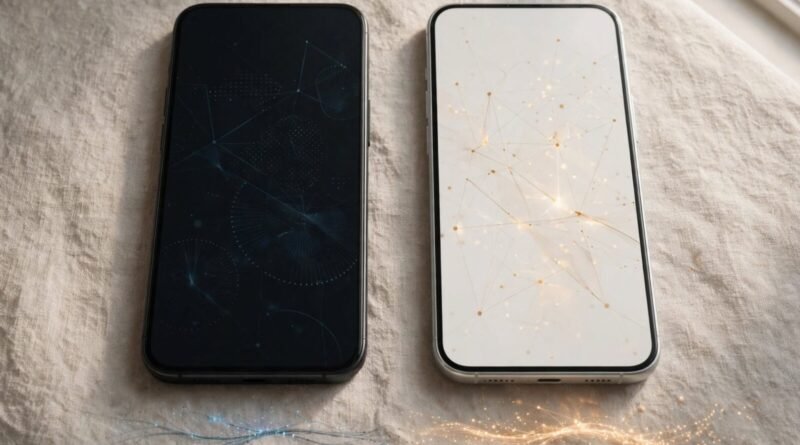
Does Dark Mode Always Save Battery?
Dark mode is often promoted as an easy battery-life hack: switch bright backgrounds to black and the phone supposedly lasts much longer. The idea is technically plausible on some displays, but it is not universal. Whether dark mode reduces power depends heavily on the display technology, brightness, interface colors and how much of the screen is actually dark.
Table of Contents
OLED and LCD screens work differently
OLED-family displays create light at individual pixels. A black pixel can use very little display power because it does not need to emit light. Turning a large white interface into a predominantly black one can therefore reduce display energy.
Traditional LCDs use a backlight behind the panel. Making the displayed pixels black does not normally switch off the corresponding portion of that backlight. As a result, dark mode usually has much less direct effect on the display’s power consumption on an LCD.
Brightness changes the size of the benefit
Research measuring OLED smartphones has found that dark-mode savings can vary substantially with screen brightness. At low brightness, the absolute difference may be modest. At high brightness, replacing large bright areas with dark pixels can have a larger effect.
This means a dramatic claim based on a maximum-brightness laboratory test should not automatically be applied to someone who uses adaptive brightness indoors. The real-world result depends on the conditions.
The screen is only part of phone power use
A smartphone also powers its processor, modem, memory, cameras, sensors, audio hardware and wireless radios. During gaming, navigation, video calls or weak-signal cellular use, those components can consume substantial energy. Saving power on the display does not eliminate the rest of the workload.
If a phone spends most of the day with the screen off, changing interface colors cannot transform total battery life. Conversely, someone who reads for hours at high brightness on an OLED screen has more opportunity to benefit.
Not every dark theme is truly black
Many dark modes use dark gray rather than pure black. OLED pixels displaying gray still emit light, though typically less than a bright white interface at the same conditions. App design also matters: photos, videos, maps and websites may contain large bright regions regardless of the operating-system theme.
Some apps do not fully follow the system setting, so the percentage of the day spent viewing dark content varies.
Dark mode can be useful for other reasons
Battery life is not the only reason people choose a dark interface. Some users find it more comfortable in low-light environments, while others prefer light mode for readability. Accessibility needs differ, and contrast should be evaluated for the individual rather than assuming one color scheme is universally easier to read.
At night, lowering excessive screen brightness may be more immediately useful than changing the theme while leaving brightness high.
How to test your own phone
First determine whether the device uses an OLED-type or LCD display. Then use the phone normally for several comparable days with each theme, keeping brightness behavior and workload as similar as practical. Battery statistics are noisy, so a single afternoon is not a controlled experiment.
If the battery problem is severe, inspect the operating system’s battery-usage screen. A background app, degraded battery or poor cellular signal may be a much larger factor than interface color.
Earnyx takeaway
Dark mode can save display energy on OLED-type screens, but it does not always produce a meaningful battery improvement. The effect depends on display technology, brightness, how much content is actually dark and what else the phone is doing.
Use dark mode if you prefer it, and treat any battery saving as a device- and usage-dependent bonus. If maximum runtime matters, combine sensible brightness, battery-saver features and investigation of high-usage apps rather than relying on theme color alone. See more technology fact checks in Earnyx Everyday Myths.
Sources
ACM MobiSys research — dark mode power consumption on OLED smartphones; Google Android Help — app and device management guidance.