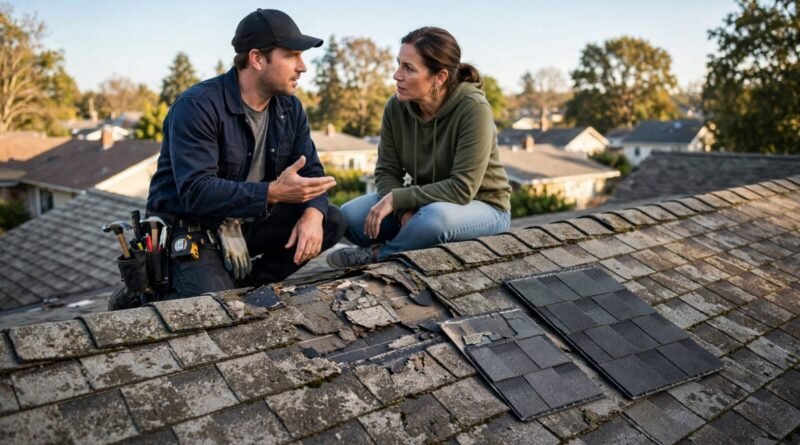
Roof Repair vs Replacement: When Is Another Repair No Longer the Cheaper Choice?
A roof leak does not automatically mean the entire roof needs replacement. Many problems are localized: damaged flashing, a failed pipe boot, a small storm-damaged area, a puncture, or a limited section of deteriorated material. But repeated repairs can also become a costly way to postpone a replacement that the roof genuinely needs.
The right decision is based on the location and cause of failure, the condition of the rest of the roof, the expected durability of the repair, and the cost of continued risk—not on age alone.
Table of Contents
Start by identifying the failure
Before comparing prices, determine what is actually wrong. A contractor should be able to explain whether the leak or damage comes from:
- flashing;
- a penetration or pipe boot;
- missing or damaged roofing material;
- a valley;
- a chimney or wall intersection;
- underlayment or decking;
- poor ventilation or condensation;
- storm damage;
- or widespread material deterioration.
Repair economics are very different when the defect is isolated versus systemic.
Age is a clue, not a verdict
Roof materials have expected service ranges, but actual condition depends on material, installation, climate, ventilation, maintenance, storm exposure, and repairs.
Do not replace a sound roof solely because it reached a generic age threshold. Likewise, do not keep repairing a failing roof because a brochure says it should have years remaining.
Localized damage usually favors repair
If the roof is otherwise in good condition and the problem is limited to one flashing detail or a small damaged section, a properly executed repair can restore service at far lower cost than full replacement.
The key is whether the repair addresses the root cause rather than covering the symptom.
Widespread deterioration changes the math
When leaks appear in multiple areas, roofing material is broadly failing, decking damage is widespread, or repeated repairs are becoming routine, replacement can become more rational.
At that point, each repair buys less reliable service and leaves more of the aging system untouched.
Use expected repair life, not just repair price
A $1,200 repair that is expected to solve a localized problem for many years can be excellent value. A $1,200 repair that is likely to be followed by another repair next season is a different purchase.
Ask the contractor what part of the roof is being repaired, why it failed, and what risk remains elsewhere.
The dollar figure is illustrative.
Compare cumulative repairs with replacement
A simple framework is:
Expected keep-repairing cost = current repair + likely additional repairs + expected secondary-damage risk
Compare that with:
Replacement cost = full installed replacement − value of avoiding near-term recurring repairs
The calculation is uncertain, so use scenarios rather than pretending to know exactly when the next leak will occur.
Secondary damage can make waiting expensive
A roof leak can damage insulation, ceilings, walls, flooring, electrical components, framing, and personal property. Mold or rot can also develop when moisture remains.
A repair decision should therefore include the consequence of failure, not only the roofing invoice.
Decking condition can push toward replacement
If inspection or prior repairs reveal widespread soft, rotted, or damaged decking, replacing only the visible roofing material in one small area may leave larger problems in place.
Decking cannot always be fully assessed before tear-off, but recurring structural deterioration is an important warning signal.
Flashing problems can often be repaired
Chimneys, sidewalls, skylights, valleys, and penetrations are common leak locations. When the surrounding roof remains serviceable, correcting the flashing can be more rational than replacing the entire system.
Ask whether the repair includes proper removal and reconstruction of the detail rather than surface sealant alone.
Storm damage requires a separate insurance review
If the damage resulted from a storm or other potentially covered event, review the homeowners policy before authorizing major work. Coverage depends on the cause, policy, deductible, loss-settlement terms, and insurer findings.
Earnyx’s insurance exclusions guide explains why insurance should not be assumed to cover ordinary wear or deterioration.
Matching materials can affect repair practicality
Older roofing products can be discontinued, faded, brittle, or difficult to integrate with new material. A repair may remain technically sound even if it does not match perfectly, but availability can affect both appearance and scope.
For some systems, removing surrounding material to make a durable repair can expand the project significantly.
Warranty status matters
Check manufacturer and workmanship warranties before hiring a new contractor. Some defects may be covered; other repairs performed by an unauthorized party could affect warranty rights.
Read the actual terms rather than assuming a long warranty covers every leak.
A hypothetical scenario
Imagine a roof with one failed flashing detail. Repair is quoted at $1,500, while replacement is $20,000. A qualified contractor finds the remaining roof in good condition. Repair is likely the stronger economic choice.
Now imagine the same repair quote on a roof with multiple active leaks, widespread surface failure, and previous repairs totaling $5,000 over two years. The replacement case becomes much stronger.
These figures are hypothetical.
Replacement can create a clearer cost ceiling
A full replacement can resolve multiple aging components at once and reset the maintenance cycle for the roof system, although future repairs are still possible.
That predictability has value for owners who want to reduce repeated emergency calls and interior-damage risk.
Do not replace simply to “get a warranty”
A new warranty has value only if the installation is correct, the contractor remains available, required maintenance is followed, and the covered failure actually fits the warranty terms.
Warranty length should not substitute for scope and workmanship quality.
Get at least one diagnosis that explains both options
A contractor whose business model is primarily replacement may naturally emphasize replacement. A repair-focused contractor may emphasize repair. For an expensive decision, seek enough independent information to understand the technical condition rather than buying the first recommendation.
Normalize replacement quotes
If replacement becomes likely, compare roof area, material, tear-off, underlayment, flashing, ventilation, decking, permits, disposal, warranty, and payment schedule.
The related Earnyx roof-replacement framework should be applied to the full installed scope, not just the headline bid.
Bottom line
Roof repair is usually strongest when the defect is localized and the rest of the roof remains serviceable. Replacement becomes stronger when deterioration is widespread, repairs are recurring, or the consequence of another failure is becoming too expensive.
Diagnose the cause, compare the expected durability of the repair with the condition of the whole roof, and include secondary-damage risk. The cheapest invoice today is not always the cheapest roof strategy over the next several years.