
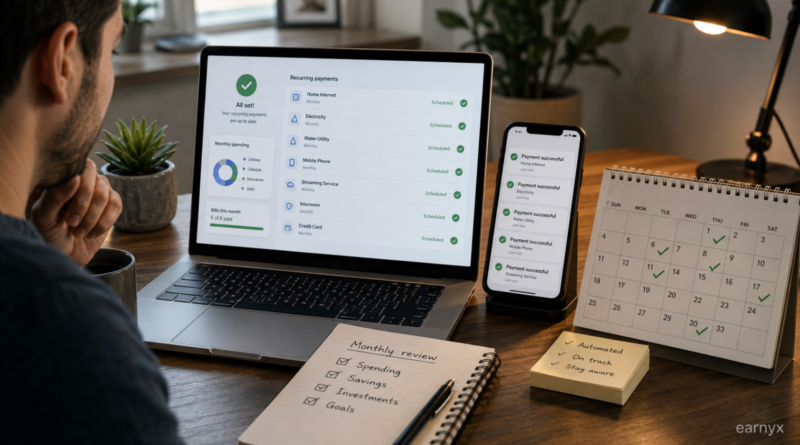
Automatic Bill Pay vs Manual Payments: How Much Time Does Autopay Really Save?
Table of Contents
01 Event
Automatic bill pay can remove a small recurring task from every month: opening the bill, remembering the due date, logging in and making the payment.
Each payment may only take a few minutes, but households can have many recurring bills. The question is whether automating them saves enough time and mental effort to justify giving up some manual control.
02 What Changed?
Most recurring bills can now be automated either through the company collecting the payment or through recurring bill-pay instructions at a bank or credit union.
The Consumer Financial Protection Bureau notes an important distinction: with automatic debit, you authorize a company to take money from your account; with bank bill-pay, you instruct your financial institution to send the payment.
03 Why It Matters
Automation can reduce missed due dates and repetitive administrative work. CFPB guidance says automatic payments can be a convenient way to make sure bills are paid on time, and some lenders may even offer an interest-rate reduction for automatic debit.
But automation does not eliminate financial management. If the account balance is too low, an automatic payment can trigger overdraft or nonsufficient-funds fees. You also need to monitor variable bills and make sure canceled services stop charging.
04 What It Means for You
Autopay works best for predictable obligations where you maintain a sufficient account buffer: mortgages, fixed loan payments, subscriptions and stable recurring bills.
For highly variable bills or accounts with tight cash flow, manual review before payment may provide useful control. Another approach is to automate the payment but keep alerts for the statement amount and withdrawal date.
Think about the system rather than each individual bill. If you manually handle 12 payments per month and each requires five minutes of attention, that is about one hour monthly. Automation may reduce most of that work to a short weekly or monthly review.
05 Numbers + Context
Example: 10 bills × 5 minutes each = 50 minutes of payment administration per month, or 10 hours per year. If automation reduces that to a 15-minute monthly account review, the recovered time is about seven hours per year.
The value disappears quickly if automation causes even one expensive overdraft or allows an unwanted recurring charge to continue for months.
A useful rule is:
Automate execution, not oversight.
Let the system make routine payments, but continue reviewing statements, balances and upcoming withdrawals.
06 Earnyx Takeaway
Automatic bill pay is a strong time-saving tool precisely because bill payment is repetitive and predictable.
But “automatic” should never mean “ignored.” The best setup removes the mechanical work while preserving a short review routine. Done properly, autopay buys back small pieces of time every month and reduces missed-payment risk. Done carelessly, it can simply automate mistakes.