
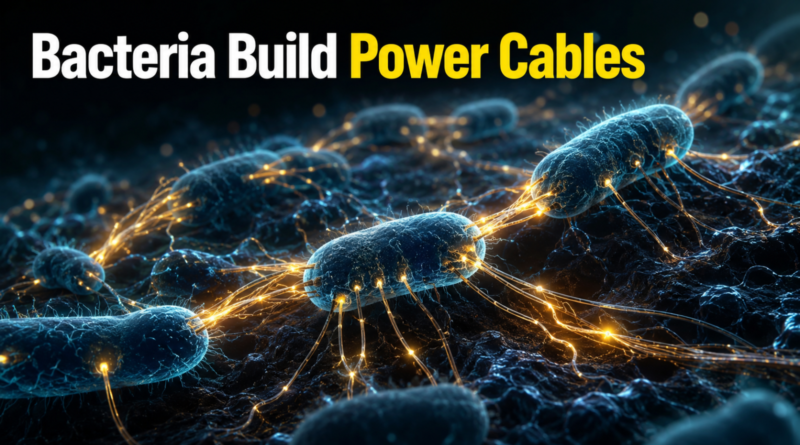
Bacteria Build Microscopic ‘Power Cables’ to Boost Energy Production
Table of Contents
01 Event
Monash University researchers discovered that some bacteria build long, hollow filaments that act like microscopic power cables, extending parts of their energy-producing machinery deep into the cell.
02 What Changed?
Biologists had largely assumed that increasing respiratory capacity required more membrane surface or more elaborate membrane architecture. The newly described filaments provide a third strategy by transporting quinones, molecules that carry electrons during respiration.
03 Why It Matters
The discovery changes a basic assumption about how cells organize energy production. It also gives engineers a new biological design principle for moving energy-carrying molecules through extremely small spaces.
04 What It Means for You
There is no consumer device built from this finding yet. The practical possibility is longer-term: researchers say the mechanism could inspire synthetic biology and nanoscale systems designed to capture, transport, or manage energy.
05 Numbers + Context
The team used cryo-electron microscopy, lipid analysis, and molecular modeling and found related genetic systems across hundreds of bacteria, suggesting the mechanism may be widespread. Source: Monash Biomedicine Discovery Institute; study published in Nature Microbiology.
06 Earnyx Takeaway
This is exactly the kind of discovery where the immediate value is understanding what nature already figured out. A bacterial structure evolved to solve an energy bottleneck could eventually give scientists ideas for building better molecular-scale energy systems of their own.


