
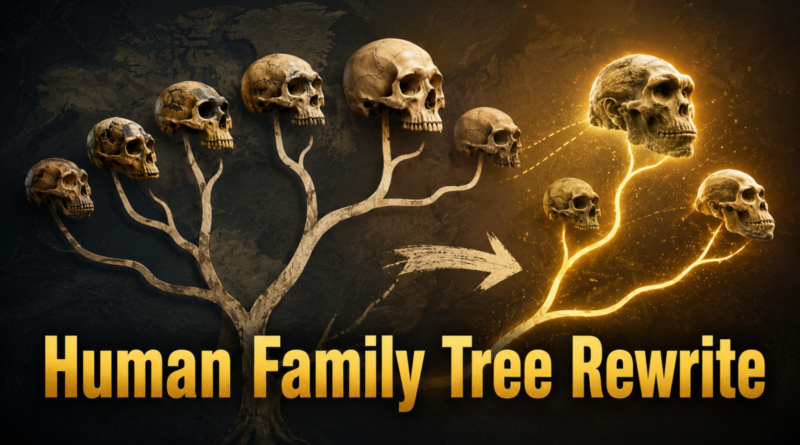
Scientists Say the Human Family Tree May Need a Major Rewrite
Table of Contents
01 Event
New research argues that several famous early human relatives traditionally placed in Australopithecus and Paranthropus may belong inside an expanded genus Homo.
02 What Changed?
The proposal comes from a growing problem in human evolution: traits once used to separate these groups are becoming harder to defend as new fossils and genetic evidence reveal more overlap in anatomy and behavior.
03 Why It Matters
Taxonomy is more than naming. It shapes how scientists describe evolutionary relationships. If the current labels no longer reflect the branching history of our ancestors, a broader classification could make the human family tree more consistent.
04 What It Means for You
This does not mean scientists suddenly discovered a new ancestor. It is a debate over how existing fossils should be grouped. The bigger story is that our evolutionary history keeps looking less like a neat ladder and more like a complex network of closely related populations.
05 Numbers + Context
The proposal would place human species and close fossil relatives from roughly the past 4 to 5 million years within Homo, including Australopithecus and Paranthropus. Source: Monash University via ScienceDaily; study published in the American Journal of Biological Anthropology.
06 Earnyx Takeaway
The useful takeaway is not that textbooks are instantly wrong. It is that classifications change when evidence improves. If researchers increasingly agree that old boundaries no longer fit the fossils, the labels we use for our own ancestry may become much simpler—and more accurate.



Pingback: Dark Matter: LUX-ZEPLIN Records Possible WIMP-Like Event