
Dark Matter Experiment Records a Possible WIMP-Like Event, but Scientists Stop Short of a Discovery
Table of Contents
01 Event
Scientists working on the LUX-ZEPLIN dark-matter experiment have reported a particle interaction that may be consistent with a WIMP, one of the leading hypothetical candidates for dark matter. The event was recorded deep underground at the Sanford Underground Research Facility in South Dakota.
The researchers are being deliberately cautious. Reuters reported that the team observed a single interaction involving a xenon atom and another particle that appeared to behave in the way a WIMP might. The scientists are not claiming a discovery because one event does not meet the statistical threshold required to say dark matter has been directly detected.
Lead author Sam Eriksen of the University of Bristol described it as something that “could be the first hint” of a dark-matter observation, while the team emphasized that other explanations still need to be ruled out.
02 What Changed?
Dark matter has been inferred for decades from its gravitational effects, but scientists have not directly identified the particle or particles responsible for it. The LUX-ZEPLIN experiment is designed specifically to detect extremely rare interactions between hypothetical dark-matter particles and ordinary matter.
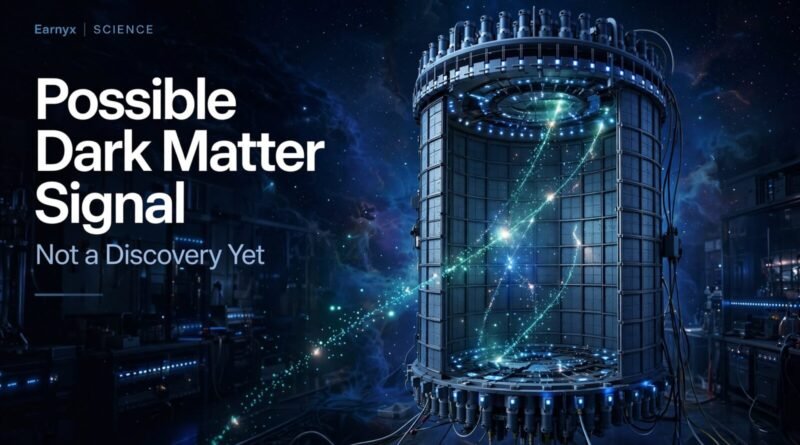
The detector uses about 10 tons of liquid xenon inside a vessel located roughly a mile underground. The underground location helps shield the experiment from cosmic rays and other background signals that could imitate the rare events scientists are trying to find.
In the reported event, a particle appears to have struck a xenon nucleus, transferring a small amount of energy. The collision generated a faint ultraviolet flash and a nuclear recoil, which is the type of signature researchers expect from a WIMP interaction.
That makes the event scientifically interesting. It does not make it conclusive.
03 Why It Matters
Ordinary matter—the material that makes up stars, planets and people—accounts for only about 15% of all matter in the universe. The rest is thought to be dark matter. Scientists cannot see it because it does not emit or reflect light, but its gravitational effects are visible in the way galaxies and clusters behave.
If researchers eventually identify the particle behind dark matter, it would answer one of the biggest unresolved questions in modern physics. It could also reshape models of how galaxies formed and how the universe evolved.
The important part of this story is therefore not that scientists have “found dark matter.” They have not. The important part is that a highly sensitive experiment has recorded an event with properties worth investigating further.
That same distinction between an intriguing result and a confirmed breakthrough matters across science. Earnyx has used similar caution in coverage of emerging research such as new evidence that could reshape the human family tree and research using silver nanoparticles to speed DNA assembly.
04 What It Means for You
For non-scientists, the most useful takeaway is how scientific evidence is evaluated. A single unusual event can be important enough to report and study without being strong enough to prove a theory.
Researchers need to determine whether the event could have been produced by background radiation, detector behavior, another known particle or some other source. They also need more data. If similar events appear with the expected characteristics and at a statistically significant rate, the case for a genuine dark-matter interaction would become much stronger.
This is why headlines matter. Calling the result a confirmed detection would go beyond what the researchers themselves are saying. “Possible hint” is the accurate framing at this stage.
05 Numbers + Context
The LUX-ZEPLIN detector contains about 10 tons of liquid xenon and operates roughly 1.6 kilometers underground. Dark matter is thought to represent about 85% of all matter in the universe, while ordinary visible matter accounts for roughly 15%.
WIMP stands for weakly interacting massive particle. The theory is attractive partly because a particle that interacts only very rarely with ordinary matter could be abundant in the universe while remaining extremely difficult to detect in a laboratory.
The team reported only one event with the relevant characteristics. That is the central number to remember because it explains both the excitement and the caution. One event can justify further investigation, but it cannot by itself establish a discovery.
06 Earnyx Takeaway
The LUX-ZEPLIN result is potentially important precisely because the researchers are not overstating it. They saw one event that behaved in a way a WIMP could behave. They are now trying to eliminate more ordinary explanations before drawing a stronger conclusion.
If future data produces additional events with the same expected signature, this could become a landmark result. For now, it is a scientifically credible hint—not proof that the mystery of dark matter has been solved.
Source: Reuters, September 1, 2026.