Model Context Protocol Explained: Why MCP Matters for Connecting AI to Tools
AI assistants become much more useful when they can work with information and software outside the chat window. The difficulty is that every data source and every tool can have a different interface. Model Context Protocol, usually shortened to MCP, is an open protocol designed to give AI applications a more standardized way to discover and connect to external tools, resources and reusable prompts.
Table of Contents
01 What It Is
MCP is best understood as a connection layer between an AI application and outside capabilities. Instead of building a completely custom integration every time an assistant needs access to a database, file system, business application or service, an MCP-compatible server can expose those capabilities in a common format.
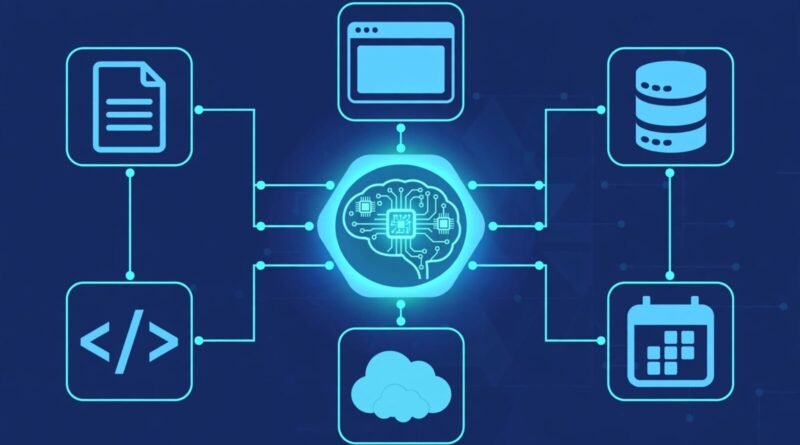
The protocol separates the AI host from the external server. The host might be a desktop assistant, coding environment or other AI application. The server describes what it can provide. According to the MCP specification, servers can expose three major primitives: tools, which let models perform actions or retrieve information; resources, which provide contextual data such as files or schemas; and prompts, which provide reusable prompt templates.
This does not mean MCP makes every service identical. A payroll system, source-code repository and cloud drive still have different capabilities. MCP standardizes how those capabilities are described and requested so an AI client does not need a completely different conceptual interface for each one.
02 How It Works
An MCP client connects to an MCP server and learns what that server exposes. A resource could be a document or database schema. A tool could be a function that searches records, writes a file or calls an API. Prompts can package repeatable workflows or instructions.
The distinction matters because not every capability should be controlled the same way. MCP documentation describes resources as application-controlled, prompts as user-controlled and tools as model-controlled. In practice, a well-designed application can still require human approval before sensitive tools execute. The MCP specification explicitly recommends a human in the loop for tool invocations where trust and safety matter.
MCP also does not replace authentication or permissions. A connection standard can describe a tool, but access to that tool should still be limited by the credentials, scopes and policies of the underlying system. If an AI assistant can reach a finance system, the question is not merely whether the connection works; it is whether the user and the assistant are authorized to perform the requested action.
03 Why It Matters
The biggest promise of MCP is reduced integration friction. Without a shared protocol, an AI product may need one bespoke connector for a file service, another for a CRM, another for a database and another for an internal application. Each integration needs its own discovery logic, input format and error handling. A common protocol can make that ecosystem easier to extend.
This is especially important as AI shifts from answering questions to taking actions. Earnyx has already covered AI agents that can send email and handle payment-related tasks. The more tools an agent can reach, the more valuable standardized connections become—but the consequences of weak permission design also increase.
MCP is therefore not just a convenience feature for developers. It is part of a broader shift toward AI systems that can operate across many applications. If the protocol becomes widely adopted, users may be able to connect one compatible service to multiple AI clients instead of waiting for every vendor to build a proprietary integration.
04 What It Means for You
For ordinary users, MCP may eventually show up less as a visible feature and more as the plumbing behind “connect your tools” experiences. You might authorize an assistant to read project files, search a knowledge base or query a database, while the underlying integration uses MCP.
For businesses, the practical value is potentially larger. Internal systems that expose carefully scoped MCP servers could become accessible to multiple approved AI applications. That can reduce duplicated integration work. But it also creates a governance requirement: organizations need to know which servers exist, what they expose, who can connect, what credentials are used and which actions require approval.
For developers, MCP can reduce the amount of custom glue code needed to make tools discoverable to models. It does not eliminate application logic. You still need validation, authorization, logging, retries, rate limits and safe handling of tool outputs.
05 Numbers + Context
The important “number” in MCP is not a performance benchmark. It is the number of one-off integrations an organization can avoid. If five AI applications each need access to ten internal systems, proprietary pair-by-pair integrations can create a large maintenance burden. A shared protocol does not remove all integration work, but it can reduce how much of that work has to be reinvented.
MCP also sits alongside other tool-use mechanisms rather than replacing them. OpenAI, for example, supports built-in tools, custom function calling and remote MCP connections in its API ecosystem. That illustrates the broader architecture: models can have several ways to reach external capabilities, while MCP provides one standardized path for compatible servers.
06 Earnyx Takeaway
MCP matters because AI is moving beyond isolated chat. The useful assistant of the future is likely to work with files, databases, APIs and business software. A common protocol can make those connections easier to build and reuse.
But standardization should not be confused with safety. MCP can describe and expose a powerful tool; it does not decide whether that tool should be available to a particular user or whether an action should run without approval. The winners will not simply be the systems with the most connectors. They will be the ones that combine useful access with clear permissions, auditability and human control.