Pantry Inventory Systems: The Simple Habit That Prevents Duplicate Grocery Spending
A pantry inventory sounds like a small household habit, but it solves a surprisingly expensive problem: buying food you already own. Cans get pushed behind newer cans, pasta disappears into a cabinet, spices are replaced before the old jar is finished, and snacks expire because nobody remembers they are there. A simple inventory system makes that hidden stock visible before money leaves your account again.
Table of Contents
Why pantry visibility matters
Grocery spending is not only about the price of individual products. It is also about how efficiently a household converts purchases into meals. When food is forgotten, duplicated or allowed to expire, part of the grocery budget produces no value. The U.S. Department of Agriculture provides broader information about food loss and waste, which is a useful reminder that preventing waste begins before food reaches the trash.
A pantry inventory will not eliminate food waste, and it does not need to become a detailed accounting project. Its purpose is narrower: give you enough information to answer three questions before shopping. What do we already have? What needs to be used soon? What actually needs replacing?
Start with the products you buy repeatedly
Trying to catalog every packet and condiment on day one creates unnecessary work. Start with the 15 to 30 products your household buys most often: rice, pasta, canned goods, cereal, sauces, flour, coffee, snacks or other staples. Record an approximate quantity rather than an exact weight. “Two cans of tomatoes” is usually more useful than maintaining a laboratory-grade count.
Choose the simplest format you will actually maintain. A note on the refrigerator, a shared phone note, a spreadsheet or a pantry app can all work. The best system is not the one with the most features; it is the one household members can update in seconds.
Use zones so stock stays visible
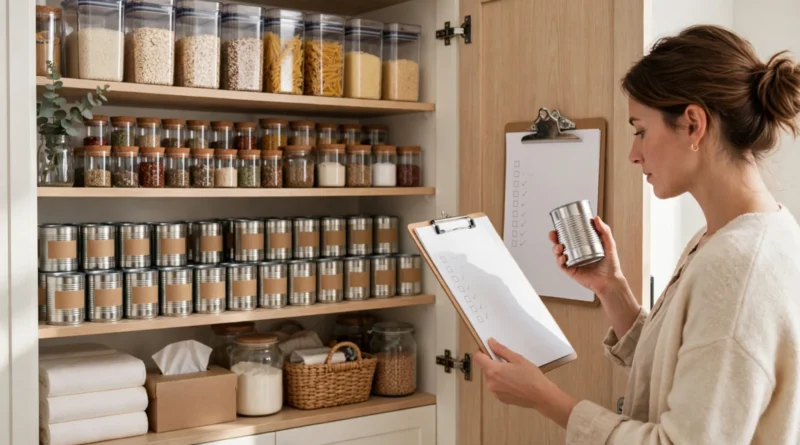
Organization makes the inventory easier to maintain. Group similar items together—breakfast foods in one area, baking supplies in another, canned vegetables together and so on. If every product has a predictable location, checking stock takes less time and duplicate purchases become easier to spot.
Within each zone, move older products toward the front and newer purchases behind them when practical. This first-in, first-out approach is common in food management because it makes older inventory easier to use before newer stock. Always follow package storage instructions and food-safety guidance rather than relying only on visual organization.
Build the inventory into grocery planning
The system becomes valuable when it changes what happens before a shopping trip. Before writing the grocery list, scan the pantry and refrigerator. Cross off items that are already adequately stocked and flag foods that should be used soon. Then build several meals around what is already available before adding new ingredients.
This works especially well with a weekly spending ceiling. Earnyx’s guide to building a weekly grocery budget explains how recurring staples and real eating patterns can be used to create a more realistic grocery target. Inventory visibility makes that budget more accurate because the shopping list reflects what the household truly needs.
How duplicate purchases add up
Imagine a household accidentally spends an extra $10 each month on staples it already has or food that is forgotten before use. That is $120 per year. At $20 a month, the annual amount becomes $240. These are simple illustrations rather than estimates of typical household waste, but they show why a small recurring leak deserves attention.
The financial effect is larger than the wasted item itself when duplication triggers extra shopping trips. A forgotten ingredient can lead to another store visit, where transportation costs and unplanned purchases may be added to the original mistake.
Avoid turning the system into overstocking
An inventory can create a second problem if it encourages stockpiling simply because an item is discounted. A sale is useful only when the household will consume the product before quality deteriorates and when buying extra does not crowd out more important spending.
Set a rough “par level” for frequent staples: the quantity you normally want on hand. For example, you might decide that one unopened jar of a frequently used sauce is enough backup stock. When the backup is opened, the item returns to the shopping list. This creates a simple replenishment trigger without accumulating excessive inventory.
Check unit prices before restocking
Once you know an item genuinely needs replacing, compare the price per unit rather than assuming the largest package is cheapest. Earnyx’s grocery price-per-unit guide explains how to compare package sizes on a common basis. Inventory control and unit pricing solve different problems: one prevents unnecessary purchases, while the other helps make necessary purchases more economical.
Bulk sizes can be good value for products your household uses reliably. They can be poor value for perishable foods, products you are testing for the first time or items that occupy scarce storage space. A pantry system should improve turnover, not simply maximize how much food fits in the home.
Use a short weekly reset
A five-minute review once a week is usually more sustainable than trying to update every item perfectly in real time. Check the most important categories, remove empty packages, note anything running low and identify products approaching their quality or date limits. Then create the next shopping list from that information.
Households with several shoppers can use a shared list so one person does not unknowingly replace something another person already bought. The system is particularly useful for staples that are inexpensive individually but purchased frequently enough to create meaningful annual spending.
What the inventory cannot tell you
A pantry list is a purchasing tool, not a food-safety authority. Follow manufacturer storage directions and official food-safety guidance for questions about whether a product is safe to eat. Dates on packages can have different meanings depending on the product and jurisdiction, so avoid treating a simple spreadsheet as a substitute for appropriate safety information.
Likewise, the inventory cannot decide whether a promotional purchase is worthwhile. It can only tell you how much you already have. Your consumption rate, storage space, cash flow and unit price still determine whether buying more makes financial sense.
Earnyx takeaway
A useful pantry inventory is intentionally boring: a short list, predictable storage zones and a quick check before shopping. That simplicity is what makes it sustainable. By making existing food visible, you reduce duplicate purchases, improve meal planning and make grocery budgets reflect actual household needs. Before searching for a coupon or driving to another store, first check whether the cheapest version of the item is already sitting on your shelf.