Delivery Driver Tips: How Much Do They Add to the Real Cost of Takeout?
Food delivery is usually more expensive than the restaurant menu suggests. The final cost can include higher in-app menu prices, delivery fees, service fees, taxes, small-order charges and a tip for the courier.
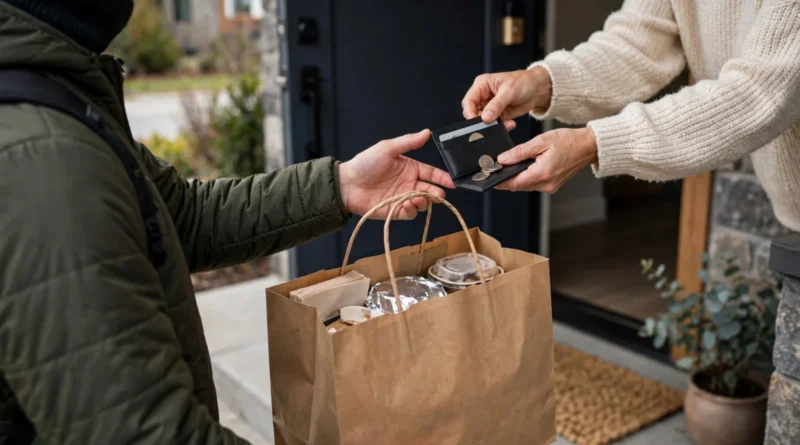
When tipping is customary in your market, the tip is part of the realistic cost of choosing delivery. It may be voluntary, but it still changes what leaves the household budget.
Table of Contents
Start with the full delivered total
The cleanest comparison is not “menu price versus menu price.” It is:
Delivered cost = food subtotal + platform fees + delivery fees + taxes + tip + other checkout charges
Then compare that total with what pickup, dine-in or cooking at home would actually cost.
Delivery fees and tips are not the same thing
A common source of confusion is assuming that a mandatory fee shown by the app is automatically a gratuity. Platforms can label charges differently, and the way fees are allocated can vary by market.
Uber Eats, for example, states in current help documentation that order fees can include delivery and service charges, while its tipping guidance separately describes tips and says the courier receives the tip added through the app. See Uber’s courier tipping guidance.
The practical rule is simple: read the checkout breakdown instead of assuming a charge with “delivery” in the name replaces whatever tip you planned to give.
Suggested tips can change the final price quickly
Delivery apps often present suggested tip amounts or percentages near checkout. A percentage-based tip naturally grows with the food subtotal even when the driving distance stays similar.
That does not mean percentage tipping is wrong. It means the customer should recognize the tip as part of the total before deciding whether the order still fits the budget.
Example: the $35 order that becomes $48
Imagine a $35 food basket with $7 in mandatory delivery and platform charges. The pre-tip total is $42 before any applicable tax. Add a hypothetical $6 tip and the total becomes $48 before tax.
The convenience-related difference is now $13 above the base food subtotal.
If pickup would cost $35 plus $2 of fuel or transit, the economic comparison is closer to $37 versus $48—not $35 versus $35.
These figures are illustrative rather than a claim about current app pricing.
Frequency matters more than one order
A $5 tip can feel small in isolation. Twice a week, that is about $520 over a year. Again, that does not mean the money is wasted. It means recurring convenience spending should be evaluated at recurring frequency.
The same is true of delivery and service fees. A household that orders twice per month has very different economics from one that orders five nights per week.
Track a month of complete delivery spending
Instead of focusing only on tips, record the full delivered total for every order during one month. Separately note the food subtotal.
At the end of the month, calculate:
Delivery premium = total delivered spending − equivalent food subtotal
This exposes how much is being spent on the convenience layer rather than the food itself.
Menu prices can differ from in-store prices
The app price for a meal may not always match the restaurant’s direct or in-store price. Uber’s fee documentation notes that merchants control menu pricing and that prices in the app can differ from prices at the restaurant. See Uber Eats’ fee explanation.
This means the real delivery premium can begin before a delivery fee or tip appears. If you want an accurate comparison, check the restaurant’s direct price when practical.
Memberships do not automatically make delivery cheap
Delivery subscriptions can reduce certain fees on eligible orders, but they also add a recurring membership cost and may not eliminate every charge.
Evaluate the membership separately: annualize its cost, estimate how much it realistically saves on orders you would place anyway, and do not count a waived fee as a saving if the subscription caused you to order more frequently.
A larger order can spread fixed fees
When a platform charges a fixed delivery fee, ordering for several people can reduce that fee per meal. A $6 delivery charge on one entrée is economically different from the same charge on dinner for four.
But larger baskets can also increase percentage-based service fees or tips, so the full checkout total still matters.
Small-order fees can punish frequent tiny orders
Some services add charges below a minimum basket size. If you routinely place very small orders, the cost per item can become especially high.
Consolidating purchases can reduce repeated delivery costs, but do not add food you do not need simply to cross a fee threshold. Spending $10 extra to avoid a $3 charge is not a saving unless you would have bought those items anyway.
Pickup can be the middle ground
Pickup preserves much of the convenience of restaurant food while removing some delivery-specific charges. The trade-off is your own transportation time and cost.
If the restaurant is already on your route home, pickup can have very low incremental cost. If it requires a long detour, parking, or ride-hailing, the difference may be smaller.
Cooking from frozen or prepared food is another alternative
The alternative to takeout does not have to be cooking a complex meal from scratch. Keeping a few convenient meals at home can reduce the number of nights when delivery feels like the only option.
Earnyx’s guide to frozen vs fresh prepared meals compares another convenience trade-off without requiring delivery on every busy night.
Tips should be budgeted intentionally
Tipping practices differ by country, city and delivery model, so there is no universal percentage that Earnyx can sensibly prescribe for every reader.
Where you normally tip, decide on your approach before checkout and include it in the expected price. Weather, distance, order complexity, stairs and unusual access can affect how some customers think about gratuity, but the budgeting principle stays the same: do not treat a predictable tip as a surprise after you have already decided to order.
Do not reduce a delivery decision to the tip alone
If delivery feels too expensive, the largest saving may come from ordering less frequently, choosing pickup, ordering directly, consolidating meals or selecting a less expensive restaurant—not from focusing on the smallest line item.
A $5 tip matters, but a $20 difference in menu pricing and platform charges matters more.
Compare convenience with the time it saves
Delivery can still be rational at a premium. A caregiver, worker on a deadline, person without transportation or household dealing with illness may reasonably value the time and effort saved more than the extra cost.
The goal is not to declare delivery “bad.” It is to see the premium clearly and decide when it earns its place in the budget.
Bottom line
Delivery-driver tips are one part of the real cost of takeout, alongside menu-price differences, platform fees, delivery charges and taxes. Where tipping is customary, include the amount you realistically expect to pay before deciding whether the order is affordable.
Track the complete delivered total, compare it with pickup or other convenient alternatives, and annualize recurring habits. Delivery can be worth paying for, but the decision is much clearer when every predictable dollar—including the tip—is visible before you press order.