
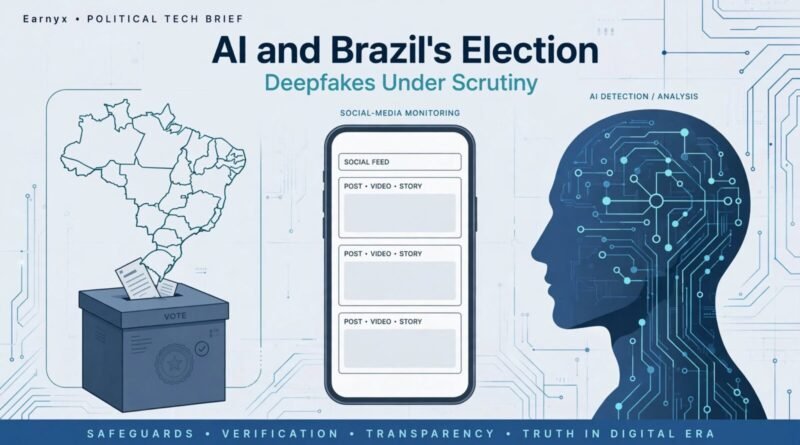
Brazil Tightens AI Election Rules as Deepfakes and Chatbots Test Campaign Safeguards
Table of Contents
01 Event
Brazilian election authorities are moving to tighten controls on artificial intelligence as AI-generated political content spreads across social media ahead of the country’s October 4 presidential election.
Reuters reported that Brazil’s Superior Electoral Court, known as the TSE, is expected to clarify new limits on AI-generated and altered political content. The immediate case involves Senator Flávio Bolsonaro, whose party convention used an AI avatar of his father, former President Jair Bolsonaro, who is under house arrest and prohibited from addressing the public.
The dispute has pushed a broader question to the center of the election: when does AI-generated campaign material become misleading enough to threaten the integrity of the vote?
Olhar Digital background video: Brazil’s 2026 election rules on AI-generated content, deepfakes and disclosure requirements.
02 What Changed?
Brazil already has expanded AI restrictions for the 2026 election. Reuters reported that the rules include mandatory labels for AI-generated content, bans on deepfakes and candidate-recommendation systems, and a blackout on publishing or paid promotion of new AI-generated material immediately before and after voting.
The TSE is now being asked to define more clearly what counts as a deepfake. That matters because campaign AI can range from obviously fictional memes and stylized promotional videos to highly realistic content that depicts events that never happened.
Supporters of both major candidates have used AI-generated material, though Reuters reported that Bolsonaro-aligned accounts have embraced it more aggressively than President Luiz Inácio Lula da Silva’s campaign.
03 Why It Matters
The core problem is not that every AI-generated image or video is deceptive. Some campaign content is plainly creative or satirical. The risk increases when a realistic synthetic video or audio clip presents a false event as if it were real.
That creates a verification problem for voters. Social platforms can distribute a convincing fake much faster than courts, journalists or campaigns can investigate and correct it.
Reuters reported that the TSE received 19 cases involving AI in the first 11 days of the campaign. In early August, a TSE justice ordered the removal of a video that falsely portrayed Bolsonaro with former banker Daniel Vorcaro in situations that did not occur.
The story connects with Earnyx’s coverage of AI-generated video and entertainment. The same technology that lowers the cost of creative production can also lower the cost of producing persuasive political fakes.
04 What It Means for You
For voters, the practical lesson is to treat emotionally charged political media as something to verify before sharing. A realistic face, voice or video no longer proves that an event happened.
For platforms and AI developers, Brazil’s rules create a more direct responsibility question. The TSE has banned generative-AI systems from recommending or ranking candidates, even when users ask them to do so. Yet Reuters cited an ITS Rio study finding that seven widely used chatbots ranked or ordered candidates in 90% of their responses during testing.
That gap between written rules and actual system behavior is likely to become one of the most important enforcement questions as AI becomes part of ordinary political research.
05 Numbers + Context
The first round of Brazil’s presidential election is scheduled for October 4, 2026. The TSE had received 19 AI-related complaints in the first 11 days of campaigning, according to court data cited by Reuters.
A survey from the Fundação Itaú Observatory found that AI is already part of the daily lives of 75% of Brazilians. Another survey by Projeto Brief found that nearly 63% of voters were willing to consult AI tools about candidates.
Reuters also cited an ITS Rio study in which seven widely used chatbots ranked or ordered candidates in 90% of responses despite the TSE’s rule against candidate recommendation systems.
Those figures show why the issue is larger than campaign advertising. AI is becoming part of how voters search for and interpret political information.
06 Earnyx Takeaway
Brazil’s election is becoming an early test of whether rules designed for social-media misinformation can keep up with generative AI. Labels and deepfake bans can help, but enforcement becomes difficult when synthetic content is cheap to produce and chatbots themselves can influence how voters compare candidates.
The safest standard for voters is straightforward: verify important political claims through multiple credible sources, especially when a video or audio clip appears unusually dramatic or perfectly timed to provoke outrage.
The technology itself is not proof of manipulation. The problem is when synthetic media is used to make false events look real or when automated systems quietly cross rules intended to keep them neutral.
Source: Reuters, September 1, 2026.