
Britain Records Its Hottest Summer on Record for a Second Consecutive Year
Table of Contents
01 Event
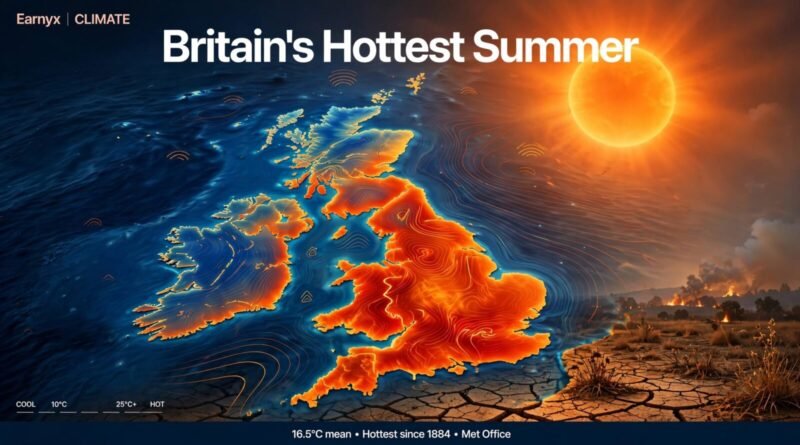
Britain has recorded its hottest summer since national records began in 1884, according to provisional Met Office figures. The average mean temperature for summer 2026 reached 16.5°C, making this the second consecutive record-breaking summer in the United Kingdom.
The season brought sustained heat and drought, an unprecedented number of wildfires and growing pressure on agriculture. The Met Office said human-caused climate change made a summer like this around 130 times more likely than it would have been in a climate without human-generated greenhouse gases.
Reuters reported that Britain’s five warmest summers have all occurred since 2003.
UK Met Office weather context: a June 2026 forecast following another period of record-breaking heat during the summer.
02 What Changed?
The record is significant because it was not driven by a single extreme day. The UK’s highest temperature this summer was 38.1°C in London on August 13, which was only the fifth-highest single-day temperature recorded nationally. What made 2026 exceptional was the sustained average warmth across the season.
That distinction matters. A summer can set an average-temperature record even without producing the hottest individual day, because prolonged warm conditions affect soil moisture, water supplies, crops and wildfire risk over weeks and months.
The UK also broke its summer temperature record in 2025, meaning the country has now set a new seasonal record in consecutive years.
03 Why It Matters
Heat becomes economically important when it lasts long enough to affect infrastructure and production. Reuters reported that drought has been declared across much of the country, while wildfires reached unprecedented levels and in some cases destroyed homes.
Agriculture is another major concern. Britain’s cereal harvest is on track to be the worst since comparable records began in 1984. Heat and low rainfall can reduce yields, increase irrigation needs and raise costs for farmers, with some of those pressures eventually reaching food markets.
This is consistent with broader patterns Earnyx has covered in Europe’s rising economic costs from extreme heat and the effects of extreme climate patterns on food and commodity markets.
04 What It Means for You
For households, extreme heat can affect energy use, food prices, water restrictions and insurance risk. The exact impact varies by location, but repeated hot summers make adaptation more than a one-season issue.
For businesses, the important question is how much operating infrastructure was designed around older climate assumptions. Warehouses, offices, rail systems and public buildings built for milder conditions can face higher cooling costs or reduced performance during prolonged heat.
Consumers should also distinguish weather from climate. One unusually hot day does not prove a long-term trend by itself. A record seasonal average combined with attribution analysis and a concentration of the warmest summers in recent decades provides much stronger evidence.
05 Numbers + Context
The UK’s average mean temperature for summer 2026 was 16.5°C, or 61.7°F. The Met Office said a summer like this would occur roughly once in 1,000 years in a climate without human-generated greenhouse-gas warming.
Under current climate conditions, the agency estimates a similar summer is now roughly a one-in-nine-year event. It also calculated that human-driven climate change made the 2026 summer about 130 times more likely.
Britain’s peak temperature this summer was 38.1°C in London on August 13. Despite being extremely high, that was only the fifth-hottest individual day on record, reinforcing that the seasonal record came from persistent heat rather than one isolated spike.
Comparable cereal-harvest records begin in 1984, and the 2026 harvest is currently expected to be the weakest in that series.
06 Earnyx Takeaway
The most important part of Britain’s record summer is not the headline temperature. It is the persistence. Consecutive record summers, widespread drought, wildfire pressure and agricultural losses show how sustained heat can become an economic and infrastructure issue.
The Met Office’s attribution estimate also gives the story context: this type of summer has shifted from something expected extremely rarely in a pre-industrial climate to something that could recur within ordinary planning horizons.
For households, governments and businesses, that means the cost calculation increasingly includes adaptation—cooling, water management, fire preparedness and agricultural resilience—not just emergency response when a heatwave arrives.
The economic effect will not be identical every year, so one record summer should not be treated as a fixed forecast of future losses. The planning signal is the change in probability described by the Met Office. When an extreme season moves from roughly a one-in-1,000-year event in a climate without human-generated greenhouse-gas warming to about a one-in-nine-year event under current conditions, infrastructure and agricultural planning assumptions need to reflect that higher recurrence risk.
Source: Reuters, September 1, 2026, reporting provisional Met Office statistics.