Open-Weight vs Closed AI Models: What Users Actually Gain or Lose
When an AI model is described as “open,” that word can hide several very different arrangements. Some models publish downloadable weights but restrict certain uses through a custom license. Others release code but not training data. Closed models keep the weights on the provider’s infrastructure and expose access through an app or API. Understanding the difference matters because “open-weight” and “open-source” are not automatically the same thing.
Table of Contents
01 What It Is
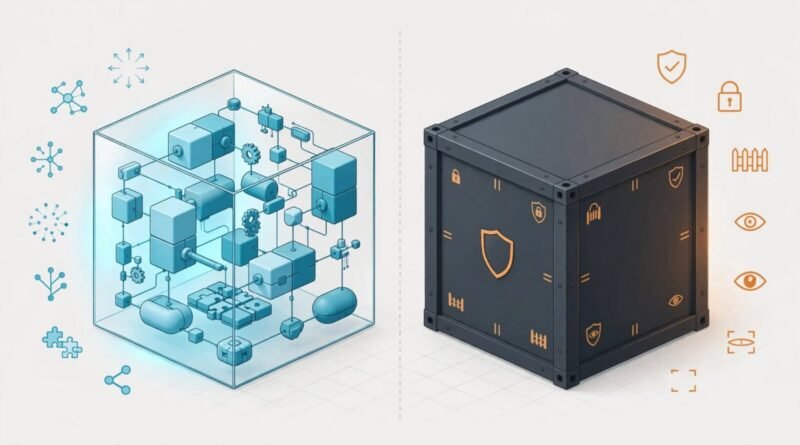
A model’s weights are the learned numerical parameters produced during training. If those weights are available for download, the model is generally described as open-weight. Users can potentially run it on their own hardware or infrastructure, subject to the model’s license and technical requirements.
A closed model keeps those weights private. Users interact through the provider’s application or API. The provider controls the infrastructure, updates, moderation layers and usually the exact version available to customers.
Open-source has a more demanding meaning in software because it normally refers to rights granted by an approved license to inspect, modify and redistribute source code. AI models complicate the concept because a complete system can include training code, weights, datasets, preprocessing, evaluation methods and other components. Releasing weights alone does not necessarily make every part of the model open source.
02 How It Works
With an open-weight model, an organization can download the model files and choose how to serve them. That can mean running locally on a workstation, deploying to a private cloud, quantizing the model to reduce memory requirements or fine-tuning it for a specialized task.
That control comes with operational work. Someone has to provide GPUs or other compute, secure the deployment, manage updates, monitor performance and handle scaling. The model may be free to download while the infrastructure needed to run it is not free at all.
Closed models move much of that operational burden to the provider. A developer calls an API and pays for usage. The provider handles model serving and can roll out improvements without the customer managing weights directly. The trade-off is less control over the underlying model and greater dependence on the vendor’s pricing, policies and availability.
03 Why It Matters
The choice affects privacy, customization, cost structure and vendor dependence. An organization with strict data requirements may prefer a model it can run inside controlled infrastructure. A startup that needs powerful AI immediately may prefer a hosted closed model rather than buying hardware and building an inference stack.
Licensing is equally important. Hugging Face’s model repositories support many license types, ranging from familiar software licenses such as Apache 2.0 and MIT to model-specific community and research licenses. Downloadable weights do not automatically mean unrestricted commercial use. Users need to read the actual license attached to the model.
The economics can also change with scale. API access converts infrastructure into a usage expense. Self-hosting creates its own compute, engineering and operations costs. Earnyx has covered the broader pressure around business AI spending; open-weight models give companies another option, but they do not make AI infrastructure disappear.
04 What It Means for You
For an individual experimenting with AI, open-weight models can provide privacy and control when the hardware is sufficient. Some smaller models can run locally on consumer devices, while larger models may require substantial memory and accelerator capacity.
For businesses, the decision should start with requirements rather than ideology. Ask whether data must remain in a specific environment, whether the model needs custom fine-tuning, whether the team can operate inference infrastructure and how quickly workloads may scale.
Also examine update strategy. Closed providers can improve or change models behind an API, which is convenient but can alter behavior. Self-hosted open-weight models give you version control, but you become responsible for deciding when to upgrade and for testing each change.
05 Numbers + Context
Model size affects infrastructure requirements, but parameter count alone is not a complete cost measure. Precision and quantization can dramatically change the memory needed to load weights. Serving many simultaneous users adds additional memory and compute demands beyond simply storing the model.
The right comparison therefore includes total cost of ownership: hardware or cloud compute, engineering time, monitoring, security, energy, scaling and downtime on the open-weight side versus token charges, vendor limits and possible data-egress or premium-feature costs on the closed side.
Model cards can help users evaluate downloadable models. Hugging Face recommends that model cards describe intended uses, limitations, training information, datasets and evaluation results, alongside license metadata. Those details are especially important when a model is being considered for production rather than experimentation.
06 Earnyx Takeaway
Open-weight models offer control. Closed models offer convenience. Neither category is automatically cheaper, safer or better.
The strongest reason to choose open weights is when control over deployment, privacy, customization or versioning has real value. The strongest reason to choose closed access is when managed infrastructure and fast access to high-end capability matter more than owning the model files. And before treating any downloadable model as “open source,” read the license. Access to weights is only one part of openness.