Black Friday EV Charger Deals: When Does Buying a Home Charger Make Financial Sense?
A Black Friday discount on a home EV charger can look like an easy way to reduce charging costs, but the hardware is only part of the decision. The real economics depend on how often you charge at home, whether your existing outlet already meets your needs, installation cost, electrical-panel capacity, utility rates, charging speed, and how long you expect to keep an electric vehicle.
A discounted charger makes financial sense when it solves a real charging limitation and the combined hardware-and-installation cost is justified by convenience, avoided public-charging cost, or time saved.
Table of Contents
Start with how you charge today
If overnight Level 1 charging already restores enough range for your daily driving, a faster Level 2 charger may be a convenience upgrade rather than a financial necessity.
If your daily mileage regularly exceeds what your current setup can replenish, faster home charging can reduce dependence on public stations and make EV ownership easier.
The U.S. Department of Energy’s Alternative Fuels Data Center explains the differences between residential charging levels and charging equipment at AFDC electric charging resources.
Hardware price is not the installed price
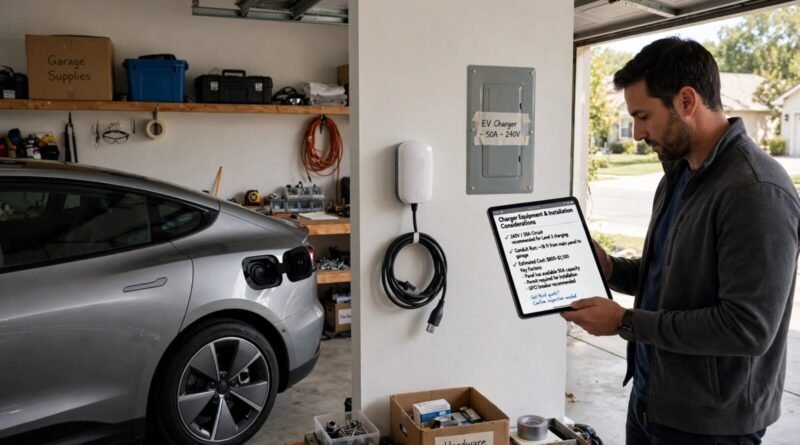
A charger discounted from $600 to $400 saves $200 on hardware, but installation may cost more than the charger depending on the electrical work required.
Potential costs include a new circuit, breaker, wiring, conduit, outlet or hardwiring, permits, labor, and in some homes an electrical-panel upgrade.
These figures are illustrative, not current market quotes.
Get an installation estimate before chasing the sale
A low hardware price is most useful when you already know what installation will require. A charger bought first can create a surprise if the panel lacks capacity or the parking location is far from the electrical service.
For an expensive installation, consider obtaining an electrician’s estimate before purchasing the unit.
Compare Level 1 and Level 2 economics
Level 1 uses a standard lower-power household connection in many U.S. homes, while Level 2 generally uses higher-voltage equipment and can charge substantially faster. The correct choice depends on daily mileage and dwell time.
A commuter who drives modest distances and parks for twelve hours every night may not need faster equipment. A household sharing one charger between two EVs may benefit much more.
Public charging avoidance can create savings
Home charging can be cheaper than frequent public fast charging in many situations, but electricity prices vary by utility, location, and tariff.
Calculate the difference using your own home electricity rate and the public stations you actually use.
Annual charging savings = annual kWh shifted home × difference in cost per kWh
Example: simple payback
Imagine a charger and installation cost $1,200 total. You estimate that better home charging will avoid $300 per year of higher-cost public charging.
The simple payback is four years before considering maintenance, financing, or time value.
If installation costs $2,500 and annual avoided cost is only $100, the payback is much longer. The Black Friday hardware discount does not change that basic relationship.
Time-of-use rates can matter
Some utilities offer lower rates during off-peak periods or special EV tariffs. A networked charger that can schedule charging may make it easier to use those rates.
Do not assume a smart charger automatically saves money. The savings come from the rate structure and charging behavior, not the Wi-Fi connection itself.
Smart features should solve a problem
App control, energy monitoring, load management, utility integration, solar coordination, and scheduled charging can be useful. But a basic charger can be the better value when the vehicle itself already handles scheduling.
List the features your car and utility do not already provide before paying for premium hardware.
Electrical capacity can determine the real project cost
Older homes or heavily loaded panels may not have room for a high-current circuit without additional work. Load-management equipment can sometimes provide alternatives to a full service upgrade, depending on local rules and equipment.
Use a qualified electrician and follow local electrical codes.
Portable versus wall-mounted equipment
A portable charging cable can move with you and may reduce installation complexity when a suitable outlet already exists. A hardwired wall unit can support higher power and cleaner cable management.
Neither is automatically cheaper once installation and future housing plans are considered.
Renters need a different calculation
Renters may have limited ability to modify electrical systems, and the charger may remain with the property depending on the installation.
If you expect to move soon, a large permanent installation can have a short useful life unless the landlord shares the cost or the equipment is portable.
Rebates and incentives can change the break-even
Utilities, states, local governments, and other programs may offer charger or installation incentives, but eligibility and funding change over time.
Check current official programs before buying. Do not assume an incentive exists because it was available in a previous year.
Black Friday should not override compatibility
Verify connector type, maximum current, cable length, indoor/outdoor rating, hardwire or plug requirements, certification, vehicle compatibility, and warranty.
A deeply discounted charger that cannot deliver the installation or power level you need is not a bargain.
Safety certification matters
EV charging equipment handles substantial electrical loads for long periods. Choose equipment that meets applicable safety standards and is installed appropriately.
The charger is not a category where an unknown product should win solely because it is the cheapest listing.
Home charging belongs in total EV cost
Earnyx’s gas vs hybrid vs EV total-cost guide treats charging infrastructure as part of ownership economics rather than an isolated accessory.
If a home charger materially lowers operating cost or improves usability, include the installation in the total EV budget.
When buying on Black Friday is stronger
Buy when you already own or have ordered an EV, you know the installation requirements, faster charging solves a recurring problem, and the discounted unit meets your electrical and vehicle needs.
When waiting is stronger
Wait when Level 1 already meets your driving needs, you are uncertain about installation, you may move soon, or you are buying the charger before deciding which vehicle you will own.
Bottom line
A Black Friday home EV charger makes financial sense when the total installed cost produces enough value through avoided public charging, utility-rate savings, convenience, or multi-vehicle use to justify the investment.
Price the full project—not just the box. Installation, electrical capacity, charging behavior, utility rates, compatibility, and expected years of use determine whether the discount is meaningful.