
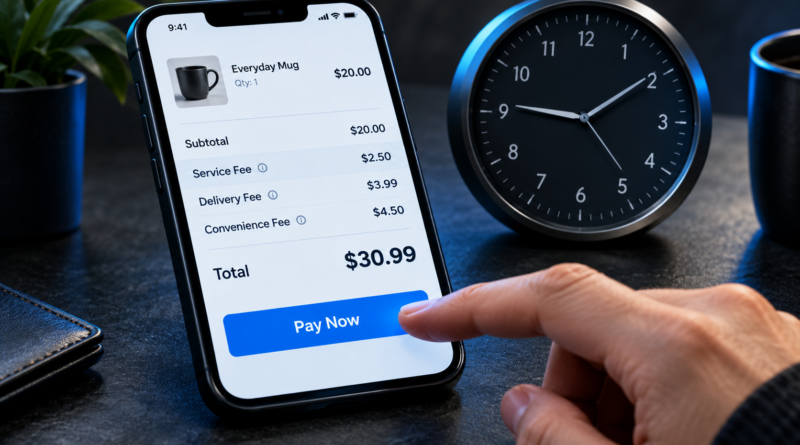
The Convenience Fee Problem: How Much Are We Paying Just to Save a Few Minutes?
Convenience has a price, but we rarely total it. A few pesos to pay a bill online, a delivery fee because going out takes too long, or a service charge at checkout rarely feels large enough to reconsider on its own.
Table of Contents
01 Event
Convenience fees have become a normal part of digital payments, food delivery, booking, and platform-based services. The individual charge is usually small; the cumulative cost can be much larger.
02 What Changed?
Current Philippine examples show how quickly these charges can spread. Globe lists convenience fees ranging from ₱5 to ₱15 across several bill-payment partners, with a ₱7 charge for some postpaid payments through GCash. Jollibee’s official delivery help page lists a flat ₱49 delivery fee for orders through its website or app.
Neither fee is inherently unreasonable. Payment processing and delivery cost money. What changes the economics is frequency.
03 Why It Matters
Small charges are easy to ignore because they are attached to larger purchases. That makes convenience spending hard to see in a normal budget. The real cost appears only when you separate the extra fee from the product or service itself.
The same pattern appears in subscriptions and platform fees: individually small amounts become meaningful when they repeat. See our breakdown of how small recurring charges become large annual costs.
04 What It Means for You
Do not automatically avoid convenience fees. Compare the fee with the real alternative cost: travel, fuel, parking, waiting time, and the value of your time. A ₱49 delivery charge can be excellent value if it saves an hour of traffic and transport. A ₱7 payment fee may be cheaper than travelling to a payment center.
For one month, create a budget line called Convenience and put every delivery, service, platform, and payment fee there. Do not include the underlying purchase—only the extra charge paid to make the transaction easier.
05 Numbers + Context
Consider a deliberately ordinary month:
- Four ₱49 food-delivery fees: ₱196
- Four ₱7 bill-payment fees: ₱28
- Four other ₱15 transaction charges: ₱60
- Total: ₱284/month
- Annualized: ₱3,408/year
This example excludes markups, subscriptions, priority fees, small-order fees, tips, transport, and impulse purchases made easier by convenience itself. The point is not that ₱284 is financially devastating; it is that most people can tell you what lunch cost but not what they spent simply making transactions easier.
06 Earnyx Takeaway
The goal is not to eliminate convenience. It is to make sure the convenience you buy is actually worth the fee.
At the end of the month, ask: Which charges genuinely saved meaningful time or hassle, and which ones did I pay simply because I stopped noticing them?
Sources: Globe convenience-fee guide; Jollibee delivery fee; Philippine government electronic-payment guidance.
Pingback: Your “Cheap” Subscriptions May Be Costing More Than Your Biggest Purchase - Earnyx
Pingback: Selling Online as a Side Hustle: The Fees People Forget to Calculate - Earnyx
Pingback: Your Online Behavior Could Be Changing the Price You Pay. The FTC Wants Disclosure - Earnyx
Pingback: The Convenience Economy: How Much Are We Paying Just to Save Time? - Earnyx
Pingback: How Much Is Your Time Actually Worth? - Earnyx