
Owning a Car vs. Using Grab: At What Point Does One Actually Become Cheaper?
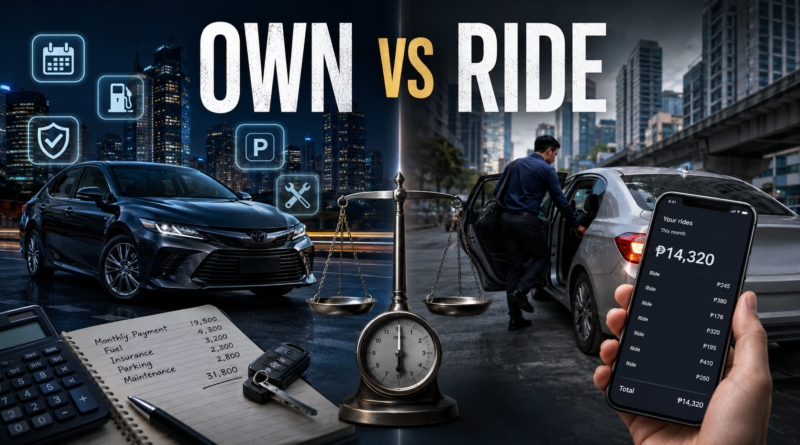
A ₱400 Grab ride feels expensive because you see the whole cost immediately. A car trip can feel cheaper because the fuel used on that trip may only be a fraction of the fare. But that is not the real comparison.
Table of Contents
01 Event
The real question is whether owning a car or using ride-hailing is cheaper at your actual level of travel.
02 What Changed?
Car ownership bundles financing or depreciation, insurance, registration, maintenance, tires, parking, fuel, and tolls into one decision. Ride-hailing flips the structure: there is little fixed cost, but you pay directly for each trip. Grab says Philippine GrabCar fares are shown upfront and can vary with distance, demand, supply, traffic, and estimated journey time.
03 Why It Matters
Comparing only gasoline with a Grab fare makes ownership look artificially cheap. Fixed costs exist before the car even moves. That means utilization—the amount you actually drive—is one of the biggest variables in the economics.
A car costing ₱25,000 a month all-in and traveling 1,500 km has a very different effective cost from the same car traveling only 300 km.
04 What It Means for You
Use your own last three months of spending. For ownership, include everything, not just fuel. For Grab, use actual app history rather than a guessed fare. Then compare monthly total cost, cost per trip or kilometer, and the convenience you are buying with the difference.
If you are still deciding whether to buy a vehicle at all, also compare our Gas vs Hybrid vs EV total-cost guide.
05 Numbers + Context
Consider an illustrative monthly ownership example:
- Financing/depreciation allocation: ₱15,000
- Insurance/registration: ₱2,000
- Maintenance/tires reserve: ₱2,000
- Parking: ₱3,000
- Fixed monthly cost: ₱22,000 before fuel and tolls
If comparable ride-hailing spend is only ₱12,000 a month, ownership does not become cheaper simply because individual car trips feel inexpensive. But with daily commuting, school runs, weekend travel, or multiple family users, the ride-hailing bill can eventually overtake ownership cost.
Time belongs in the calculation too. Owning gives immediate access, but also means driving, parking, maintenance, and administration. Ride-hailing can convert driving time into passenger time, but introduces waiting and surge pricing.
06 Earnyx Takeaway
There is no universal winner. The cheaper option depends on your actual utilization and the fixed costs you are carrying.
The correct question is not “Is owning a car cheaper than Grab?” It is “At my level of use, what am I paying for each option—and what convenience am I buying with the difference?”
For a personalized calculation, use our Car vs Grab break-even calculator.
Sources: GrabCar Philippines and Grab Philippines fare information. Ownership figures above are illustrative.


owning a car for time saving
Pingback: Gas vs Hybrid vs EV: Which One Really Costs Less to Own? - Earnyx
Pingback: How Much Is Your Commute Really Costing You Every Month? - Earnyx
Pingback: Car vs Grab Calculator: Find Your Monthly Break-Even Point - Earnyx