
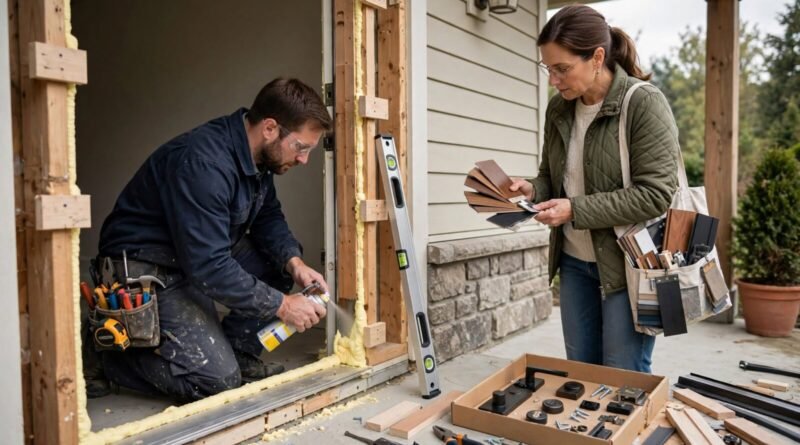
Door Replacement Costs: How to Compare the Door, Frame, Hardware, and Installation
A replacement door can look inexpensive in a store and become a much larger project once the frame, threshold, weatherstripping, locks, trim, paint, siding, and wall opening are included. The price also changes depending on whether you replace only the slab or the entire prehung assembly.
The useful comparison is the complete installed opening, not the retail price of the door alone.
Table of Contents
Slab replacement and prehung replacement are different projects
A slab replacement reuses the existing frame and requires the new door to fit the current opening, hinge locations, and hardware. A prehung replacement includes a new frame and can address a damaged, out-of-square, or poorly sealed opening.
Compare quotes only after confirming which approach is being priced.
The frame can be the real problem
Rot, water intrusion, insect damage, failed seals, movement, or a damaged threshold can make slab-only replacement poor value.
If the old frame is compromised, installing a new door into it can leave the original problem untouched.
Exterior doors need weather management
Flashing, sill pans, sealants, threshold details, and integration with siding or masonry affect water and air leakage.
A low-cost installation that focuses only on hanging the door can create expensive wall or floor damage later.
ENERGY STAR ratings can help compare efficiency
ENERGY STAR provides criteria for qualified exterior doors. Product ratings can help compare thermal performance, but installation quality still matters.
Do not expect a new door to produce large utility savings if the old door was already reasonably tight and the rest of the home has larger air leaks.
Security features change cost
Deadbolts, multipoint locks, reinforced strike plates, smart locks, sidelights, glass inserts, and impact-rated products can add cost.
Choose the hardware and security level you actually need rather than comparing a basic door with a fully upgraded unit.
A hypothetical quote comparison
Suppose Installer A quotes $1,800 for a prehung exterior door, while Installer B quotes $2,700. Installer B includes rot repair, new flashing, threshold work, upgraded hardware, interior trim, exterior trim, and painting.
The $900 difference is not simply a higher door price.
These figures are illustrative.
Custom sizes can change the economics
Older homes and architectural openings may not match current standard sizes. A custom unit or modification to the rough opening can increase material and labor.
Ask whether the quote assumes a stock size or custom fabrication.
Glass affects privacy, efficiency, and security
Decorative glass, sidelights, transoms, low-emissivity coatings, impact-resistant glass, and privacy treatments can all change cost and performance.
Compare the exact glass package, not only the door style.
Interior doors have a different cost structure
Interior door replacement usually has fewer weatherproofing requirements but can still involve jambs, casing, hardware, paint, floor clearances, and wall alignment.
A solid-core door can also cost more and weigh more than a hollow-core option.
Lead-safe requirements can apply
In U.S. homes built before 1978, replacing doors can disturb painted surfaces and may trigger EPA Renovation, Repair and Painting requirements.
Use qualified contractors and compare compliant scopes.
Paint and finishing should be defined
Some doors arrive primed but not finished. Exterior units often need proper finishing on all required surfaces under manufacturer instructions.
Ask who paints or stains the door and whether the finish is included in the warranty conditions.
Smart locks create recurring or replacement costs
Electronic locks can add batteries, connectivity, subscriptions in some ecosystems, and future hardware replacement. These features can still be useful, but they should be treated separately from the cost of the door itself.
Internal home-efficiency context
Earnyx’s insulation versus new windows analysis illustrates the broader principle: building-envelope upgrades should target the actual source of leakage or discomfort rather than the most visible component.
Normalize door quotes
Compare:
- slab versus prehung;
- door material;
- frame and jamb;
- threshold;
- flashing and sealants;
- hardware;
- glass;
- trim;
- paint or stain;
- lead-safe work where applicable;
- disposal;
- and warranties.
Bottom line
Door replacement cost is the price of restoring the entire opening, not simply purchasing a panel.
Inspect the frame, water management, threshold, hardware, and trim before comparing bids. The cheapest door installation is poor value if the new unit still leaks air or water because the opening was never repaired correctly.