
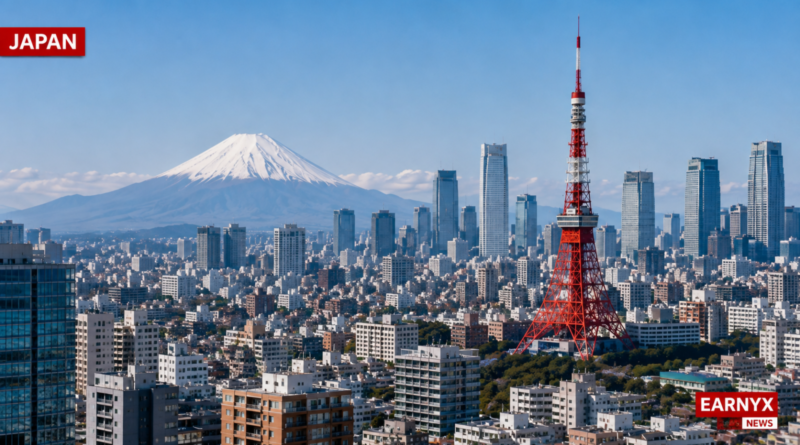
Magnitude 5.9 Earthquake Shakes Tokyo Region, Injuring at Least 37
Table of Contents
01 Event
A magnitude 5.9 earthquake struck eastern Japan early Sunday, August 23, shaking Tokyo and surrounding prefectures and injuring at least 37 people across five prefectures, according to the Associated Press.
The Japan Meteorological Agency (JMA) placed the epicenter in southern Ibaraki Prefecture at about 2:00 a.m. local time, at a depth of roughly 70 kilometers. The agency recorded a maximum seismic intensity of lower 5 on Japan’s seven-point scale. No tsunami warning was issued.
Sources: Japan Meteorological Agency; Associated Press.
02 What Changed?
The quake was strong enough to trigger emergency mobile alerts and disrupt parts of the Tokyo region during the early-morning hours. AP reported delays affecting several express trains serving Tokyo and Narita Airport, while Shinkansen bullet-train operations were not disrupted.
Most reported injuries were minor, including people hurt after being startled awake and falling or striking furniture. AP reported that an elderly woman in Yokohama suffered a serious hip injury. A water pipe also ruptured in Tokyo’s Koto ward and was subsequently repaired.
Japan’s government established a task force to assess the situation. Authorities reported no irregularities at nuclear power facilities, and the absence of a tsunami threat reduced the risk of a broader coastal emergency.
03 Why It Matters
A magnitude number alone does not determine how disruptive an earthquake will be. Depth, location, local geology, building design and proximity to dense population centers all matter. This quake occurred beneath a region connected to one of the world’s largest metropolitan economies, so even moderate shaking can affect transportation, utilities and daily activity across a very large population.
The event also demonstrates why Japan invests heavily in earthquake-resistant construction, early-warning systems and rapid infrastructure checks. The quake produced notable shaking across the Tokyo area, but the initial reports point to limited structural and infrastructure damage rather than a catastrophic urban disaster.
04 What It Means for You
For people in eastern Japan, the immediate issue is aftershock risk. JMA has advised continued caution following the earthquake. Residents should pay attention to official alerts, secure objects that may have shifted during the initial shaking and verify transportation conditions before traveling.
For travelers, the most practical concern is temporary disruption rather than widespread shutdown. Rail services and airport connections can be delayed while operators inspect infrastructure after significant shaking, so checking official train and airline updates before departure is sensible.
For people outside Japan, the event is also a reminder that earthquake headlines should be read beyond the magnitude figure. A 5.9 event beneath a densely populated region can have a very different impact from an earthquake of similar magnitude in a remote area.
05 Numbers + Context
- Magnitude: 5.9, according to the JMA’s reviewed event information.
- Time: About 2:00 a.m. local time on August 23.
- Epicenter: Southern Ibaraki Prefecture.
- Depth: About 70 kilometers.
- Maximum observed intensity: Lower 5 on Japan’s seismic intensity scale.
- Reported injuries: At least 37 across five prefectures, according to AP.
- Tsunami: No tsunami alert was issued.
JMA observations also show long-period ground motion reaching level 2 in southern Saitama, northwestern Chiba and Tokyo’s 23 wards. Those longer-period motions are especially relevant to taller buildings, which can sway differently from low-rise structures during an earthquake.
06 Earnyx Takeaway
The important part of this earthquake is not simply that Japan experienced another magnitude 5.9 tremor. It is the contrast between the size of the exposed urban area and the relatively contained initial damage.
That makes this an infrastructure-resilience story as much as a natural-disaster story. Emergency warnings, building standards, transport inspections and utility response do not prevent earthquakes, but they can determine whether a moderate event becomes a mass-casualty disaster or a disruptive but manageable emergency.
The next thing to watch is not the headline magnitude—it is whether aftershocks produce additional injuries or infrastructure problems and whether transportation and utilities return fully to normal. For readers, that distinction matters: breaking-news magnitude figures describe the geological event, while injuries, service interruptions and recovery time describe its real economic and human impact.