
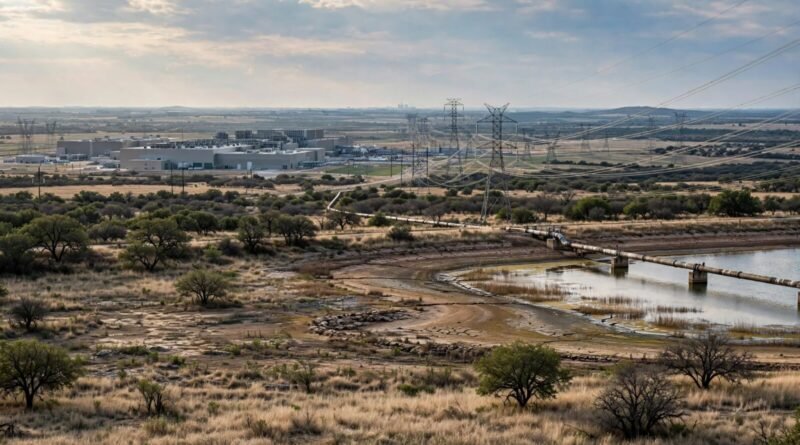
Texas Freezes New Data-Center Permits as AI Power and Water Demands Face Review
Texas has put new data-center permitting on hold while state regulators review the growing demands that large computing facilities are placing on electricity, water and other infrastructure.
Reuters reported on September 22 that Governor Greg Abbott directed regulators to freeze new permits during an audit of the sector’s infrastructure requirements. The move arrives as Texas has become one of the most important U.S. markets for large data centers, helped by available land, energy resources and a business-friendly development environment.
The pause highlights a constraint that is becoming central to the economics of artificial intelligence: models may be digital, but the infrastructure running them depends on very physical resources.
Table of Contents
Why data centers are testing the Texas grid
AI data centers can require hundreds of megawatts of electricity, and the largest planned campuses can reach gigawatt-scale demand. Connecting loads of that size is not comparable to adding an ordinary commercial building.
Utilities and grid operators may need new transmission lines, substations, transformers and generation. Those projects can take years, creating a mismatch between the speed at which technology companies want to deploy computing equipment and the pace at which energy infrastructure can expand.
Texas is particularly important because its ERCOT grid operates largely separately from the major eastern and western U.S. interconnections. The state has added substantial renewable generation, but it also has to manage periods of extreme heat and other weather events that can sharply increase electricity demand.
Water is becoming part of the AI infrastructure debate
Electricity receives most of the attention, but data centers can also consume significant amounts of water depending on their cooling systems. In regions facing drought or rapid population growth, large industrial water users can become politically sensitive.
Not every facility uses the same cooling architecture. Some systems minimize water use but consume more electricity, while others rely more heavily on evaporative cooling. Location, climate and workload all affect the trade-offs.
A statewide review gives regulators an opportunity to examine those differences rather than treating every proposed data center as identical.
The hidden infrastructure bill behind AI
Technology companies typically describe AI investment in terms of chips, models and software. Yet a functioning AI campus also requires land, grid connections, backup power, cooling equipment, fiber networks and skilled construction labor.
Those supporting investments can shift costs beyond the data-center owner. Utilities may need infrastructure upgrades whose costs are ultimately allocated among customers, depending on local regulation and contract structures. Communities may also need roads, water systems and emergency services.
This is why permitting debates increasingly focus on who pays for infrastructure and whether large computing customers bear an appropriate share of the costs they create.
A pause does not necessarily mean Texas is rejecting data centers
A permitting freeze can slow development without representing a permanent ban. Texas has strong incentives to attract technology investment, construction activity and high-value infrastructure. At the same time, approving projects faster than the grid can serve them creates reliability and cost risks.
The review could therefore lead to new connection rules, infrastructure requirements or cost-sharing arrangements rather than an outright retreat from data-center development.
AI developers face a new kind of bottleneck
For years, the primary constraint on AI expansion was access to advanced chips. Hardware supply remains important, but electricity availability is increasingly becoming an equally important limitation.
A company can order thousands of accelerators and still be unable to deploy them if a site cannot obtain enough power. Grid queues, transformer shortages and construction timelines can turn energy infrastructure into the critical path for an AI project.
This dynamic is already influencing where companies build. Regions with available generation and faster interconnection processes can become more attractive even if land or labor costs are higher.
What the Texas review could change
One question is whether large data centers will face stronger requirements to provide their own generation or participate in demand-response programs. Flexible loads could theoretically reduce consumption during grid emergencies, although the operational requirements of AI workloads may limit how much demand can be shifted.
Another issue is financial security. Regulators may want developers to commit capital before utilities build expensive infrastructure, reducing the risk that speculative projects reserve grid capacity and later disappear.
Water-use reporting and efficiency standards could also become more prominent, especially in communities where local supplies are constrained.
The broader lesson for the AI boom
Texas is a useful case study because it combines rapid economic growth, a large energy market and intense interest from data-center developers. If infrastructure limits are appearing there, similar tensions are likely elsewhere.
AI investment is increasingly colliding with planning systems built for slower-moving industrial demand. Power plants, transmission lines and water projects often take much longer to approve and construct than a technology company’s product cycle.
That mismatch can affect the pace and cost of AI deployment globally.
Bottom line
Texas’s permitting pause shows that the AI infrastructure boom is entering a more constrained phase. The question is no longer simply how many chips companies can buy. It is whether communities and grids can support the facilities those chips require.
The review could produce new rules around power connections, water use and infrastructure costs. Whatever Texas decides, the underlying challenge will remain: AI demand is growing on software timelines, while the electricity and water systems supporting it expand on infrastructure timelines. Reconciling those two speeds may become one of the defining economic problems of the next stage of the AI boom.


