
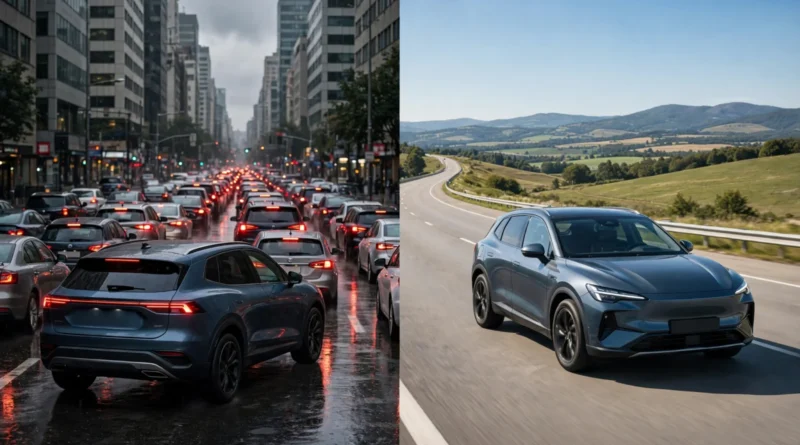
City vs Highway Fuel Consumption: Why the Same Car Can Use So Much More Fuel
The same car can return very different fuel economy in city traffic and on the highway. That is not a contradiction in the vehicle’s rating. City and highway driving ask the powertrain to do different work.
Stop-and-go traffic repeatedly uses energy to accelerate the vehicle and then throws much of that energy away through braking. Highway driving usually involves fewer stops and steadier speed, although very high speeds increase aerodynamic drag. The result is that your real fuel cost depends heavily on where and how you drive.
Table of Contents
Why city driving usually uses more fuel
In urban traffic, a vehicle may accelerate from a stop dozens of times during a short trip. Every acceleration requires energy. In a conventional gasoline car, much of that energy is later lost as heat when the brakes slow the vehicle.
Traffic lights, congestion, parking searches, idling and short trips also reduce efficiency. Even if the route covers only a few miles, the engine may spend significant time running without moving the car very far.
Why highways can be more efficient
Once a car reaches a steady cruising speed, it can often maintain that speed with less repeated acceleration. Engines and transmissions can operate closer to efficient conditions, and the vehicle covers more distance for each minute the engine is running.
That does not mean faster is always better. At higher speeds, aerodynamic drag rises and the engine must use more energy to push air out of the way. The most efficient highway speed therefore depends on the vehicle, road, gearing, weather and traffic.
The U.S. Department of Energy’s FuelEconomy.gov driving guidance explains how speed, aggressive driving and other habits can affect fuel consumption.
Official city and highway ratings are test results, not guarantees
Fuel-economy labels provide standardized estimates so consumers can compare vehicles. Your personal result can be higher or lower because real-world conditions differ from a laboratory test.
Trip length, temperature, terrain, congestion, tire pressure, passenger load, cargo, air conditioning and driving behavior can all change consumption. The useful role of the rating is comparison, not a promise that every driver will achieve exactly the displayed number.
Short city trips can be especially inefficient
A short trip can use disproportionately more fuel because the engine and other systems may not spend much time at normal operating temperature. Repeatedly driving a few miles, shutting the car off, and starting again later can produce worse fuel economy than combining those errands into one longer trip.
That means two drivers with the same “city mileage” can still have different results. One may drive a continuous 15-mile urban commute; another may make several separate two-mile trips.
Traffic makes the city-highway gap wider
Not all city driving is equally inefficient. A lightly trafficked urban road with long stretches between lights may be much easier on fuel than gridlocked traffic that moves a few car lengths at a time.
A useful way to think about the problem is average speed. If a car spends 45 minutes traveling only 10 miles, the engine, climate system and accessories have been operating for a long time relative to the distance covered.
Hybrids can change the pattern
Hybrid vehicles can narrow—and sometimes reverse—the conventional city-highway relationship because regenerative braking can recover part of the energy that would otherwise be lost during deceleration. The electric motor can also assist at low speeds and reduce engine idling.
That does not mean every hybrid is more efficient in every urban condition, but it explains why some hybrids post city ratings that are close to or even better than their highway ratings.
Earnyx’s guide to gas, hybrid and EV total cost looks at how those drivetrain differences affect the larger ownership decision.
Electric vehicles also respond differently
Electric vehicles avoid engine idling and can recover energy through regenerative braking, so stop-and-go traffic does not create exactly the same fuel-efficiency penalty as it does for a conventional gasoline vehicle.
However, EV energy use can still rise with high speeds, aggressive acceleration, heating, cooling, heavy loads and extreme temperatures. City-versus-highway efficiency remains relevant even when the energy source changes.
Example: how driving mix changes annual fuel use
Consider a hypothetical car that averages 24 mpg in city use and 34 mpg on the highway. A driver covering 12,000 miles entirely at 24 mpg would use about 500 gallons. At 34 mpg, the same 12,000 miles would require about 353 gallons.
That is a difference of roughly 147 gallons per year. If fuel were hypothetically $3.50 per gallon, the difference would be about $515 annually. These are illustrative assumptions, not a forecast of current fuel prices or a guarantee for any vehicle.
The exercise shows why a driver’s route can matter as much as a small difference in sticker-price fuel economy.
Use your actual city-highway split
If 70% of your mileage is urban and only 30% is highway, the combined number on a vehicle label may not represent your personal result very well. A vehicle that performs particularly well in city conditions could be more valuable to you than to a driver who spends most of the week on open highways.
Estimate your annual mileage by type of driving. Then compare vehicles using the city and highway figures separately instead of relying only on the combined figure.
Driving style still matters inside each category
Two drivers on the same city route can produce different fuel consumption. Rapid acceleration followed by hard braking wastes more energy than smoother driving when traffic conditions allow. Likewise, very high highway speeds can increase aerodynamic losses.
But driving technique should not distract from the larger structural factor: if your daily route is congested and stop-heavy, the vehicle is operating in a fundamentally different environment than steady highway cruising.
Air conditioning and weather can change both results
Hot weather may increase air-conditioning use, while cold conditions can affect warm-up time and other systems. Climate demands can be particularly noticeable during slow city driving because the vehicle covers less distance while the cabin system continues operating.
Earnyx’s guide to air-conditioning fuel use explains why the effect varies by conditions and vehicle.
Measure consumption over several tanks
To understand your own city-highway pattern, track fuel purchased and distance driven over several fill-ups. One tank can be distorted by a road trip, unusual congestion or an inconsistent fill level.
If possible, note the rough percentage of city and highway mileage for each tank. Over time, the relationship between route mix and fuel use becomes much clearer.
Do not chase highway efficiency by taking a much longer route
A smoother highway route can improve miles per gallon but still use more total fuel if it adds substantial distance. The relevant measure is fuel used for the whole trip, not just the mpg displayed on the dashboard.
For example, a 10-mile city route at 25 mpg uses about 0.4 gallon. A 16-mile highway route at 35 mpg uses about 0.46 gallon. The highway route has better mpg but slightly higher total fuel use because it is much longer.
Bottom line
The same car can use much more fuel in city driving because repeated acceleration, braking, idling and short trips consume energy without producing as much distance. Highway driving often improves efficiency because speed is steadier, but very high speeds can erase part of that advantage through aerodynamic drag.
Use city and highway ratings as comparison tools, then adjust your expectations for your actual route mix. The most useful question is not whether a car has a good combined mpg number. It is how efficiently that car operates in the type of driving you actually do most often.


Pingback: Fuel Economy vs Fuel Price: Which Matters More?