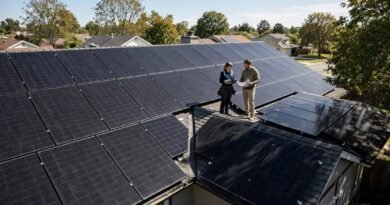

Solar Installer Quotes: How to Compare Prices Without Missing the Expensive Details
Table of Contents
01 Event
Residential solar quotes can look similar on the first page and differ substantially underneath. Two installers may propose systems with comparable headline prices while using different panel quantities, inverter designs, production assumptions, warranties, financing structures and scopes of work.
A useful comparison therefore needs more than total price. The objective is to normalize the proposals so you can see what each dollar is buying and which assumptions drive the projected savings.
02 What Changed?
Solar proposals increasingly bundle equipment, design, permitting, installation, monitoring and financing into one presentation. That makes shopping convenient, but it can obscure differences between cash price and financed cost or between equipment warranty and installation workmanship coverage.
Online production tools also make it easier to sanity-check estimates. NREL’s PVWatts Calculator can provide an independent estimate based on location and system assumptions, although it is not a substitute for a site-specific engineering assessment.
03 Why It Matters
A lower price per watt can be attractive, but it does not automatically mean the quote has better value. Roof work, electrical upgrades, monitoring, service commitments and equipment quality can affect total ownership cost.
Production estimates matter because savings projections depend on them. If one quote assumes materially higher output from a similar roof, investigate why instead of simply accepting the larger savings number.
04 What It Means for You
Ask each installer for the cash price, system size in kilowatts, panel and inverter models, estimated first-year production, degradation assumptions, warranty details and a clear list of included work.
Separate financing from system price. Compare cash-equivalent costs before comparing loan payments. Interest rates, dealer fees and loan terms can make two similar systems produce very different total payments.
Check whether roof repairs, trenching, electrical-panel upgrades, permits, interconnection fees or other site work are included or excluded. The U.S. Department of Energy’s Homeowner’s Guide to Going Solar provides a useful overview of the residential solar process.
Earnyx’s solar system sizing guide explains why the proposed system size should reflect future electricity demand as well as current usage.
05 Numbers + Context
Start with:
Cash price per watt = total cash system price ÷ system capacity in watts
Suppose Quote A is a hypothetical $24,000 for an 8 kW system, or $3.00 per watt. Quote B is $25,500 for an 8.5 kW system, also $3.00 per watt. The equal unit price does not make the proposals equivalent: production, equipment, roof layout and scope still need comparison.
You can also calculate price per estimated first-year kilowatt-hour, but treat that carefully because production is an estimate rather than a guaranteed output.
06 Earnyx Takeaway
The best solar quote is not necessarily the lowest total price or the lowest monthly payment. It is the proposal with a competitive normalized cost, credible production assumptions, appropriate system size and a scope you understand.
Compare identical dimensions across installers. If one quote includes a battery and another does not, separate the battery cost before judging the solar portion.
Review warranties by responsibility. Manufacturer product and performance warranties are different from installer workmanship or roof-penetration coverage.
Ask who handles warranty service if an equipment manufacturer approves a claim. A long warranty is less convenient if labor and troubleshooting responsibilities are unclear.
Examine panel layout. More panels on heavily shaded or poorly oriented roof sections can increase nameplate capacity without producing proportionally more useful electricity.
Ask how production was modeled and whether shading was included. Small differences in assumptions can compound over a long savings projection.
Do not treat future utility rates as certain. Savings projections often depend on assumptions about electricity prices, export compensation and household consumption. Test conservative scenarios.
Likewise, do not assume tax incentives or rebates without confirming current eligibility and rules from authoritative sources. Tax treatment depends on jurisdiction and individual circumstances.
Look at cancellation, deposit and change-order terms. A competitive initial quote can become expensive if common site conditions trigger poorly defined add-ons.
Roof age matters because removing and reinstalling panels later can create additional cost. Coordinate roof and solar planning when replacement is likely.
Check installer credentials and applicable licensing requirements in your jurisdiction. Ask for references and understand which company is contractually responsible for installation and service.
The Earnyx method is to build a one-page comparison table with cash price, watts, estimated annual production, equipment, included work, warranties and financing. Once every proposal is expressed in the same units, meaningful differences become much easier to see.