
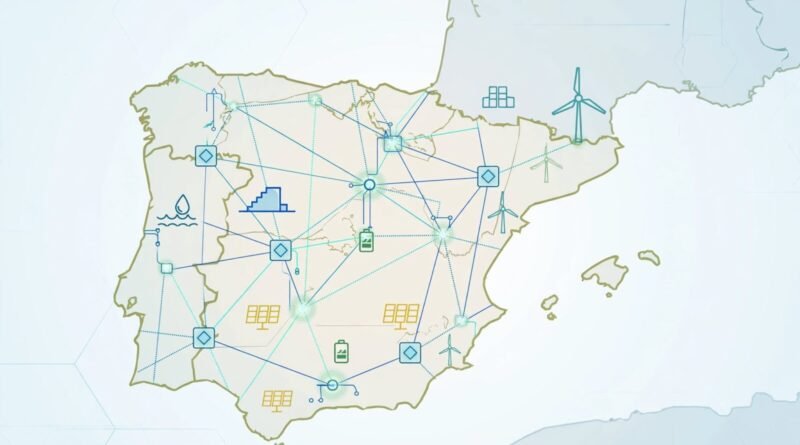
Spain’s Grid Expansion Plan Targets Data Centers and Electrification
Spain is planning a major expansion of electricity-grid investment as data centers, industrial electrification and renewable energy place new demands on infrastructure that was not built for today’s power flows.
Reuters reported on September 17 that the government is proposing roughly 16 billion euros of investment in the electricity grid through 2030. The plan would raise spending compared with the previous framework and is intended to support economic growth and new electricity demand.
The story matters beyond Spain because power availability is becoming one of the most important constraints on the AI and data-center boom. Companies can buy chips and build server halls faster than many regions can expand transmission lines and substations.
Table of Contents
Why grids need large upgrades
Electricity grids were historically designed around large power plants sending electricity toward homes and businesses. Modern systems are more complex.
Solar and wind farms may be located far from major cities. Rooftop solar can send electricity back into local networks. Electric vehicles and heat pumps increase household demand. Data centers can require enormous, concentrated loads.
Accommodating those changes requires new transmission lines, substations, transformers, digital controls and connections.
Data centers are changing electricity planning
AI data centers can consume power on the scale of industrial facilities. They also tend to cluster in regions with strong fiber connections, available land and reliable electricity.
That concentration creates challenges for grid planners. National electricity supply may be adequate while a particular region lacks enough transmission capacity to connect another large facility.
Developers can therefore face years-long waits for grid connections even when construction itself could proceed faster.
Earnyx has examined how billions of dollars are flowing into AI cloud infrastructure. Spain’s grid proposal highlights the other side of that investment: computing capacity ultimately depends on physical energy networks.
Renewable energy creates both opportunity and complexity
Spain has strong solar and wind resources, giving it the potential to supply electricity-intensive industries with lower-carbon power. But renewable generation is variable and often located away from demand centers.
Transmission allows electricity to move from regions with abundant generation to cities and industrial areas. Stronger interconnections can also reduce curtailment, which occurs when renewable plants are capable of producing electricity but the grid cannot absorb it.
Storage and demand management can complement transmission, but they do not eliminate the need for network investment.
Who pays for grid expansion?
Grid infrastructure is ultimately financed through some combination of utility investment, network charges, government policy and consumer bills. That makes spending decisions politically and economically sensitive even when the infrastructure is clearly needed.
If investment is too low, businesses can face connection delays and reliability problems. If investment is poorly targeted, consumers may pay for assets that are underused.
Regulators therefore have to forecast demand many years ahead, a difficult task when data-center projects can appear quickly and individual facilities can require very large loads.
Electric vehicles add another source of demand
Transportation electrification changes where and when electricity is consumed. Home charging can increase evening demand, while highway fast-charging sites can require substantial local capacity.
Smart charging can reduce strain by shifting consumption toward lower-demand periods. But widespread EV adoption still requires stronger distribution networks in many locations.
The same is true for heat pumps and industrial electrification. Replacing fossil-fuel equipment with electric alternatives reduces direct fuel use but moves more energy demand onto the power system.
Grid capacity can influence where companies invest
For energy-intensive businesses, electricity availability is becoming a site-selection factor alongside taxes, labor and real estate.
A region with cheap renewable generation may still be unattractive if companies cannot obtain a timely grid connection. Conversely, areas with spare network capacity can gain an advantage in attracting data centers and factories.
This means grid investment can function as economic-development infrastructure much like ports, highways and broadband.
Spain is not alone
Countries across Europe and North America are facing similar problems. Transmission projects can take many years because they require planning, permitting, land access and specialized equipment.
Transformers and high-voltage components can also have long manufacturing lead times. Money alone cannot instantly expand the grid if supply chains and approvals become bottlenecks.
That makes early planning important. Electricity demand from AI, vehicles and industry can grow faster than infrastructure built under older assumptions.
What consumers should understand
Grid investment may sound remote from household finances, but network costs are part of electricity bills. At the same time, insufficient investment can increase congestion and limit access to cheaper generation.
Consumers therefore have an interest in efficient grid spending: enough to maintain reliability and connect lower-cost generation, but disciplined enough to avoid unnecessary costs.
Households can also become participants through rooftop solar, batteries and smart charging. Future electricity systems will likely rely more on flexible demand than older one-directional grids did.
What businesses should watch
Companies considering large electric loads should investigate connection timelines before committing to a site. Electricity price forecasts are not enough if physical capacity is unavailable.
Data-center developers in particular should evaluate grid queues, substation requirements and backup-power rules. The cost of delays can be substantial when expensive land and equipment sit idle.
Long-term power contracts can provide price certainty, but they still depend on network access.
The bigger picture
Spain’s proposed 16 billion-euro grid plan shows how the energy transition and AI boom are converging. Both require far more electricity infrastructure than the digital economy’s language of software and cloud computing might suggest.
The limiting factor for future growth may increasingly be transformers, transmission lines and connection permits rather than processors alone.
For Spain, stronger networks could support renewable energy, industrial investment and data centers. The challenge is building them quickly enough while keeping costs disciplined. That same challenge is emerging across many economies as electricity becomes the foundation for more transportation, heating, industry and computing.


