
AI Hardware Demand Helps Lift Factory Activity Across Asia and Europe
Table of Contents
01 Event
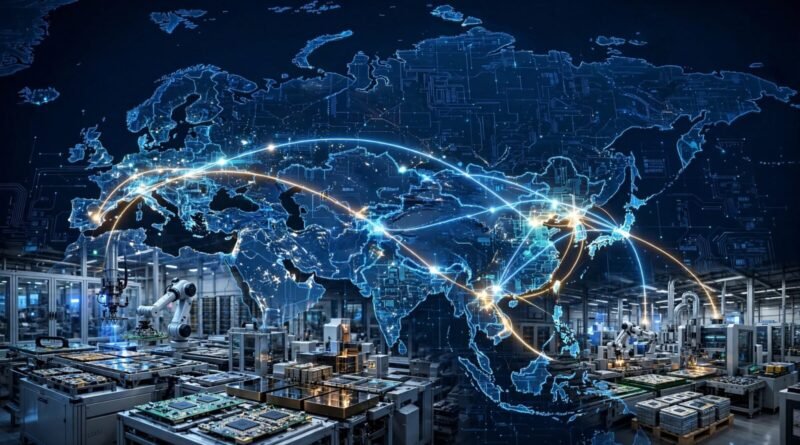
Manufacturing activity improved across several major economies in August, with demand for semiconductors, computers and other AI-related hardware helping support factory growth in Asia while new orders strengthened in parts of Europe.
Reuters reported that China, Japan and South Korea all recorded manufacturing expansion in August. In Europe, the eurozone manufacturing Purchasing Managers’ Index rose to its highest level in more than four years.
The improvement does not mean every manufacturing economy is strong. Italy and Spain remained in contraction, and official Chinese factory data still showed weakness even as a private survey moved further into expansion territory.
02 What Changed?
The strongest common theme is technology demand. Japan reported its fastest growth in new manufacturing business since January 2018, supported by semiconductors and AI-related products. South Korean factories expanded for a ninth consecutive month, while separate government data showed exports surging 68.7% from a year earlier.
China’s RatingDog China General Manufacturing PMI, compiled by S&P Global, rose to 51.5 in August from 50.9. That beat the 51.0 median estimate in a Reuters poll, although China’s official manufacturing survey continued to indicate contraction.
The split between surveys is a reminder not to treat one PMI number as a complete picture of an economy. Different surveys cover different company groups, and an improvement in technology-related manufacturing can coexist with weakness elsewhere.
03 Why It Matters
The AI boom is increasingly visible in physical trade and manufacturing rather than only in technology-company valuations. More AI computing requires memory chips, processors, servers, networking equipment, power systems and other hardware that has to be manufactured somewhere.
That demand is benefiting economies with large semiconductor and electronics industries. South Korea is particularly exposed through companies such as Samsung Electronics and SK Hynix, while Japan remains a major supplier of semiconductor materials and equipment.
Earnyx has already tracked the financial side of the trend through Nvidia and Salesforce’s AI-driven rally and the infrastructure side through more than $700 billion in AI data-center spending. The latest manufacturing data shows the same cycle reaching factories and exports.
04 What It Means for You
For consumers, stronger factory activity can improve product availability, but it does not automatically mean lower prices. High demand for advanced chips can keep prices elevated even when factories are busy, while energy and shipping disruptions can push costs in the opposite direction.
For workers and businesses, the pattern shows where demand is concentrated. Semiconductor, electronics and data-center supply chains are receiving strong orders, while more traditional manufacturing sectors may not experience the same momentum.
For investors, broad economic labels such as “manufacturing recovery” need to be unpacked. A recovery led heavily by AI-related hardware may be more dependent on technology capital spending than one driven evenly across consumer goods, autos, machinery and construction.
05 Numbers + Context
The eurozone manufacturing PMI rose to 52.7 in August from 51.9 in July, its highest reading since May 2022. Germany reached 54.3 and France rose to 51.1, while Italy and Spain were in contraction. PMI readings above 50 indicate expansion.
Britain’s manufacturing PMI eased to 51.7, although Reuters reported that factories hired workers at the fastest pace in more than two years as production requirements increased.
In Asia, China’s private manufacturing PMI rose to 51.5. Japan’s PMI increased to 54.9 from 54.5, marking an eighth straight month of expansion. South Korea’s PMI eased to 52.3 from 53.1 but stayed above 50 for a ninth consecutive month.
South Korean exports reached $98.26 billion in August, up 68.7% year over year and extending export growth to a 15th consecutive month. Imports rose 22.5%, producing a preliminary trade surplus of $34.75 billion.
06 Earnyx Takeaway
The latest factory data gives the AI boom a more concrete shape. Demand for computing is not confined to software subscriptions or stock-market expectations; it is moving through chip factories, electronics exporters and industrial supply chains.
But the recovery is uneven. Strong AI hardware demand can lift countries and sectors positioned around semiconductors while leaving other parts of manufacturing weak. That makes the useful question not simply whether factories are expanding, but what is driving the expansion and how durable that demand is.
If AI capital spending remains high, the manufacturing benefits can continue. If that spending slows, economies with the greatest exposure to the current hardware cycle may feel the change quickly.
Sources: Reuters global manufacturing report and Reuters South Korea trade data, September 1, 2026.



Pingback: Cohere Aleph Alpha Deal Targets Enterprise AI Market
Pingback: $22 Billion AI Cloud Financing Shows Scale of Infrastructure Boom
Pingback: Snap Specs Enterprise Push Adds Nvidia and Salesforce AI
Pingback: Google Ad Tech Ruling: No Breakup, New Competition Rules