
Toll Road vs Free Road: How Much Should You Pay to Save Time?
Table of Contents
01 Event
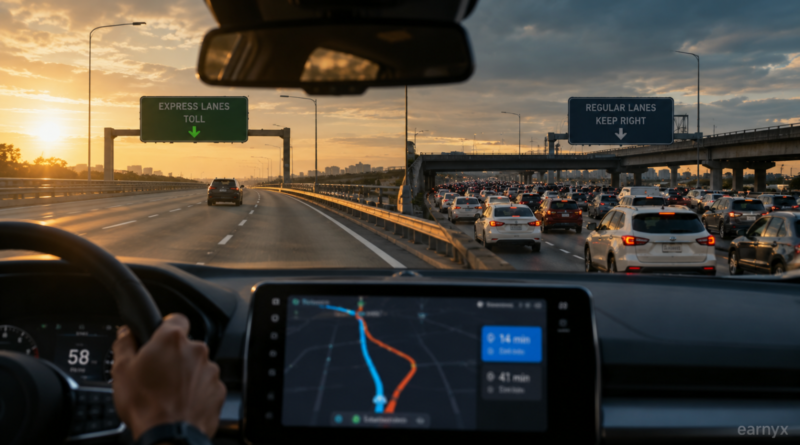
Navigation apps often present a simple choice: pay a toll and arrive sooner, or avoid tolls and keep the cash. The cheapest-looking route is not necessarily the lowest-cost route once time, fuel and reliability are considered.
02 What Changed?
The useful comparison is not “toll versus free.” It is toll plus operating cost versus extra travel time and distance.
Transportation agencies already use the value of travel-time savings in benefit-cost analysis because time spent traveling has an economic and personal cost. Drivers can apply the same principle on a much smaller scale.
03 Why It Matters
A $5 toll can look expensive when the alternate road costs nothing. But if avoiding the toll adds 35 minutes, extra distance and uncertain traffic, the decision changes.
The reverse is also true. Paying $8 to save five minutes on a relaxed weekend trip may provide almost no meaningful value.
04 What It Means for You
Before choosing, look at four things: toll price, expected minutes saved, extra distance on the free route, and how important arrival-time reliability is for that trip.
Then calculate the implied price of the time savings.
Hourly price of time saved = toll ÷ minutes saved × 60.
If a $6 toll saves 30 minutes, you are paying $12 per hour of time recovered. If the same $6 saves 10 minutes, you are paying $36 per hour.
For a commute, multiply the difference across the number of trips you make each month. A toll that feels small once can become a major recurring expense. On the other hand, using the toll road selectively—only when congestion is severe or punctuality matters—can capture much of the benefit without paying every day.
05 Numbers + Context
The Federal Highway Administration describes travel-time savings as a key parameter in transportation benefit-cost analysis because time used for travel could otherwise be used for productive or more enjoyable activities.
Historical express-lane research also shows that travelers sometimes pay for more than raw minutes saved. Reliability matters. Knowing a trip is likely to take 30 minutes can be more valuable than choosing a free route that might take anywhere from 30 to 60 minutes.
Example: a toll road costs $4.50 and saves 20 minutes. That implies $13.50 per hour saved. If the free road also adds five miles, the toll’s effective premium is smaller once fuel and vehicle wear are considered.
06 Earnyx Takeaway
A toll is not automatically a waste of money, and a free road is not automatically free.
Use toll roads where the combination of time saved, distance avoided and arrival reliability is worth the price. Avoid paying simply out of habit. The strongest strategy is often selective use: free route when time is flexible, toll route when the minutes genuinely matter.



Pingback: Parking Garage vs Street Parking: When Is Paying More Worth It?