
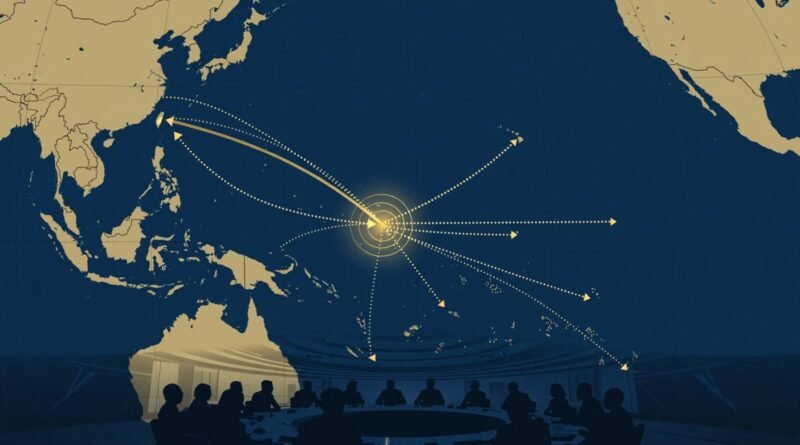
China-Taiwan Tensions Overshadow Pacific Islands Forum as Palau Hosts Regional Leaders
Table of Contents
01 Event
China-Taiwan tensions moved to the center of the Pacific Islands Forum in Palau on September 1, 2026, after Beijing objected to the presence of Taiwanese officials at events surrounding the regional summit. Palau, one of the small number of countries that maintains formal diplomatic relations with Taiwan, invited Taiwan Foreign Minister Lin Chia-lung for meetings and side events.
China said Taiwan was not qualified to participate in forum activities and warned there would be unspecified “consequences.” Australia and New Zealand responded that the 18-member Pacific bloc would determine for itself who participates in the gathering.
02 What Changed?
The dispute added a geopolitical layer to a summit intended to focus on Pacific priorities such as economic development, regional integration and security. Taiwan is not a formal dialogue partner of the Pacific Islands Forum; it participates as a development partner. China, the United States, the European Union, Britain, Canada, India and Japan are among the forum’s dialogue partners.
The meeting also drew attention because several Pacific heads of government were absent. Reuters reported that the prime ministers of Fiji, Vanuatu, Samoa and the Solomon Islands and the president of Kiribati were not attending, with ministers or other officials representing their governments. The reasons varied, and no single explanation should be assigned to all of the absences.
03 Why It Matters
Pacific island states occupy strategically important territory across a vast ocean region and have become the focus of increasing diplomatic, economic and security competition. China has expanded engagement through trade, infrastructure and security relationships, while the United States, Australia and New Zealand have increased their own investment and diplomatic attention.
Taiwan’s diplomatic position is also part of that competition. In the Pacific, only Palau, Tuvalu and the Marshall Islands currently maintain formal diplomatic ties with Taipei. Beijing considers Taiwan part of China and has steadily reduced the number of governments that formally recognize Taiwan.
For Pacific governments, the challenge is maintaining room to set regional priorities rather than allowing competition among larger powers to dominate the agenda. Palau President Surangel Whipps Jr. used the forum opening to emphasize that outside partners were welcome but should not determine the region’s direction.
04 What It Means for You
This is not primarily a consumer-price story, but the strategic competition has practical economic consequences. Infrastructure investment, tourism, fisheries, digital connectivity, ports and resource agreements can all be influenced by the relationships Pacific governments maintain with larger powers.
One example came during the same summit when the United States and New Zealand announced funding for an upgrade to a World War II-era port in the Cook Islands. Washington said it intended to contribute $50 million, while New Zealand planned NZ$17.5 million, or roughly $10 million, for the project. That port announcement is separate from the Taiwan dispute, but it demonstrates the scale of external investment flowing into the region.
Earnyx readers can also compare the broader regional-risk context with our coverage of cost pressure facing Southeast Asia’s budget airlines, another example of how regional developments can ultimately affect transport and consumer economics.
05 Numbers + Context
The Pacific Islands Forum has 18 member states and territories. Reuters reported that China, the United States, the EU, Britain, Canada, India and Japan are among 21 dialogue partners. Taiwan participates as a development partner rather than a formal dialogue partner.
Only three Pacific island countries—Palau, Tuvalu and the Marshall Islands—retain formal diplomatic relations with Taiwan. Five heads of government were absent from the Palau summit, although their governments were represented and the individual reasons for absence were not identical.
China’s special envoy Qian Bo said Taiwan’s presence would have consequences but did not specify what those consequences would be. That distinction matters: reports of a warning should not be converted into claims about sanctions, trade retaliation or other action unless Beijing actually announces such measures.
06 Earnyx Takeaway
The Pacific Islands Forum is showing how difficult it is for smaller states to keep regional development priorities separate from great-power competition. China and Taiwan are the immediate source of friction, but the broader story also includes U.S., Australian and New Zealand efforts to deepen influence through infrastructure and security partnerships.
The key fact is not that the Pacific has chosen one side. The forum’s members continue to pursue different diplomatic relationships, and Australia and New Zealand explicitly defended the bloc’s right to set its own participation rules. Any stronger conclusion would go beyond what the summit reporting currently supports.
The diplomatic structure of the forum helps explain why the dispute is sensitive. Reuters reported that Taiwan is a development partner rather than a formal dialogue partner, while China is one of the forum’s dialogue partners. That means Taiwan’s presence did not amount to membership in the forum or recognition by all 18 members. It reflected Palau’s invitation and the forum’s own participation arrangements.
China’s objection also came against a backdrop of long-term competition over formal diplomatic recognition. Palau, Tuvalu and the Marshall Islands are now the only Pacific island countries maintaining formal ties with Taipei. Other Pacific governments have shifted recognition to Beijing over time. That history makes each regional meeting a test of how much room smaller Pacific states retain to manage their own external relationships.
Australia and New Zealand emphasized that point publicly. Australian Prime Minister Anthony Albanese described the gathering as primarily a meeting of the “Pacific family,” while New Zealand Foreign Minister Winston Peters said the bloc does not take instructions from countries outside it. Peters also said he was suspicious that foreign interference might have contributed to some leaders’ absences, but Reuters noted he did not directly accuse China and said New Zealand would verify the situation before assigning blame.
For readers, the important factual line is that the summit exposed competing influence without producing a single Pacific position on China or Taiwan. Member governments retain different diplomatic relationships and economic interests, so the region should not be treated as one geopolitical bloc.
Sources: Reuters, September 1, 2026; Associated Press, September 1, 2026; Reuters on the Cook Islands port project, September 1, 2026.