
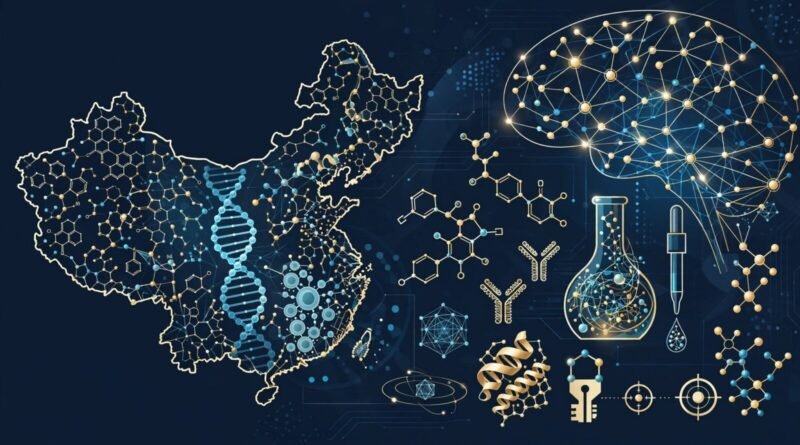
AstraZeneca Invests $15 Billion in China as AI Drug Discovery Expands
AstraZeneca is planning one of the largest foreign pharmaceutical investments in China, committing $15 billion through 2030 to expand research, manufacturing and artificial-intelligence-enabled drug discovery.
Reuters reported on September 16 that the investment will include new manufacturing sites in Wuxi and Qingdao as well as research and development in Beijing and Shanghai. The company said it expects its China workforce to grow to more than 20,000 from more than 17,000.
The scale of the commitment highlights a major trend in healthcare: AI is moving beyond general-purpose chatbots into scientific research where even modest improvements in discovery speed can have enormous economic value.
Table of Contents
Why AI matters in drug discovery
Developing a medicine is expensive and uncertain. Researchers must identify promising biological targets, design compounds, test safety and effectiveness, and then complete clinical trials and regulatory review.
AI can assist at several stages. Models can analyze biological data, predict molecular properties, identify patterns in scientific literature and help researchers prioritize which compounds to test.
The technology does not eliminate laboratory work or clinical trials. Its value is in narrowing enormous search spaces so scientists can spend more time on the most promising possibilities.
Small efficiency gains can be financially significant
Most experimental drug candidates never become approved medicines. That means pharmaceutical companies spend heavily on projects that ultimately fail.
If AI helps identify weak candidates earlier, companies can avoid some unnecessary laboratory and trial costs. If it helps discover stronger candidates faster, valuable medicines can potentially reach later development stages sooner.
These gains do not require AI to invent drugs autonomously. Improving the probability and speed of human research decisions can already create substantial value.
Why China is important for pharmaceutical research
China has a large scientific workforce, a growing biotechnology sector and a substantial domestic healthcare market. Global pharmaceutical companies increasingly collaborate with Chinese biotech firms and research institutions.
AstraZeneca already has a significant presence in the country. Expanding R&D and manufacturing can place scientists closer to local partners and patients while increasing production capacity.
The company said the investment includes AI-enabled drug discovery, showing that computing and biological research are becoming more tightly linked.
AI infrastructure is spreading into every major industry
The current AI investment boom is often associated with data centers and cloud companies. Pharmaceutical research shows why demand can spread far beyond the technology sector.
Drug discovery models require computing resources, specialized datasets and scientists capable of interpreting outputs. As more industries build domain-specific AI systems, demand for compute can become broader and more persistent.
Earnyx has covered how AI agents could dramatically increase future computing traffic. Scientific AI is another source of demand, but one where the value of a successful output can be exceptionally high.
Manufacturing remains as important as software
AstraZeneca’s investment is not solely digital. Reuters reported that it also includes manufacturing facilities in Wuxi and Qingdao.
This is an important reminder that pharmaceutical innovation ultimately requires physical production. A model can suggest a promising molecule, but companies still need laboratories, clinical supply chains and factories capable of manufacturing medicines to strict quality standards.
The combination of AI research and manufacturing investment reflects how modern industrial strategies increasingly connect software with physical capacity.
Why the workforce is still growing
Automation headlines often imply that AI investment necessarily means fewer employees. AstraZeneca’s plan points in a different direction, with the company expecting its China workforce to exceed 20,000.
In research-intensive industries, AI can increase the productivity of scientists without removing the need for scientific expertise. Researchers must design experiments, validate model outputs and make decisions under uncertainty.
Manufacturing expansion also requires engineers, quality specialists and operational staff.
The limits of AI in medicine
Biology is extraordinarily complex. A model that performs well on historical data can still fail when a compound reaches real patients.
Clinical trials remain essential because they test safety and effectiveness in humans. Regulators also require evidence that cannot simply be replaced by computational predictions.
Companies therefore need to avoid confusing faster hypothesis generation with guaranteed drug success. AI can improve the research process without removing the fundamental uncertainty of medicine development.
Data quality becomes a competitive advantage
AI systems are only as useful as the information available to them. Pharmaceutical companies hold large amounts of proprietary experimental and clinical data accumulated over decades.
That data can become a strategic asset when combined with modern machine learning. A company with unique, well-organized scientific datasets may be able to build tools that competitors cannot easily reproduce using public information alone.
This also increases the importance of data governance, privacy and secure computing.
What investors should watch
Large investment announcements should be evaluated through actual research productivity and commercial outcomes. Useful measures include the number of candidates entering clinical development, trial success rates and the time required to move projects through the pipeline.
AI-related partnerships can also reveal where pharmaceutical companies believe outside expertise is valuable. The sector may see more collaborations between biotech firms, cloud providers and model developers.
However, attributing a successful medicine specifically to AI can be difficult because drug development involves many scientific steps and teams.
The bigger picture
AstraZeneca’s $15 billion commitment demonstrates how AI investment is becoming embedded in established industries rather than remaining a standalone technology story.
Pharmaceutical companies have a particularly strong incentive to use AI because research decisions are expensive and the value of a successful new medicine can be enormous. That makes drug discovery one of the clearest places where better prediction can translate into economic value.
The investment also shows that the AI boom is not purely virtual. It connects data centers, scientific research, laboratories and manufacturing plants. The companies that benefit most may be those that combine computational tools with deep domain expertise and the physical capability to turn digital discoveries into real products.