
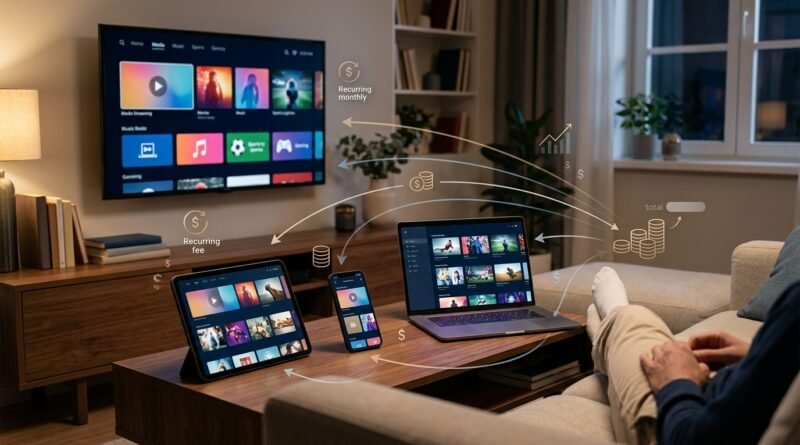
Netflix, Disney+, Spotify and More: How Much Are Your Streaming Subscriptions Really Costing Per Year?
A single streaming subscription rarely feels expensive. The problem appears when video, music, gaming, cloud storage, sports, creator memberships and premium app plans all sit on the same card.
Each charge is small enough to ignore. The annual total is not always small.
The useful question is not “Is this service worth ₱399 this month?” It is “Is this entire subscription stack worth what I will spend on it over a full year?”
Table of Contents
01 Event
Streaming and digital subscriptions are easy to add one at a time, but the real household commitment appears only when the entire stack is annualized.
02 What Changed?
Entertainment has shifted from buying individual media toward recurring access across video, music, gaming, creator memberships, and premium apps. That spreads spending across many small monthly charges instead of one visible purchase.
03 Why It Matters
Recurring charges become background spending. A service that looks harmless monthly can represent thousands of pesos over a year, especially when several subscriptions overlap.
04 What It Means for You
List every active subscription, annualize it, note when you last used it, and decide which services genuinely deserve permanent access. Rotation can be more efficient than keeping every service active all year.
05 Numbers + Context
As one current reference point, Spotify Premium Individual in the Philippines is listed at ₱169 per month after its current introductory offer. At the regular monthly rate, that is ₱2,028 per year for one music subscription alone. The larger table below remains illustrative rather than a claim about current service prices.
06 Earnyx Takeaway
Streaming is not expensive simply because it recurs. The problem is invisibility. Annualize the stack, compare the total with actual use, and make every service compete for a place in your budget.
Reference: Spotify Premium Philippines. Prices and promotions can change.
Deep Dive
Start by annualizing every monthly charge
Monthly pricing softens the psychological impact of a recurring expense. A service that costs ₱500 per month becomes ₱6,000 a year. Three services at that price become ₱18,000.
The calculation is simple:
Monthly subscription × 12 = annual cost
For annual plans, use the amount actually charged. Then add every entertainment subscription together.
The point of annualizing is not to make subscriptions look bad. It is to make recurring spending visible enough to compare with other things you could buy with the same money.
What belongs in the streaming budget?
Do not stop at Netflix-style video services. Your entertainment stack may include:
- Video streaming
- Music streaming
- Sports packages
- Gaming subscriptions
- Premium creator memberships
- Cloud gaming
- Premium podcast or audiobook plans
- Ad-free upgrades
- Channel add-ons
- Family-plan upgrades
Some households also mix entertainment and utility subscriptions—cloud storage, AI tools, delivery memberships and productivity apps. Those deserve their own audit even if you decide not to count them as entertainment.
An illustrative annual stack
The following numbers are hypothetical examples, not current service prices.
| Subscription | Monthly | Annual |
|---|---|---|
| Video service A | ₱549 | ₱6,588 |
| Video service B | ₱369 | ₱4,428 |
| Music | ₱239 | ₱2,868 |
| Gaming | ₱449 | ₱5,388 |
| Total | ₱1,606 | ₱19,272 |
Nothing in that example is outrageous on its own. The useful realization is that the household is not making four tiny decisions. It is carrying a recurring entertainment commitment of more than ₱19,000 per year.
Usage matters more than catalog size
Streaming services advertise enormous libraries. You do not consume enormous libraries. You consume a limited number of hours.
That suggests another useful metric:
Monthly subscription cost ÷ hours actually used = cost per hour
If a ₱500 service gets 40 hours of household use, that is roughly ₱12.50 per hour. If you open it once and watch one two-hour movie, the same subscription effectively cost ₱250 per hour of use that month.
Neither number automatically tells you whether to cancel. It simply makes usage visible.
Watch for overlapping subscriptions
The biggest waste is often not a service you never use. It is several services that solve the same problem.
Two or three video subscriptions may all be worthwhile during months when each has something you actively want to watch. Keeping every service permanently because you might want something later is a different decision.
This is the same pattern we explored in how cheap subscriptions become expensive when stacked together.
Rotation can be more efficient than permanent access
Streaming subscriptions are unusually easy to rotate because most are not long-term commitments.
You might subscribe to one video platform for a month or two, watch the shows you actually care about, cancel, and move to another later.
This approach works best when you are willing to treat subscriptions as temporary purchases rather than permanent utilities.
It also reduces the number of services you need to remember to review.
Family plans can help—but only if they are genuinely shared
A family or household plan can lower the effective cost per user when several people actively use the service.
But paying extra for additional profiles that nobody uses does not create value simply because the plan sounds more generous.
Evaluate household subscriptions at the household level: who uses it, how often, and what would actually change if it disappeared?
Beware the “included” subscription
Some subscriptions come bundled with telecom plans, devices, credit-card benefits or other services.
Bundled access can be excellent value, but it can also make it easy to forget what happens after the promotional period ends.
Whenever you activate a trial or bundled service, record:
- The regular price after the promotion
- The date charging begins
- Whether cancellation is automatic or manual
- Which payment method will be charged
A calendar reminder is often more useful than relying on memory.
Create a subscription ceiling
Instead of asking whether each individual service is affordable, decide how much total entertainment subscription spending fits comfortably within your budget.
For example, if your personal ceiling is ₱1,500 per month and you are already at ₱1,450, adding another ₱300 service means something else has to compete for the same budget.
This turns subscription decisions from endless accumulation into prioritization.
Canceling is not permanent
People sometimes keep subscriptions because canceling feels like losing access forever.
In most cases, you can subscribe again later.
A simple test is to cancel a questionable service for 30 days. If you repeatedly miss it, that is useful evidence that the service has value. If nobody notices, you also learned something useful.
Streaming versus ownership
Streaming is attractive because you get access to enormous catalogs without buying individual media. For frequently used services, that can be excellent value.
But access is different from ownership. Titles can disappear, catalogs change, prices change and subscriptions end when you stop paying.
That does not make ownership automatically better. It simply means the correct comparison depends on whether you value access, permanence, convenience or variety.
A 15-minute streaming audit
- List every entertainment subscription currently charging you.
- Convert each one to an annual cost.
- Write down when you last used it.
- Identify services that substantially overlap.
- Mark promotions or trials that will change price later.
- Choose one service to pause if the total feels too high.
If you are also paying for AI, storage, productivity and other digital tools, our analysis of AI subscription overload applies the same logic to another fast-growing part of the monthly budget.
The Earnyx reality check
Streaming subscriptions are not a financial problem simply because they recur every month. A service you use constantly may be one of the cheapest forms of entertainment you buy.
The problem is invisibility.
When five or six inexpensive services quietly renew in the background, you stop making active decisions about them.
Add them up. Annualize the total. Compare the cost with actual use.
Then keep the services that still earn their place in your budget—and let the rest compete for it again later.
Pingback: Why Paying Annually Isn’t Always the Cheapest Option - Earnyx
Pingback: The Subscription Creep: How $5 and $10 Charges Become $1,000 a Year - Earnyx