Bulk Buying Isn’t Always Cheaper: How to Find the Real Break-Even Point
Table of Contents
01 Event
“Buy more, save more” is one of retail’s most persuasive messages. Warehouse packs, multipacks and quantity discounts can genuinely reduce the price per unit, but a lower unit price does not guarantee a lower household cost.
The missing variable is how much of the larger purchase you actually use. Food can spoil, toiletries can sit unused, preferences can change and a discounted bulk purchase can consume cash that could have been used elsewhere.
02 What Changed?
Unit pricing makes bulk comparisons easier, but shoppers still need to distinguish between theoretical savings and realized savings. The relevant calculation is not simply package price divided by quantity. It is total amount spent divided by the amount ultimately consumed.
This is particularly important when a larger pack changes behavior. Buying twice as much because the unit price is 15% lower is not a saving if consumption also rises or part of the purchase is discarded.
03 Why It Matters
Bulk buying works best for products with predictable consumption, long shelf lives and enough storage space. It works poorly for uncertain demand, perishable products and items you are trying for the first time.
The principle is similar to the problem described in Earnyx’s guide to misleading discount math: a percentage saving matters only relative to what you would otherwise have bought and spent.
04 What It Means for You
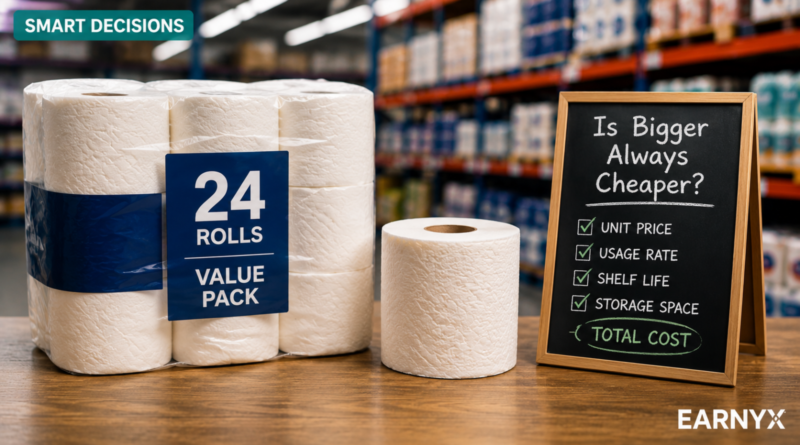
Start with the unit price, then ask four questions: How quickly will I use this? How much might be wasted? Do I have appropriate storage? Would I buy this quantity without the discount? If the last answer is no, the “saving” may simply be an incentive to spend more.
For products you use consistently, calculate the break-even quantity. If a bulk pack costs $30 while smaller packs cost $4 each, the bulk purchase becomes cheaper once it replaces more than 7.5 small packs—provided none of the bulk quantity goes unused.
05 Numbers + Context
Suppose 10 units cost $20, or $2 each, while a 20-unit bulk pack costs $34, or $1.70 each. The advertised unit saving is 15%. But if five units from the bulk pack expire unused, you effectively paid $34 for 15 consumed units, or about $2.27 each. The bulk “deal” became more expensive than the smaller pack.
That is why unit price should be the beginning of the comparison, not the end.
06 Earnyx Takeaway
Bulk buying is most valuable when your consumption is boringly predictable. The bigger the uncertainty around whether you will use something, the less meaningful the unit-price discount becomes. Compare cost per unit consumed—not merely cost per unit purchased—and many supposed bulk bargains look very different.
Sources: Federal Trade Commission consumer shopping guidance; NIST resources on unit pricing and measurement.