
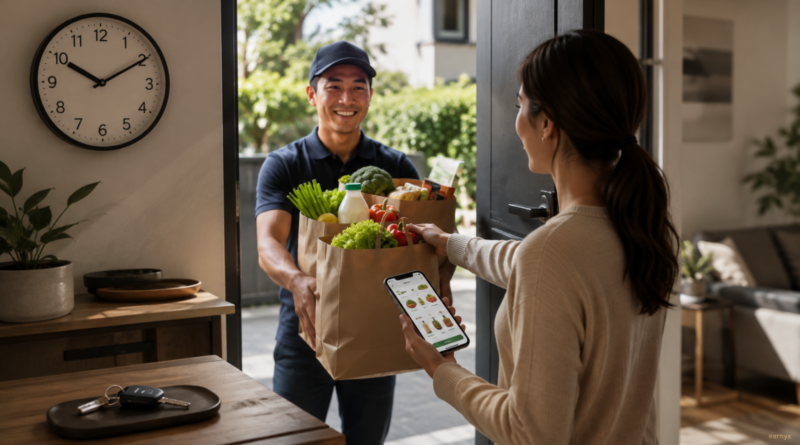
Grocery Delivery vs Shopping Yourself: When Is the Time Savings Worth the Extra Cost?
Table of Contents
01 Event
Grocery delivery turns a routine errand into a time-versus-money decision. Instead of driving to the store, walking the aisles, waiting at checkout and carrying everything home, you pay someone else to handle much of that work.
The question is not simply whether delivery costs more. It is whether the extra cost is reasonable for the amount of usable time and hassle it removes from your week.
02 What Changed?
Online grocery ordering has become a normal option rather than an occasional luxury, but the checkout total can contain more than the shelf price. Delivery platforms may charge delivery, service, priority, long-distance, bag or other fees, and tips are separate. Retailers can also set online item prices differently from in-store prices. Instacart, for example, says fees vary by retailer, order size, location and delivery speed, while retailers control their own item pricing.
That makes the real comparison delivered total versus the full cost of doing the trip yourself, not delivery fee versus zero.
03 Why It Matters
Shopping yourself consumes transportation time, aisle time, checkout time and unloading time. U.S. Bureau of Labor Statistics time-use data show that people spent an average of about 0.69 hours per day purchasing goods and services in 2025, although that includes more than groceries.
Delivery can also reduce unplanned browsing and impulse purchases for some shoppers. On the other hand, convenience can make frequent small orders easier, which can increase fees and spending.
04 What It Means for You
Start with a simple question: How much extra am I paying to avoid this particular trip?
Compare the delivered cart with what the same basket would cost in store. Add delivery and service fees, any tip you choose to give, and membership cost if you subscribe. Then estimate what shopping yourself would require: transportation expense plus the time from leaving home until the groceries are put away.
If delivery adds $15 to an order but reliably saves 90 minutes, you are effectively paying about $10 for each hour recovered. If it adds $25 and saves only 30 minutes, you are paying about $50 per hour saved. Neither answer is automatically good or bad; the useful question is whether that hour is worth that amount to you.
Delivery tends to make more sense for busy households, people with mobility or transportation constraints, caregivers, and shoppers who can consolidate purchases into larger planned orders. Shopping yourself may remain better for people who live close to the store, enjoy choosing produce personally, shop heavily from in-store promotions, or have flexible time.
05 Numbers + Context
Instacart currently states that same-day delivery fees can start at $3.99 for qualifying orders over $35, with service fees varying by order and location. Its terms also note that some retailers may price items differently online. Those figures are examples rather than universal grocery-delivery pricing.
A useful personal calculation is:
Convenience premium = delivered total − equivalent self-shopping total.
Then:
Cost per hour saved = convenience premium ÷ hours saved.
Example: a $12 premium that saves 1.5 hours equals $8 per hour saved. A $20 premium that saves 40 minutes is roughly $30 per hour saved.
If you are comparing other food-convenience choices, see Earnyx’s Meal Kits vs Grocery Shopping analysis.
06 Earnyx Takeaway
Grocery delivery is not automatically wasteful spending. It is a service that converts money into time.
The mistake is paying the premium without knowing either side of the trade. Compare the actual cart totals, calculate how much time the trip really takes, and put a rough value on that time. For a well-planned weekly order, the convenience premium can be surprisingly reasonable. For repeated small orders with multiple fees, the same convenience can become expensive very quickly.