HVAC Replacement Costs: How to Compare Equipment, Installation, and the Work Your House Actually Needs
HVAC replacement cost is not just the price of a furnace, air conditioner, or heat pump. The installed project can include load calculations, equipment sizing, duct repairs, refrigerant lines, electrical work, drains, controls, permits, commissioning, removal of old equipment, and changes needed to make the system work properly in the house.
The strongest quote is therefore not necessarily the lowest equipment price. It is the proposal that correctly sizes and installs the system the home actually needs.
Table of Contents
Start with a load calculation
The U.S. Department of Energy notes that oversized HVAC equipment can reduce efficiency, increase wear, and create comfort problems. A replacement should not automatically copy the old equipment size just because it was already there.
Ask how the contractor determined heating and cooling loads and whether the calculation accounts for insulation, windows, orientation, air leakage, climate, and other building characteristics.
Equipment efficiency is only part of performance
Higher-efficiency equipment can reduce energy use, but savings depend on climate, utility rates, runtime, duct condition, sizing, controls, and installation quality.
DOE guidance on residential heat pumps emphasizes that improper charging, oversizing, and leaky ducts can undermine expected efficiency.
Ductwork can be the hidden cost
New equipment connected to leaking, undersized, poorly balanced, or uninsulated ducts may not deliver the comfort or efficiency promised on the equipment label.
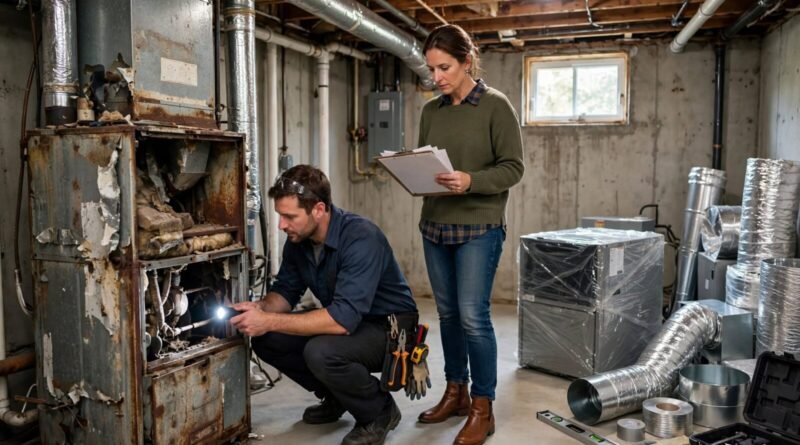
Ask whether duct inspection, leakage testing, repairs, balancing, or modifications are included. A contractor who ignores obvious duct problems can produce a cheaper bid and a worse system.
Fuel switching can change the project dramatically
Replacing gas heat with a heat pump, resistance heat with a heat pump, or another fuel conversion can require electrical capacity, new circuits, condensate management, line sets, duct changes, or removal of old fuel equipment.
Compare the total conversion project, not just the new appliance.
Electrical work belongs in the installed cost
Heat pumps, electric resistance backup, air handlers, and higher-capacity equipment can require new breakers, disconnects, wiring, or panel capacity.
If electrical upgrades are needed, obtain a defined scope before accepting the HVAC quote.
Refrigerant and line-set decisions matter
Air conditioners and heat pumps depend on correctly installed refrigerant circuits. Reusing an existing line set may be appropriate in some projects and inappropriate in others depending on equipment, condition, sizing, contamination, routing, and manufacturer requirements.
Ask what the proposal assumes.
Controls can add cost and complexity
Thermostats, zoning, communicating controls, outdoor sensors, and smart-home integrations can improve usability in some systems and create vendor lock-in in others.
Pay for controls that solve a real comfort or operating problem rather than buying every available feature.
A hypothetical quote comparison
Suppose Contractor A quotes $10,000 for new equipment connected to the existing ducts. Contractor B quotes $14,000 and includes a load calculation, duct sealing, electrical work, permit, new drain work, and commissioning.
The $4,000 difference is not simply a higher equipment markup. The scopes are different.
These figures are hypothetical.
Permits and commissioning matter
Local permits and inspections may apply. After installation, the system should be checked for airflow, temperature performance, refrigerant charge where relevant, drainage, safety, and control operation.
Ask what commissioning documentation the contractor provides.
Efficiency ratings should be compared on equivalent equipment
Cooling and heating efficiency metrics help compare equipment, but do not treat the highest rating as automatically the best financial choice.
The incremental equipment cost should be compared with expected energy savings based on your climate, usage, utility rates, and expected years of ownership.
Utility incentives can change, so verify them
Utilities, states, and other programs may offer incentives for qualifying HVAC upgrades. Eligibility, equipment requirements, funding, and deadlines change.
Use current official program information before counting a rebate or credit in the project budget.
Tax incentives should also be verified at purchase time
Federal and state tax provisions can change. Do not use an old rebate table or previous-year tax credit as if it is guaranteed for your installation date.
Check current official tax and energy-program guidance.
Comfort can be worth money even without a short payback
A well-designed HVAC replacement can improve humidity control, noise, temperature consistency, filtration, and reliability. Those benefits can justify additional cost even when energy savings alone do not produce a fast payback.
Separate comfort benefits from claimed utility savings so the decision remains honest.
Building-envelope work can reduce required HVAC capacity
Air sealing and insulation can reduce heating and cooling load. Earnyx’s insulation versus window savings guide explains why building-envelope improvements should be considered before assuming equipment is the only path to lower energy use.
In some homes, completing envelope work before final equipment sizing can support a smaller system.
Do not replace working equipment only because a salesperson predicts failure
Age alone does not identify the exact failure date. Condition, repair history, availability of parts, energy use, comfort, and reliability all matter.
If the existing system is working, obtain a diagnosis and evaluate replacement timing without artificial urgency.
Compare full scopes
For each proposal, record:
- load calculation;
- equipment model and capacity;
- efficiency ratings;
- duct scope;
- electrical work;
- refrigerant-line work;
- drainage;
- controls;
- permits;
- removal and disposal;
- commissioning;
- labor warranty;
- and manufacturer warranty.
Financing can erase operating savings
A higher-efficiency system may reduce utility bills, but expensive financing can overwhelm those savings. Compare total interest, term, and any dealer financing conditions with the cash price.
Bottom line
HVAC replacement cost is the cost of a correctly designed and commissioned system, not merely the box outside the house.
Require sensible sizing, investigate duct and electrical needs, normalize every proposal, verify current incentives, and separate comfort benefits from energy claims. A cheaper installation that performs poorly for the next decade is not the cheaper HVAC system.