RAG Explained: How AI Uses Your Own Documents Without Retraining the Model
Large language models know only what was learned during training plus whatever information is supplied when a request is made. That creates an obvious problem for businesses: how do you make an AI assistant answer from your current policies, product manuals or private documents without retraining the entire model every time something changes? One common answer is retrieval-augmented generation, better known as RAG.
Table of Contents
01 What It Is
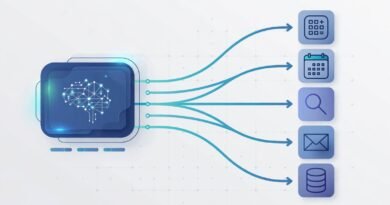
RAG combines two separate jobs: retrieval and generation. First, a search system finds information that appears relevant to the user’s question. Then that information is added to the model’s context so the model can use it while generating the answer.
The key point is that the model itself does not have to be retrained on those documents. The documents remain in an external knowledge source. When the knowledge changes, the organization can update the source rather than train a new model.
That makes RAG useful for information that is private, frequently updated or too specialized to expect a general model to know reliably. Examples include employee policies, technical documentation, support knowledge bases, contracts, research archives and product catalogs.
02 How It Works
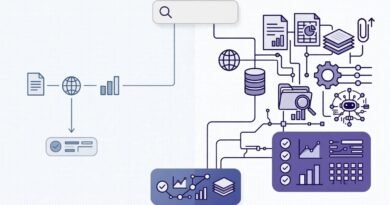
A common RAG pipeline begins by splitting documents into smaller chunks. Those chunks may be converted into embeddings and stored in a vector database together with metadata such as source, date, department and access permissions.
When a user asks a question, the system searches for relevant chunks. Semantic vector search can find passages that use different words but express similar ideas. Keyword or hybrid search may also be used where exact names and identifiers matter.
The best retrieved passages are then inserted into the model’s prompt or context window. The model receives both the question and the selected evidence and produces an answer. Well-designed systems may also return citations so the user can inspect the underlying documents.
This is why RAG and vector databases are often discussed together, but they are not the same thing. A vector database is one possible retrieval component. RAG is the larger workflow that retrieves external evidence and uses it during generation.
03 Why It Matters
RAG addresses two practical weaknesses of standalone language models: stale knowledge and missing private knowledge. A model cannot answer accurately from a company handbook it has never seen, and training a new model every time a policy changes would be inefficient.
Retrieval also gives an organization more control over the evidence used for an answer. Instead of asking the model to rely entirely on its internal training, the application can instruct it to answer from approved documents and cite them.
That does not make hallucinations disappear. Earnyx’s AI hallucinations explainer covers how models can produce plausible but unsupported claims. Retrieval can fail in several ways: the search layer might retrieve the wrong document, miss the relevant passage, surface outdated information or return text the user is not authorized to see. The model can also misread good evidence.
04 What It Means for You
For everyday users, RAG is often the technology behind “chat with your documents” and enterprise knowledge assistants. The quality of the experience depends as much on retrieval as on the language model. If the right document never reaches the model, even an excellent model may give a weak answer.
For organizations, permissions are critical. Retrieval should respect the same access rules as the original data source. A company-wide AI assistant should not expose payroll, legal or confidential project documents merely because all files were indexed into one search system.
Document hygiene matters too. Duplicate versions, outdated policies and poorly labeled files can confuse retrieval. Metadata such as effective date, owner and document type can make filtering more reliable.
Developers should also design for “no good evidence found.” A RAG system should be allowed to say that the available sources do not support an answer rather than forcing the language model to fill the gap.
05 Numbers + Context
RAG quality is usually measured at more than one layer. Retrieval metrics ask whether the correct source appears among the top results. Generation metrics ask whether the final response is accurate, relevant and supported by those sources. A system can fail at either stage.
Chunk size is another important variable. Chunks that are too small may lose context; chunks that are too large may include irrelevant material and consume unnecessary tokens. There is no universal ideal size because documents and queries differ.
Context also has a real API cost. Retrieved text becomes model input, so sending ten barely relevant passages can cost more than retrieving three strong ones. Earnyx’s AI API token pricing explainer shows how that extra context affects inference cost, while the published AI tool value guide provides a broader framework for deciding whether the workflow justifies its recurring cost.
06 Earnyx Takeaway
RAG is one of the most practical ways to make general-purpose AI useful with private or frequently changing information. It lets organizations update the knowledge layer without retraining the foundation model every time a document changes.
But RAG is not a truth switch. A strong system needs good documents, good retrieval, permission filtering, useful metadata, citation support and a clear way to abstain when evidence is weak. The model can only work with the context it receives. If retrieval sends the wrong evidence, generation simply turns the wrong evidence into a polished answer.