
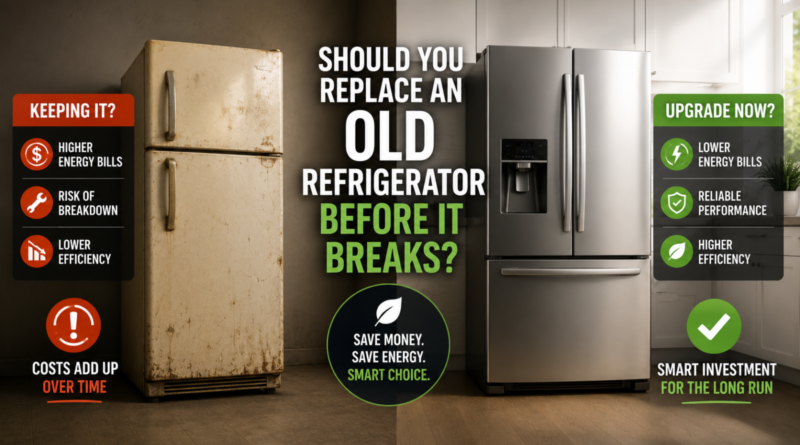
Should You Replace an Old Refrigerator Before It Breaks?
Table of Contents
01 Event
Refrigerators run 24 hours a day, so an old inefficient unit can quietly add to household electricity costs for years. The difficult question is whether the energy savings from a newer model are enough to justify replacing a refrigerator that still works.
02 What Changed?
Efficiency standards have improved substantially over time, and ENERGY STAR provides tools for estimating the operating cost of older units. That makes it possible to compare the annual energy penalty of keeping an old refrigerator with the upfront cost of replacing it.
03 Why It Matters
Replacing too early wastes the remaining value of a functioning appliance. Waiting too long can mean paying higher electricity costs and dealing with an emergency replacement when the refrigerator finally fails.
04 What It Means for You
Check the model age, annual kWh estimate and local electricity rate. If the refrigerator is relatively new and reliable, the energy savings alone may not justify replacement. If it is very old, heavily used or a second refrigerator running in a garage, the economics can change quickly.
05 Numbers + Context
ENERGY STAR says certified refrigerators are about 9% more efficient than models that merely meet current federal minimum standards, and replacing an old refrigerator with a certified model can save about $150 over a 12-year product life under its assumptions. Its Flip Your Fridge calculator can estimate savings for older models. Sources: https://www.energystar.gov/products/refrigerators and https://www.energystar.gov/products/refrigerators/flip-your-fridge
06 Earnyx Takeaway
Do not replace a refrigerator just because a newer one is more efficient. Replace when the combination of age, operating cost, reliability and repair risk makes the old unit expensive to keep. The cheapest appliance is often the one you already own—until its running cost proves otherwise.