
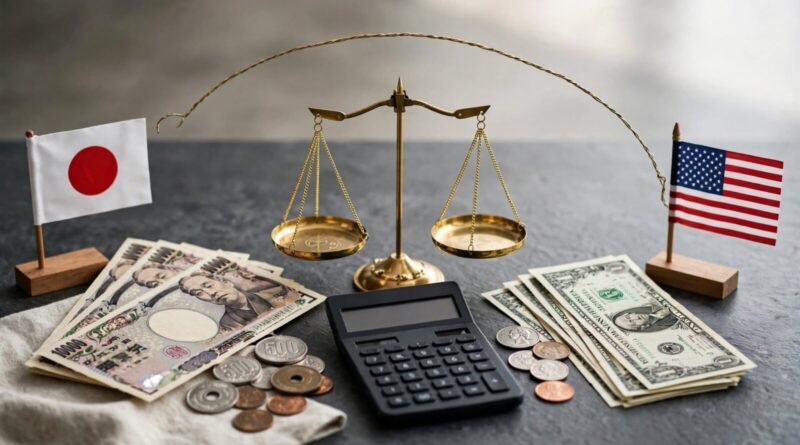
U.S. and Japan Defend Rare Yen Intervention as Currency Volatility Raises Global Market Risks
Table of Contents
01 Event
U.S. Treasury Secretary Scott Bessent warned that disorderly moves in the Japanese yen can create broader financial instability and defended a rare joint U.S.-Japan intervention in the currency market. The two countries bought yen on July 31 after the currency weakened to around 164 per dollar, a level not seen in roughly four decades.
02 What Changed?
The intervention showed that officials were willing to act directly rather than rely only on verbal warnings. The yen strengthened after the move but later weakened again toward 160 per dollar, keeping the possibility of further intervention in focus.
The U.S. role was notable because direct currency intervention by Washington is uncommon. Bessent said the goal was to prevent a disorderly move from triggering forced liquidation and wider market stress.
03 Why It Matters
The yen is heavily used in global funding and trading strategies. A rapid move can force investors to unwind leveraged positions, affecting bonds, stocks and currencies far outside Japan. That is why a currency move that appears domestic can become a global financial issue.
For consumers, exchange rates also affect travel, imported goods and investment returns. A weaker yen can make Japan cheaper for foreign visitors but raises import costs for Japanese households and companies.
04 What It Means for You
Travelers planning a Japan trip should avoid assuming the yen will stay weak. Currency intervention can move exchange rates quickly. If your travel budget is large, converting money gradually can reduce the risk of making the entire exchange at an unfavorable moment.
Investors should also be cautious with leveraged currency trades. Government intervention can create sudden price moves that overwhelm strategies designed around recent trends.
05 Numbers + Context
The yen reportedly fell near 164 per U.S. dollar before the July intervention and later weakened again toward 160. Bessent said the U.S. used the Treasury’s Exchange Stabilization Fund to participate in the operation.
Related Earnyx coverage: Read how another central bank is managing currency pressure and how Japanese markets react to global shocks.
06 Earnyx Takeaway
Currency value is not just a travel bargain indicator. Large exchange-rate moves can affect borrowing costs, imports and global markets. For ordinary consumers, the practical lesson is simple: do not build a major financial decision around the assumption that today’s exchange rate will remain available tomorrow.
Currency intervention matters because exchange rates can move for reasons that have little to do with a traveler’s personal budget. Interest-rate differences, speculative positioning, trade flows and risk sentiment can all push a currency quickly. When governments step in, those moves can become even sharper.
For travelers, the safest approach is usually to avoid trying to predict the exact best exchange rate. Converting part of a travel budget in stages reduces the risk of making the entire exchange immediately before a sudden move. That is especially useful for large trips where a few percentage points can change the peso cost materially.
For investors, the yen is more complicated because it is widely used in funding strategies. Investors can borrow cheaply in yen and invest in higher-yielding assets elsewhere. If the yen suddenly strengthens, those positions can become more expensive to unwind, creating selling pressure across unrelated markets.
That is one reason U.S. officials described disorderly yen weakness as a broader financial-stability risk. The concern is not simply whether Japan prefers a stronger currency. It is whether rapid moves trigger leveraged losses, forced asset sales or stress in government-bond markets.
Japanese households face a different cost. A weak yen makes imported fuel, food and other goods more expensive, adding pressure to domestic inflation. Exporters may benefit from translating foreign revenue back into yen, but the effect is uneven across the economy.
For Philippine consumers, the exchange rate can matter through tourism, imported Japanese products and investment exposure. A weak yen may make a Japan holiday cheaper in peso terms, but airfare and hotel prices can still rise if demand increases. Currency is only one part of total trip cost.
Businesses importing Japanese equipment or components should also avoid assuming a weak yen will persist. If margins depend heavily on one exchange rate, hedging or staged purchasing may be worth considering. The goal is to reduce the damage from a sudden reversal rather than to maximize gains from every favorable move.
The intervention also shows the limits of government action. Buying a currency can change market momentum, but long-term exchange rates are still influenced by interest-rate policy, inflation, growth and capital flows. A one-time intervention cannot permanently override those fundamentals.
The Earnyx takeaway is that exchange rates are useful when treated as a risk-management variable, not a prediction game. Travelers can convert gradually, businesses can plan around ranges, and investors can limit leverage. The yen episode is a reminder that a price that looks stable for weeks can move dramatically when policymakers decide market conditions have become disorderly.
Another practical issue is fees. Travelers can lose more through poor exchange spreads, card surcharges and ATM charges than through a modest market move in the yen. Comparing the effective exchange rate after fees is therefore more useful than watching the headline rate alone.
Likewise, businesses should distinguish transaction exposure from economic exposure. A company may not invoice in yen but can still be affected if a supplier, competitor or customer is sensitive to Japanese currency movements.
For households, the discipline is the same: make decisions that still work across a reasonable range of exchange rates. A vacation, purchase or investment that only makes sense at one unusually favorable rate may carry more currency risk than it first appears.
That is a more durable strategy than trying to outguess governments, central banks and currency traders.
Especially when intervention can suddenly change market direction.
And affect costs with little warning.
Unexpectedly.
Source: Reuters, August 29, 2026.