
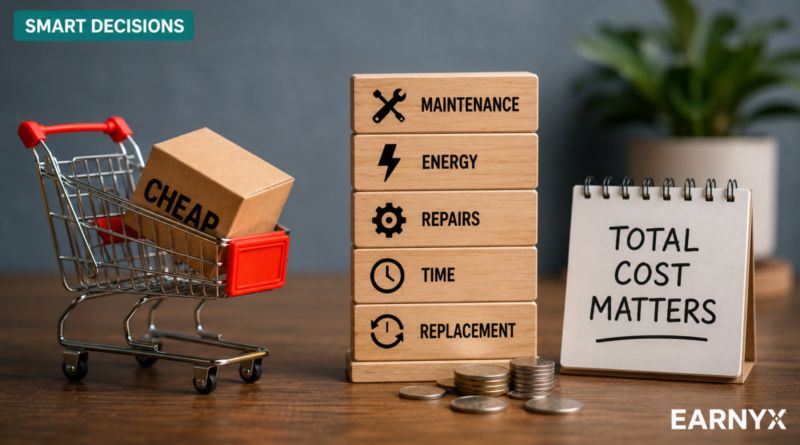
Why the Cheapest Option Can Cost More: Understanding Total Cost of Ownership
Table of Contents
01 Event
Shopping decisions are usually framed around the number on the price tag. But the purchase price is only the first cost. A cheaper product can become the more expensive choice once ownership costs such as energy, consumables, maintenance, repairs, financing and replacement are included.
The Federal Trade Commission’s online-shopping guidance recommends comparing the total cost of a purchase, including shipping, handling, delivery, taxes and other fees, rather than comparing headline prices alone.
02 What Changed?
Nothing about total cost of ownership is new, but it has become more useful for everyday consumers as products increasingly combine an upfront purchase with recurring costs. Printers need ink, connected devices may need subscriptions, appliances consume energy, and inexpensive products may need replacing sooner.
That makes a simple price comparison incomplete. The better comparison is: purchase price + recurring operating costs + expected maintenance and repair + financing and fees − expected resale value.
03 Why It Matters
A small difference in recurring cost can overwhelm a large difference in purchase price. A $100 cheaper product that costs $5 more per month to operate gives back that entire saving in 20 months. After that point, the supposedly cheaper option is costing more.
This same logic applies to decisions Earnyx has examined in how much your time is worth and the convenience economy: the visible price is only one part of value.
04 What It Means for You
Before choosing between two products, pick a realistic ownership period and estimate every cost you are reasonably likely to pay during it. Use the same assumptions for both options. If one product has uncertain repair or replacement costs, test a low and high scenario rather than pretending the uncertainty does not exist.
Also separate costs you would incur anyway from costs caused by the purchase. That prevents double-counting and makes the comparison more useful.
05 Numbers + Context
Consider two hypothetical products. Product A costs $300 and $8 per month to operate. Product B costs $450 and $3 per month to operate. Ignoring other differences, A starts $150 cheaper but costs $5 more each month. The break-even point is 30 months. Over five years, A costs $780 while B costs $630.
The exact inputs vary by category, but the method stays the same. ENERGY STAR, for example, provides standardized energy information for many product categories so shoppers can compare operating efficiency rather than relying only on purchase price.
06 Earnyx Takeaway
The cheapest option is the one with the lowest cost over the period you will actually own and use it—not automatically the one with the smallest number at checkout. For meaningful purchases, calculate the lifetime cost before comparing the price tags. A few minutes of arithmetic can expose a “bargain” that stops being cheap surprisingly quickly.
Sources: Federal Trade Commission, “Online Shopping”; ENERGY STAR product efficiency guidance.



Pingback: The Real Cost of Owning a Printer: Cheap Printer vs Cheap Ink - Earnyx
Pingback: Shein Hong Kong IPO Values Fast-Fashion Giant at $24B
Pingback: Reliance Launches 10-Rupee Ice Cream Brand in India