
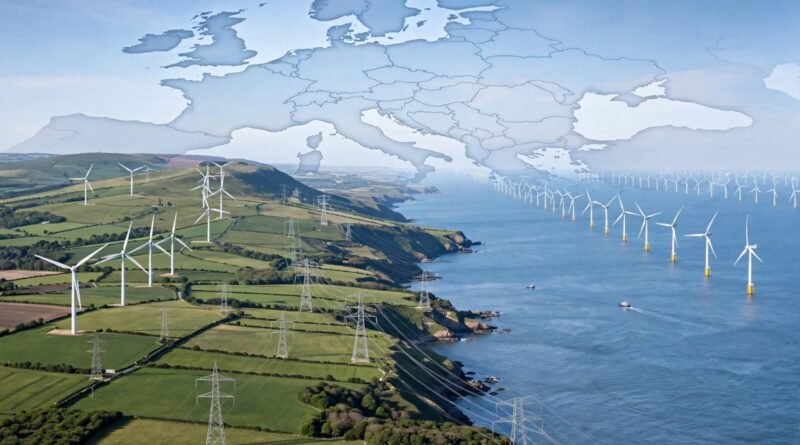
Europe Adds 8.8 GW of Wind Power in First Half of 2026 as Offshore Connections Rise
Table of Contents
01 Event
Europe added 8.8 gigawatts of new wind power capacity in the first half of 2026, according to industry group WindEurope. The total was nearly one-third higher than during the same period a year earlier and reflected stronger installation activity in several markets, including Germany, as well as a rise in offshore wind connections.
WindEurope said 7.1 GW of the new capacity was installed in the European Union. Across Europe, 74% of new wind capacity added during the period was onshore, while 2.3 GW of new offshore capacity was connected to the grid.
02 What Changed?
The first-half figures show that wind installations accelerated compared with the same period in 2025. Europe has also doubled its installed wind capacity over the past decade as governments expanded renewable-energy targets, auctions and grid connections.
WindEurope’s September 2026 data put Europe’s total wind fleet at more than 311 GW, including about 270.5 GW onshore and 40.9 GW offshore. The EU-27 accounts for nearly 252 GW of that total, including 228.4 GW onshore and 23.2 GW offshore.
The industry group expects Europe to install 148 GW of new wind capacity over 2026 through 2030, including the 8.8 GW installed in the first half of this year. Of that forecast, 111 GW is expected in the EU-27.
03 Why It Matters
Wind capacity is one part of Europe’s broader shift in electricity generation. Reuters noted that wind and solar together produced more electricity in the European Union than fossil fuels for the first time in 2025. The latest installation figures therefore matter not only as construction statistics but as an indicator of how quickly the power mix may continue changing.
More wind capacity can reduce dependence on fossil-fuel generation when weather and grid conditions allow, but installed capacity does not equal constant output. Wind generation varies with weather, and the value of new projects also depends on transmission capacity, storage, interconnection and how quickly grids can absorb new supply.
That distinction is especially important as electricity demand rises from data centers, electrification and industrial activity. New generation can help, but grid bottlenecks can limit how much of that power reaches consumers when and where it is needed.
04 What It Means for You
For households and businesses, more renewable generation can influence wholesale electricity markets over time, but a larger wind fleet does not automatically guarantee lower retail bills. Consumer electricity prices also include grid charges, taxes, market design, fuel costs and supplier margins.
For investors and energy users, the key question is not simply how many gigawatts are built but whether projects connect on schedule and can operate efficiently inside the wider power system. Offshore wind can deliver large projects, while onshore wind generally remains quicker and less capital-intensive to build.
Earnyx readers following the broader energy shift can compare this with our recent article on how the energy crisis is accelerating renewable-energy and EV adoption across Europe and Asia.
05 Numbers + Context
Europe installed 8.8 GW of new wind capacity in the first six months of 2026. The EU-27 accounted for 7.1 GW. WindEurope said 74% of Europe’s new installations were onshore and 2.3 GW were offshore projects connected to the grid.
Total installed wind capacity across Europe now exceeds 311 GW. WindEurope breaks that into 270.5 GW onshore and 40.9 GW offshore. The EU-27 has nearly 252 GW installed, including 228.4 GW onshore and 23.2 GW offshore.
The industry’s current outlook calls for 148 GW of additional European wind installations over the 2026-2030 period. The EU portion is forecast at 111 GW, equivalent to roughly 22 GW a year on average. Forecasts are not guarantees: permitting, financing, supply chains and grid access can all change actual deployment.
06 Earnyx Takeaway
The 8.8-GW first-half figure shows that European wind construction accelerated in 2026, but the more important test is whether the grid can convert installed capacity into reliable, usable electricity. Capacity growth is real; consumer savings and energy-security benefits depend on what happens after the turbines are built.
Europe’s wind buildout is therefore best viewed as infrastructure progress rather than a simple promise of cheaper electricity. The numbers support a continuing transition, but they do not erase the practical constraints of transmission, storage and variable generation.
WindEurope’s own 2030 outlook reinforces that point: the industry expects continued expansion, but the forecast still depends on permitting, grid buildout and project delivery. The 8.8-GW first-half result is a completed installation figure; the 148-GW 2026-2030 number is a projection and should be read as such.
WindEurope’s detailed first-half data adds useful context to the headline number. Germany led new installations with 3.4 GW, followed by the United Kingdom with 789 MW and Spain with 612 MW. Across Europe, onshore wind accounted for 6.5 GW of the 8.8 GW installed during the period.
The pipeline is also larger than the completed installations. WindEurope said five countries awarded support for 17.2 GW of wind capacity in the first half of 2026, split between 8.8 GW onshore and 8.4 GW offshore. European governments planned auctions for more than 24 GW in the second half of the year. Those awards represent projects expected to move forward, not power already connected to the grid.
Financing data points to the same distinction. About €9 billion was raised for new European wind projects during the first half, financing 5.2 GW of future capacity. Turbine orders totaled 10.6 GW, including 7.8 GW onshore and 2.8 GW offshore, but orders were 12% lower than the 12 GW recorded in the first half of 2025.
That mixed picture is useful for reading the sector correctly. Completed installations accelerated, Germany led actual additions and offshore connections increased, while turbine orders were lower year over year. The market therefore shows real construction growth alongside continued uncertainty in the future project pipeline.
Sources: WindEurope, Latest Wind Energy Data for Europe: Autumn 2026, published September 1, 2026; Reuters, September 1, 2026.