
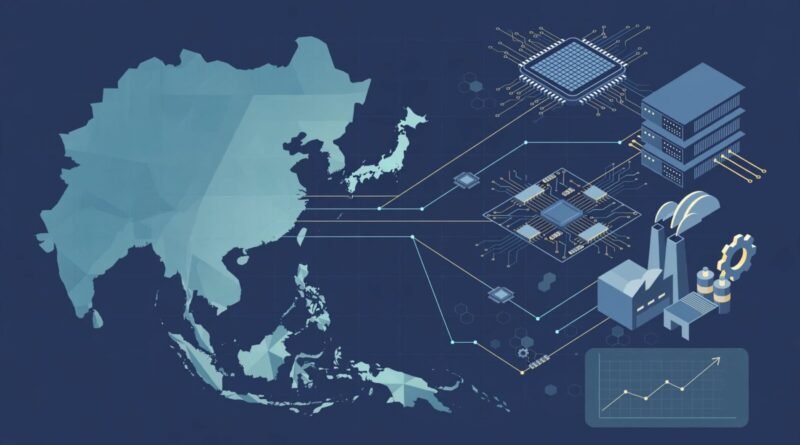
Asia Factory Growth Accelerates as AI Demand Lifts Electronics
Artificial-intelligence demand is continuing to reshape Asian manufacturing as orders for semiconductors, servers and related electronics support factory activity across major exporting economies.
Reuters reported on September 17 that AI-related demand is supporting factory activity in several Asian economies even as broader global risks remain. The pattern reinforces a key feature of the current AI boom: spending on digital services is producing very physical effects in factories, ports and power systems.
For investors and businesses, the important issue is whether this demand becomes a durable industrial cycle or remains concentrated in a relatively narrow set of technology products.
Table of Contents
Why AI demand shows up in factory data
AI models run on specialized computing equipment. That requires processors, memory, networking hardware, servers, power supplies, cooling equipment and many other components.
Much of the global electronics supply chain is concentrated in Asia. When cloud companies increase spending on data centers, orders flow through chip foundries, memory producers, component suppliers and assembly plants.
This can lift exports and factory utilization even when consumer electronics such as phones or ordinary PCs are growing more slowly.
Electronics exports can move national data
For highly trade-dependent economies, a surge in technology exports can meaningfully affect industrial production and GDP.
Singapore provided a striking example this week. Earnyx reported that Singapore’s non-oil domestic exports surged in August as electronics shipments jumped. Similar AI-related demand is influencing manufacturers elsewhere in the region.
The concentration is both a strength and a risk. Strong electronics orders can support growth, but economies become more exposed if global data-center spending slows.
The supply chain extends far beyond chips
Semiconductors receive most of the attention because advanced AI processors are expensive and technologically difficult to manufacture. But a functioning server requires many other components.
Printed circuit boards, connectors, power-management chips, cooling systems, storage and networking equipment all participate in the investment cycle.
Data centers themselves require steel, construction, transformers and backup power. This means the AI boom can support traditional industrial sectors as well as cutting-edge semiconductor firms.
High-bandwidth memory is a critical bottleneck
Modern AI accelerators rely heavily on high-bandwidth memory, which can move data quickly enough to keep processors productive.
Demand for HBM has therefore become an important driver for memory manufacturers in South Korea and elsewhere. Advanced packaging is also needed to combine memory and processors efficiently.
Earnyx recently covered SK Hynix’s planned $10 billion advanced-packaging investment, illustrating how the same demand driving Asian factories is also encouraging new capacity overseas.
Why the AI manufacturing boom can be uneven
A country can report strong technology exports while other industries remain weak. AI demand is concentrated in high-value equipment, and not every manufacturer benefits equally.
Consumer-facing factories may still struggle if household demand is soft. Industries tied to construction can follow a different cycle. Automotive production depends on vehicle demand and supply chains that are only partly connected to AI.
That is why headline manufacturing indexes should be read alongside sector-specific export and production data.
Currency movements matter to exporters
Asian manufacturers sell heavily into global markets, often with contracts priced in U.S. dollars. Currency changes can therefore affect reported revenue and competitiveness.
A weaker local currency can increase the local-currency value of export earnings, but it also makes imported equipment and energy more expensive. Semiconductor manufacturing relies on sophisticated tools and materials sourced internationally.
Exchange rates can therefore influence margins even when physical demand remains strong.
Factories are investing ahead of future demand
Semiconductor and electronics companies are expanding capacity because they expect AI computing needs to keep growing. Those projects can take years to complete.
Long lead times create a classic industrial risk: companies must decide how much capacity to build before they know exactly how large future demand will be.
If AI adoption continues expanding rapidly, new factories can enter a tight market. If demand growth slows or chips become more efficient, the industry could eventually face excess capacity.
Power availability is becoming part of manufacturing strategy
Chip fabrication and data centers both consume significant electricity. As the AI supply chain expands, reliable power can influence where companies build facilities.
Grid capacity is already becoming a bottleneck in several regions. Spain’s proposed electricity-grid expansion is one example of governments trying to prepare infrastructure for data centers and electrification.
Asian manufacturing hubs face the same long-term challenge: technology growth requires energy infrastructure as well as factories.
What businesses should watch
Companies dependent on electronics should monitor lead times and component pricing rather than assuming strong factory output means every part is readily available.
AI hardware supply chains can remain constrained in particular components even while overall semiconductor production rises. Procurement teams may need multiple suppliers and longer planning horizons for specialized equipment.
Manufacturers should also distinguish between temporary order surges and multi-year customer commitments before making major capacity investments.
The bigger picture
Asia’s AI-driven factory growth shows how quickly artificial intelligence has moved from a software story into an industrial one. Every cloud model depends on a chain of physical production that stretches from semiconductor materials to server assembly and electricity infrastructure.
That creates real economic activity in exporting countries and can support investment, jobs and trade. It also creates dependence on a fast-growing technology cycle whose long-term scale remains uncertain.
The most important indicator will be breadth. If AI investment spreads into more industries and applications, manufacturing demand could remain durable. If spending stays concentrated among a few giant cloud companies, factory growth will remain more vulnerable to changes in their capital budgets.