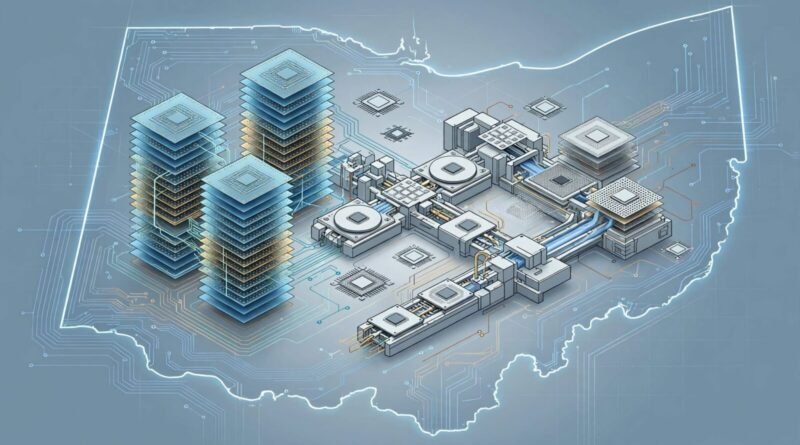
SK Hynix Plans $10 Billion Ohio Chip Packaging Plant
SK Hynix is planning a roughly $10 billion advanced chip-packaging facility in Ohio, another sign that the artificial-intelligence boom is driving investment beyond chip fabrication into the specialized processes needed to assemble high-performance processors and memory.
Reuters reported on September 16 that the South Korean memory-chip maker plans the Ohio investment as demand for advanced AI hardware expands. Advanced packaging has become increasingly important because modern AI systems combine multiple chips and high-bandwidth memory in tightly integrated packages.
The project matters because semiconductor supply chains are no longer defined only by who can manufacture the smallest transistor. Packaging, memory and interconnects can also determine performance and supply.
Table of Contents
What advanced chip packaging does
Traditional chips were often discussed as individual processors mounted on circuit boards. Modern AI accelerators are more complex.
High-performance systems can combine a graphics or AI processor with stacks of high-bandwidth memory and other components. Advanced packaging places those pieces close together so they can exchange enormous amounts of data quickly and efficiently.
The result is that packaging has become a performance technology, not merely the final step after fabrication.
Why SK Hynix is central to the AI supply chain
SK Hynix is a major producer of high-bandwidth memory, or HBM, which is used in AI accelerators. AI models need to move huge quantities of data between memory and processors, making memory bandwidth a key constraint.
Strong demand for AI accelerators has therefore increased demand for advanced memory as well as the packaging capacity needed to combine components.
This broadens the semiconductor investment cycle. A shortage in memory or packaging can limit finished AI hardware even when processor production is available.
Why Ohio is attracting chip investment
Ohio has emerged as a semiconductor investment location, with other major chip projects also planned in the state. Large manufacturing clusters can create advantages because suppliers, engineering talent and infrastructure develop around anchor facilities.
Packaging plants need reliable electricity, water, logistics and highly skilled workers. Proximity to other semiconductor operations can reduce some supply-chain friction.
At the same time, large projects face execution challenges. Construction costs, equipment availability and workforce training can affect schedules and budgets.
The AI boom is becoming a manufacturing boom
Much of the public AI conversation focuses on software models and chatbots. Behind those services is an enormous physical supply chain.
Chip factories produce processors and memory. Packaging facilities assemble them. Data centers install the finished systems. Utilities provide electricity, while networking equipment connects thousands of processors.
Earnyx has documented how AI hardware demand is influencing factory activity. The SK Hynix plan is a direct example of that trend reaching U.S. manufacturing investment.
Why packaging capacity matters to Nvidia and other chip designers
AI chip companies can design powerful processors, but finished products depend on manufacturing partners and packaging technologies. High-bandwidth memory must be integrated close to the processor to achieve the required performance.
If packaging capacity becomes constrained, lead times can increase and hardware availability can suffer.
That makes investments by memory suppliers strategically important to the entire AI ecosystem, even when the facility does not manufacture the main processor itself.
Jobs will require specialized skills
Semiconductor facilities create construction work during development and technical jobs once production begins. Advanced packaging requires engineers, technicians, equipment specialists and quality-control staff.
Regions competing for chip investment therefore need workforce programs as well as financial incentives. A facility full of sophisticated equipment cannot operate efficiently without trained workers.
Community colleges and universities often become important partners because they can develop programs aligned with local employers.
Large semiconductor projects carry risk
Chip demand is cyclical. The current AI investment boom is exceptionally strong, but semiconductor markets have historically experienced periods of shortage followed by overcapacity.
A $10 billion facility must therefore be evaluated over many years, not only against today’s demand. Advanced packaging may remain valuable even as individual chip generations change, but technology can evolve rapidly.
Companies also face concentration risk if a large share of demand comes from a small number of AI customers.
Why supply-chain diversification matters
Semiconductor production is geographically concentrated, especially in Asia. Expanding packaging and manufacturing capacity in the United States can diversify supply chains and reduce dependence on a limited number of locations.
Diversification can improve resilience, but it may cost more than concentrating production in established hubs. New facilities need local supplier ecosystems and experienced workers that take time to develop.
The economic question is therefore not simply whether domestic production is possible, but whether it can become competitive and reliable at scale.
What investors should watch
For the semiconductor industry, capital expenditure is an important signal of expectations. Large projects suggest companies believe demand will justify additional capacity.
But investors should also watch utilization rates, memory pricing and customer concentration. A facility can be technologically advanced and still produce weak returns if too much capacity enters the market.
The pace of AI infrastructure spending by cloud companies will be particularly important because those firms are major buyers of high-end accelerators and memory.
The bigger picture
SK Hynix’s planned Ohio investment shows that the AI boom is changing where semiconductor value is created. The industry is moving toward systems in which memory, packaging and interconnects are as strategically important as processor design.
For Ohio, the project could deepen a growing semiconductor cluster. For the AI industry, it could add capacity in an area that has become a critical bottleneck.
The larger lesson is that AI is not a purely digital revolution. Every model response ultimately depends on factories, packaging lines, data centers and power grids. The companies and regions that build those physical layers are becoming central participants in the economics of artificial intelligence.