
Blackstone Plans $25 Billion Pennsylvania Data Center as AI Power Race Expands
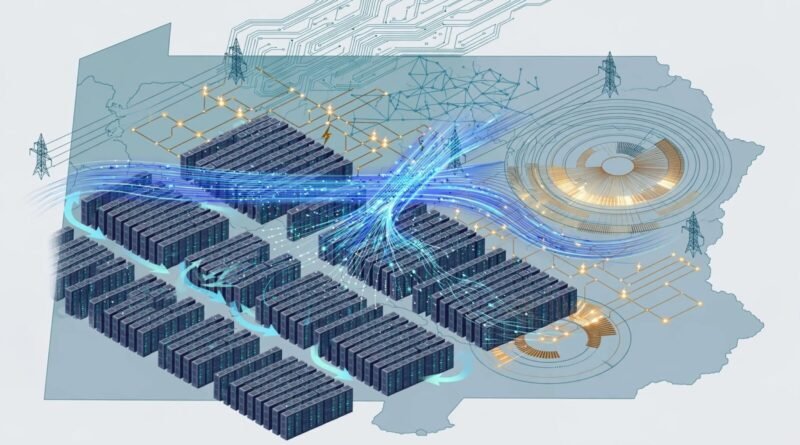
Blackstone is planning a massive new data-center campus in Pennsylvania, adding another multibillion-dollar project to the physical infrastructure race behind artificial intelligence.
Reuters reported on September 16, citing Bloomberg News, that the private-equity firm plans to invest $25 billion in a 1,200-acre campus in Greene County. The report said the site is expected to have a 1.2-gigawatt power commitment, while Blackstone declined to comment to Reuters.
The project illustrates a defining feature of the AI boom: computing is becoming an infrastructure and energy story as much as a software story.
Table of Contents
Why 1.2 gigawatts is significant
Large AI data centers require extraordinary amounts of electricity. A 1.2-gigawatt commitment is comparable to the output scale of a major power plant, although actual consumption can vary as a facility is built out and utilized.
Securing that capacity is increasingly difficult in regions where transmission systems were not designed for sudden clusters of enormous computing loads. Developers may wait years for grid connections or invest directly in supporting infrastructure.
Power availability can therefore determine where data centers are built even when land and fiber connectivity are attractive elsewhere.
AI is changing data-center economics
Traditional data centers serve websites, enterprise applications, storage and cloud workloads. AI adds dense clusters of specialized processors that can consume much more electricity per rack.
Those processors also generate substantial heat, increasing the importance of cooling systems. The result is a facility that can cost significantly more to build and operate than conventional computing space.
Developers are responding by building larger campuses designed around power from the beginning rather than treating electricity as a secondary utility connection.
Why private capital is moving into digital infrastructure
Data centers can resemble infrastructure assets because they require large upfront investments and can generate long-term contracted revenue. That makes them attractive to private-equity and infrastructure investors if customer demand is dependable.
AI has increased the amount of capital required. Cloud companies and model developers want capacity quickly, while utilities and grid upgrades can take years.
Large investors can finance land, construction and power infrastructure at a scale that smaller developers may struggle to match.
The risk is building ahead of demand
Every infrastructure boom contains the possibility of overbuilding. Today’s forecasts assume AI usage will continue growing rapidly enough to fill new facilities.
That may happen, but computing technology also becomes more efficient over time. Better chips and models could reduce the amount of hardware required for a given task even while total AI usage rises.
The economics of a data center therefore depend on utilization, customer contracts and the ability to refresh hardware as technology changes.
Earnyx has covered the same investment cycle through the $22 billion financing tied to a Blackstone-Alphabet AI cloud venture. The Pennsylvania project shows how rapidly capital is flowing into both the financing and physical construction sides of AI infrastructure.
Electricity prices matter to long-term returns
Once a facility is operating, power can be one of its largest ongoing expenses. A site with reliable, competitively priced electricity can have a structural advantage over one exposed to high or volatile energy costs.
That is why developers negotiate long-term power arrangements and increasingly consider access to generation alongside access to the grid.
Energy efficiency is also financially valuable. A processor that delivers more AI work per unit of electricity can reduce both operating costs and pressure on constrained power capacity.
Communities face both opportunity and trade-offs
Large data centers can bring construction spending, property investment and tax revenue. They can also create relatively fewer permanent jobs than similarly expensive labor-intensive facilities.
Local governments therefore need to evaluate the full economic package: tax incentives, infrastructure costs, water use, grid upgrades and long-term employment.
Power demand is especially important. If a large new industrial load requires major transmission investment, regulators must determine how those costs are allocated among the developer, utility and other customers.
Why Pennsylvania is attracting interest
Pennsylvania sits within a major U.S. power market and has an extensive energy industry. Those characteristics can make it attractive for data-center developers seeking large electricity supplies.
Location decisions also depend on fiber connectivity, land, permitting and proximity to customers. AI workloads can tolerate different levels of latency depending on the application, giving developers more geographic flexibility than some consumer internet services.
The data-center race reaches beyond technology companies
The AI infrastructure buildout is creating business for utilities, construction firms, electrical-equipment manufacturers, cooling specialists and real-estate developers.
It also creates financing opportunities for banks and private credit. That broadens the economic exposure to AI investment well beyond semiconductor and software stocks.
The downside is that a slowdown in AI capital spending could also ripple across these industries. Infrastructure projects have long timelines, so decisions made during a period of optimism can continue adding capacity after market conditions change.
What investors should monitor
Announcements of planned investment are not the same as completed spending. Large campuses are typically built in phases, and timelines can change based on customers, permits and power availability.
Useful indicators include signed leases, power agreements, construction milestones and actual capital expenditure. Those show whether headline commitments are turning into operating assets.
Investors should also distinguish between facilities backed by long-term tenants and speculative capacity built in anticipation of future demand.
The bigger picture
A planned $25 billion campus demonstrates how the AI race is moving into physical infrastructure at a scale once associated with heavy industry and energy projects.
The constraint is no longer simply access to advanced chips. Companies need land, electricity, transmission, cooling, financing and construction capacity to turn those chips into usable computing.
If AI adoption continues expanding, these campuses could become essential infrastructure for the digital economy. If expectations outrun demand, they could expose investors and lenders to underused assets. Either way, the Pennsylvania project shows that the financial stakes of the AI boom are becoming much larger than software valuations alone.


